


























Views
Plays


Markup and Markdown Quiz | Essential College Business Math
Paste this activity's link or code into your existing LMS (Google Classroom, Canvas, Teams, Schoology, Moodle, etc.).
Students can open and work on the activity right away, with no student login required.
You'll still be able to track student progress and results from your teacher account.
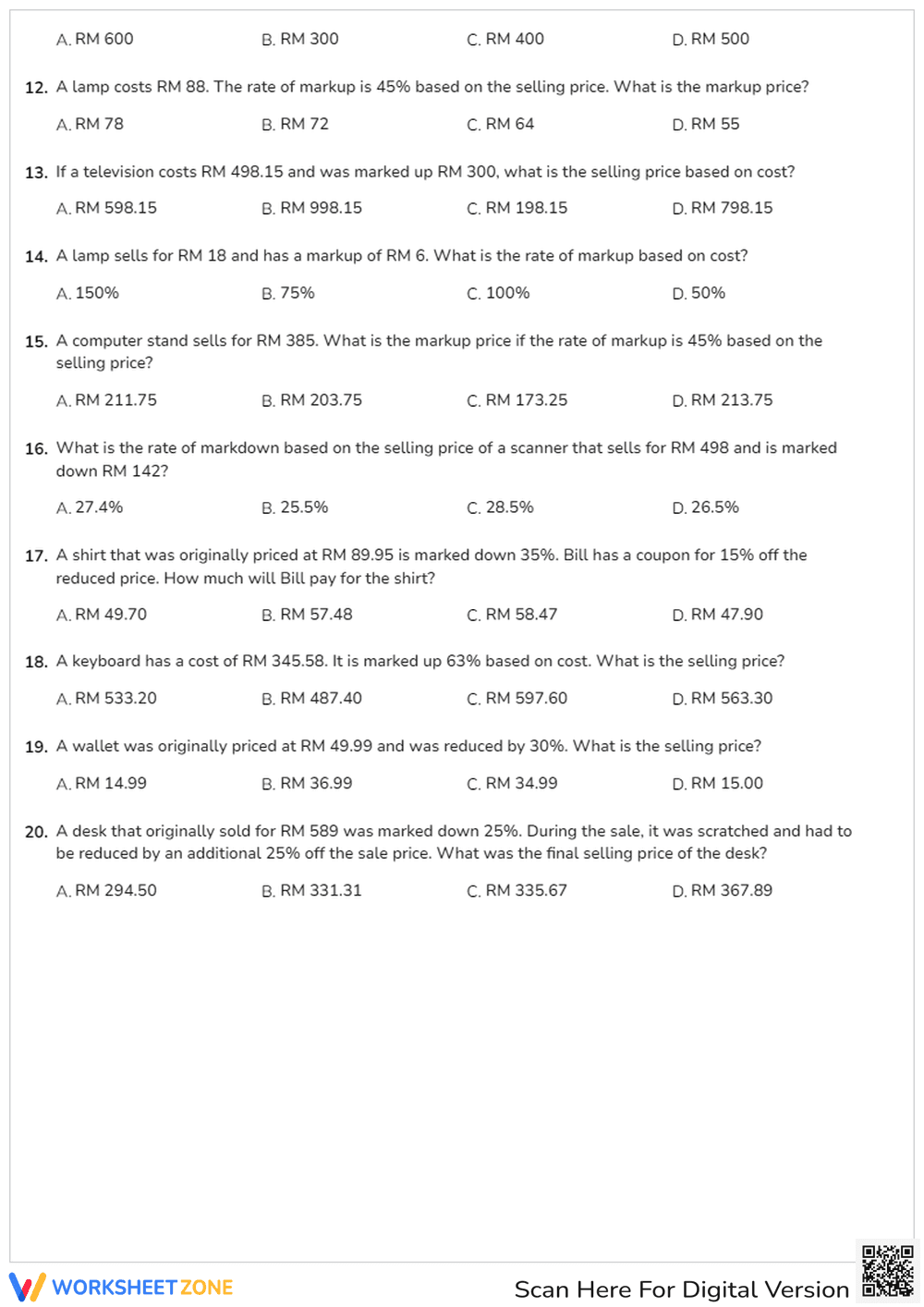
This College Business Math quiz provides a comprehensive assessment of markup and markdown calculations, ensuring students can accurately determine pricing strategies in a retail environment. By working through 20 targeted multiple-choice questions, learners demonstrate mastery over cost-based and selling-price-based percentages. This resource is designed to bridge the gap between theoretical math and practical financial application.
At a Glance
- Grade: College · Subject: Business Math
- Standard:
CCSS.MATH.CONTENT.7.RP.A.3— Use proportional relationships to solve multistep ratio and percent problems- Skill Focus: Markup and Markdown Calculations
- Format: 2 pages · 20 problems · Answer key included · PDF
- Best For: Mid-term review or chapter assessment
- Time: 30–45 minutes
Inside this two-page PDF, you will find 20 rigorous multiple-choice questions covering Chapter 6 concepts. The tasks require students to calculate markup prices, markdown rates, original selling prices, and final reduced costs. Each question is framed within a realistic business scenario and includes four distinct options to challenge common calculation errors. A full answer key is provided for rapid grading.
Zero-Prep Workflow
- Print: Generate copies of the two-page document in less than 1 minute.
- Distribute: Hand out to students for a focused 30-minute assessment session.
- Review: Use the included answer key to grade or review results in under 5 minutes.
This streamlined approach makes it an ideal choice for busy instructors or as a high-quality sub plan for business courses.
Standards Alignment
The primary standard addressed is `CCSS.MATH.CONTENT.7.RP.A.3`, which focuses on using proportional relationships to solve multistep ratio and percent problems. While foundational, these skills are applied here at a college level through complex business applications involving gross margins. Both standard codes can be copied directly into lesson plans, IEP goals, or district curriculum mapping tools.
How to Use It
Use this worksheet as a summative chapter quiz after completing direct instruction on retail pricing strategies. It also serves as an excellent formative assessment tool; observe students during the first five problems to identify if they are confusing cost-based markup with selling-price-based markup. Expect most college-level students to complete the full 20-question set within a 40-minute window.
Who It's For
This quiz is specifically tailored for college students enrolled in Business Math or Retail Management programs. It provides necessary differentiation for adult learners by using professional terminology and realistic currency values. Pair this resource with a markup anchor chart or a spreadsheet-based pricing project to reinforce the connection between manual calculations and digital financial tools.
According to the RAND AIRS 2024 report on vocational mathematics, the ability to fluently calculate markup and markdown percentages is a critical competency for students entering retail management and accounting sectors. This worksheet aligns with CCSS.MATH.CONTENT.7.RP.A.3 by requiring students to solve multi-step ratio and percent problems within a professional business context. Research from Fisher & Frey (2014) suggests that structured retrieval practice, such as this 20-question quiz, significantly improves long-term retention of mathematical formulas compared to passive review. By distinguishing between markup based on cost versus markup based on selling price, students develop the quantitative reasoning necessary for real-world financial decision-making. The inclusion of varied problem types—ranging from simple rate identification to complex multi-step price reductions—ensures that learners can apply these concepts across diverse commercial scenarios. This resource provides the rigorous practice needed to bridge the gap between classroom theory and practical application in the global marketplace.


