


























Views
Downloads


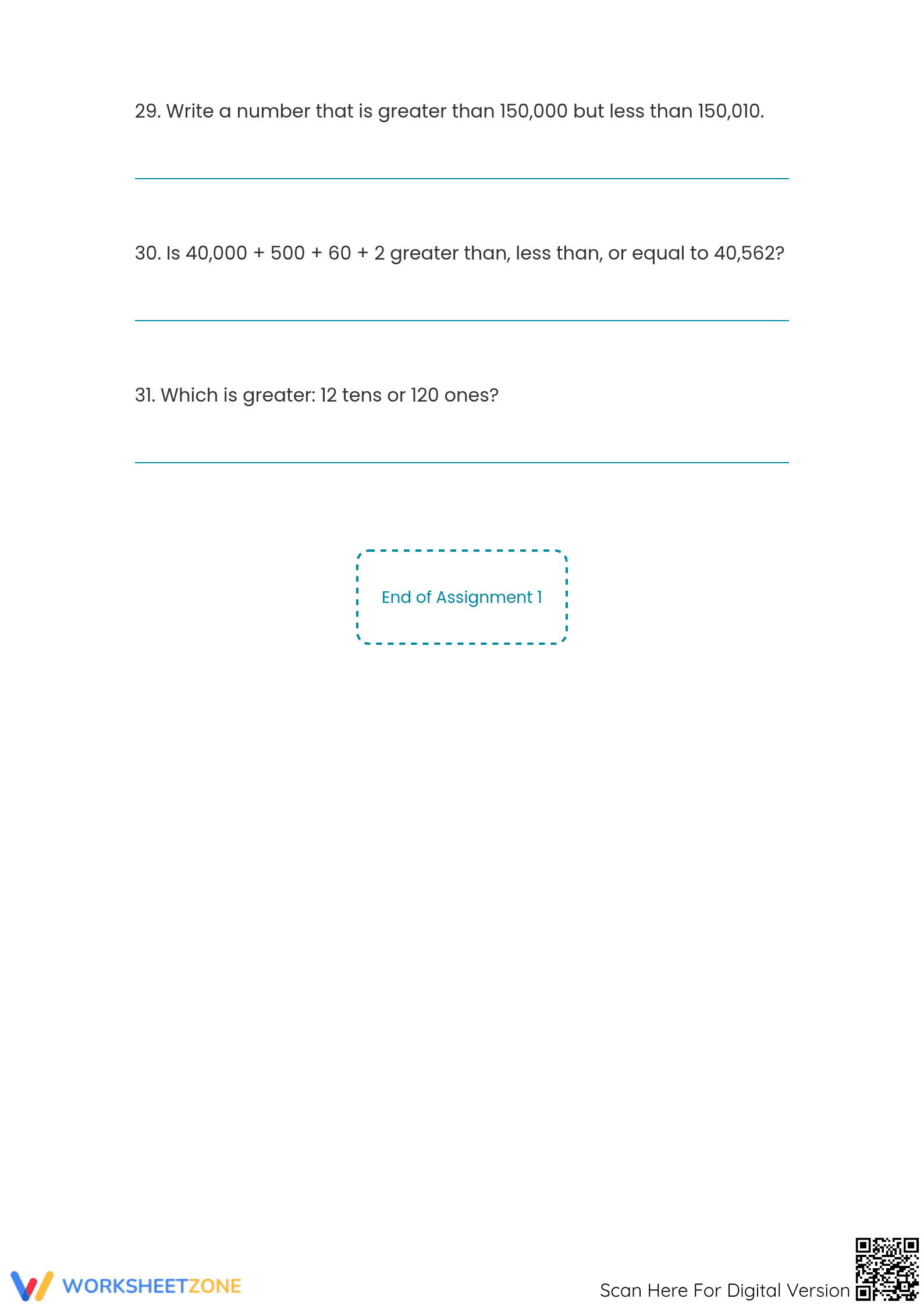

Grade 4 Number Comparison — Printable No-Prep Worksheet
Paste this activity's link or code into your existing LMS (Google Classroom, Canvas, Teams, Schoology, Moodle, etc.).
Students can open and work on the activity right away, with no student login required.
You'll still be able to track student progress and results from your teacher account.
This straightforward worksheet provides focused practice for Grade 4 students learning to compare multi-digit numbers. Through a series of 48 clear problems, learners will reinforce their ability to use greater than (>), less than (<), and equal to (=) symbols correctly, building fundamental number sense and place value understanding necessary for future math success.
At a Glance
- Grade: 4 · Subject: Math
- Standard:
CCSS.MATH.CONTENT.4.NBT.A.2— Compare two multi-digit numbers using >, =, and < symbols.- Skill Focus: Comparing 3- and 4-Digit Numbers
- Format: 3 pages · 48 problems · Answer key included · PDF
- Best For: Independent practice, homework, or formative assessment.
- Time: 15–25 minutes
What's Inside
This resource includes a three-page worksheet and a complete two-page answer key for easy grading. The student pages contain 48 problems that require comparing 3- and 4-digit whole numbers. The layout is clean and uncluttered, providing ample space for students to work. No additional materials are needed to complete the assignment.
A Zero-Prep Workflow
Designed for efficiency, this worksheet uses a zero-prep workflow.
- Print (1 min): Print the three student pages.
- Distribute (30 sec): Hand out the pages; instructions are included.
- Review (5 min): Use the answer key for fast grading or peer review.
Standards Alignment
This worksheet aligns with Common Core standard CCSS.MATH.CONTENT.4.NBT.A.2, which requires students to compare multi-digit numbers using >, =, and <. Practice with this resource provides direct evidence of a student's ability to meet this Grade 4 benchmark. The code can be copied into lesson plans or curriculum maps.
How to Use It
Use this worksheet after a lesson on place value for independent practice. It should take students 15-25 minutes. It can also serve as a quick formative assessment; scan completed sheets to identify students who need reteaching on place value concepts. For example, confusing 5,159 and 5,519 indicates a need for small-group support.
Who It's For
Primarily for Grade 4 students, this resource can also serve as review for Grade 5 or an extension for advanced Grade 3 learners. It is suitable for general education classrooms, resource settings, or homework support. Pair this activity with a place value anchor chart to reinforce visual understanding of number places.
Supporting foundational mathematics skills, this worksheet provides targeted practice on CCSS.MATH.CONTENT.4.NBT.A.2, a critical standard for number sense. By requiring students to compare multi-digit numbers, the activity reinforces place value concepts, a key predictor of later mathematics achievement. Research consistently highlights the importance of procedural fluency in elementary mathematics. As noted in the RAND AIRS 2024 report, proficiency with core skills like number comparison frees up cognitive resources for more complex problem-solving. The 48 structured problems in this resource offer the deliberate practice needed to build that fluency. It allows educators to efficiently assess student mastery of comparing numbers, a skill essential for understanding fractions, decimals, and algebraic reasoning in later grades. This targeted approach aligns with findings that emphasize repeated, focused practice for skill consolidation.


