




























Views
Downloads
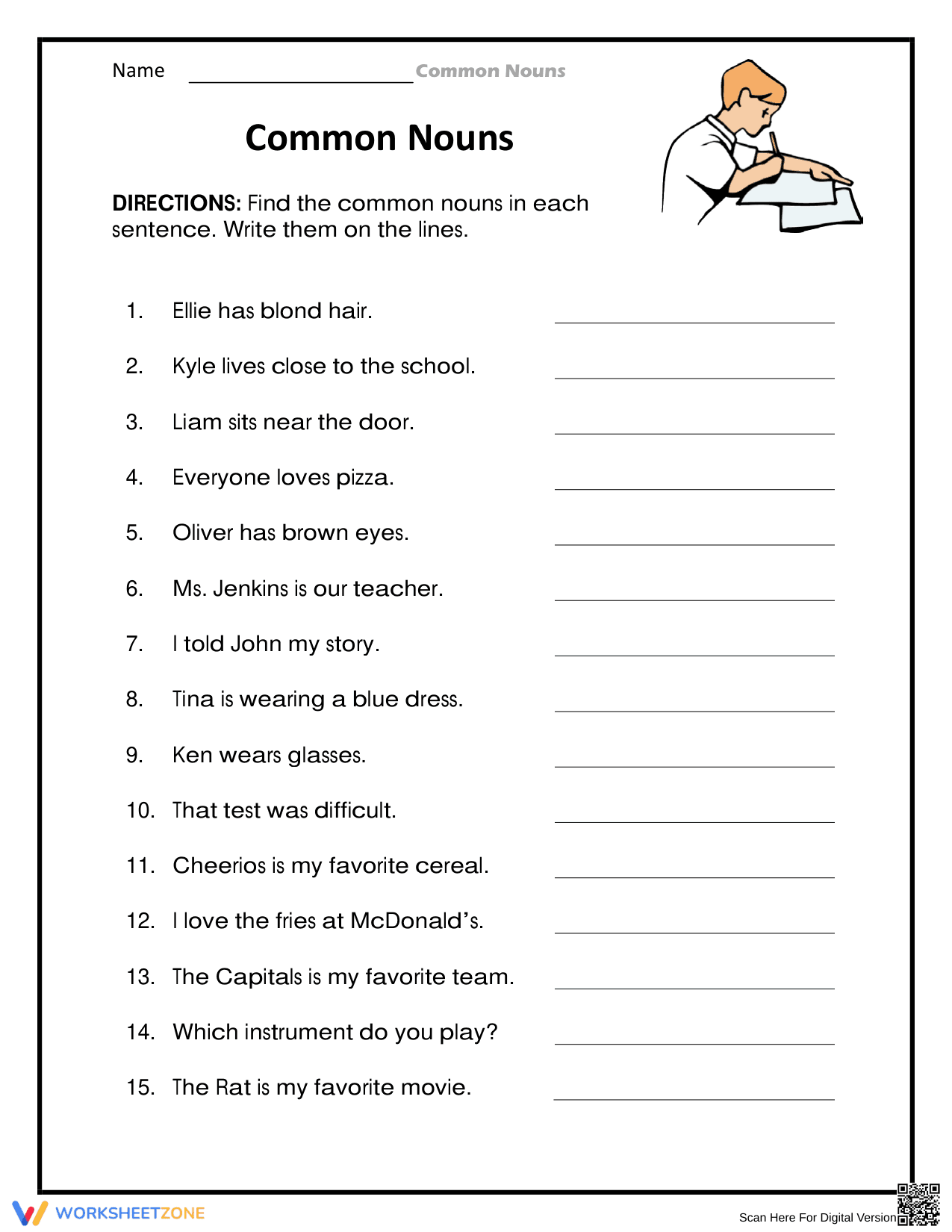

Essential Common Nouns Practice Worksheet | Grades 1-3

Paste this activity's link or code into your existing LMS (Google Classroom, Canvas, Teams, Schoology, Moodle, etc.).
Students can open and work on the activity right away, with no student login required.
You'll still be able to track student progress and results from your teacher account.
This Essential Common Nouns Practice Worksheet helps elementary students master identifying nouns within complete sentences. By isolating the person, place, or thing in fifteen unique contexts, learners build a strong foundation in grammar and mechanics. This resource ensures students can confidently distinguish nouns from other parts of speech in their writing.
At a Glance
- Grade: 1–3 · Subject: English Language Arts
- Standard:
CCSS.ELA-LITERACY.L.1.1.B— Use common nouns to name people, places, and things correctly- Skill Focus: Common Noun Identification
- Format: 1 page · 15 problems · Answer key included · PDF
- Best For: Independent grammar practice and homework
- Time: 10–15 minutes
This single-page PDF contains fifteen clear, grade-appropriate sentences designed for rapid identification practice. Each task requires the student to read the sentence, find the common noun, and transcribe it onto a designated line. The worksheet includes a full answer key, ensuring that teachers or parents can quickly verify student work and provide immediate corrective feedback on grammar skills.
Zero-Prep Workflow
- Print: Generate the single-page document in approximately 30 seconds for your entire class.
- Distribute: Assign the worksheet as a bell-ringer or independent grammar activity requiring 1 minute of transition time.
- Review: Use the included answer key to review the fifteen responses together or grade individually in under 1 minute.
Total teacher preparation time is under two minutes, making this an ideal resource for sub plans or quick skill checks.
Standards Alignment
The primary focus of this worksheet is CCSS.ELA-LITERACY.L.1.1.B, which requires students to use common, proper, and possessive nouns. This resource specifically targets the identification and usage of common nouns within sentence structures. Both standard codes can be copied directly into lesson plans, IEP goals, or district curriculum mapping tools to ensure instructional consistency across the primary grades.
How to Use It
Use this worksheet as a formative assessment after a direct instruction lesson on parts of speech. It serves as an excellent check for understanding before moving on to proper nouns. Observe whether students can identify multiple nouns in more complex sentences or if they struggle with abstract nouns like "story." Most students will complete the fifteen tasks in approximately twelve minutes.
Who It's For
This resource is tailored for Grade 1, 2, and 3 students who are developing their core grammar skills. It is particularly useful for English Language Learners (ELLs) who need repetitive, structured practice with basic sentence components. The worksheet pairs naturally with a parts-of-speech anchor chart or a short reading passage where students can find additional examples of common nouns.
Effective grammar instruction requires structured opportunities for students to apply their knowledge of linguistic categories within meaningful contexts. Research from RAND AIRS 2024 indicates that frequent, low-stakes identification tasks significantly improve a student's ability to recognize parts of speech during independent writing. By focusing on CCSS.ELA-LITERACY.L.1.1.B, this worksheet allows students to practice the plain-English skill of using common nouns to name people, places, and things accurately. Identifying nouns is a prerequisite for mastering more complex syntactic structures, such as subject-verb agreement and pronoun usage. This 15-task practice set provides the necessary repetition to move from guided recognition to independent mastery. Educators can rely on this aligned resource to bridge the gap between abstract grammar rules and concrete application. The clear layout and focused task design ensure that cognitive load is directed toward the linguistic skill rather than complex instructions.


