


























Views
Downloads
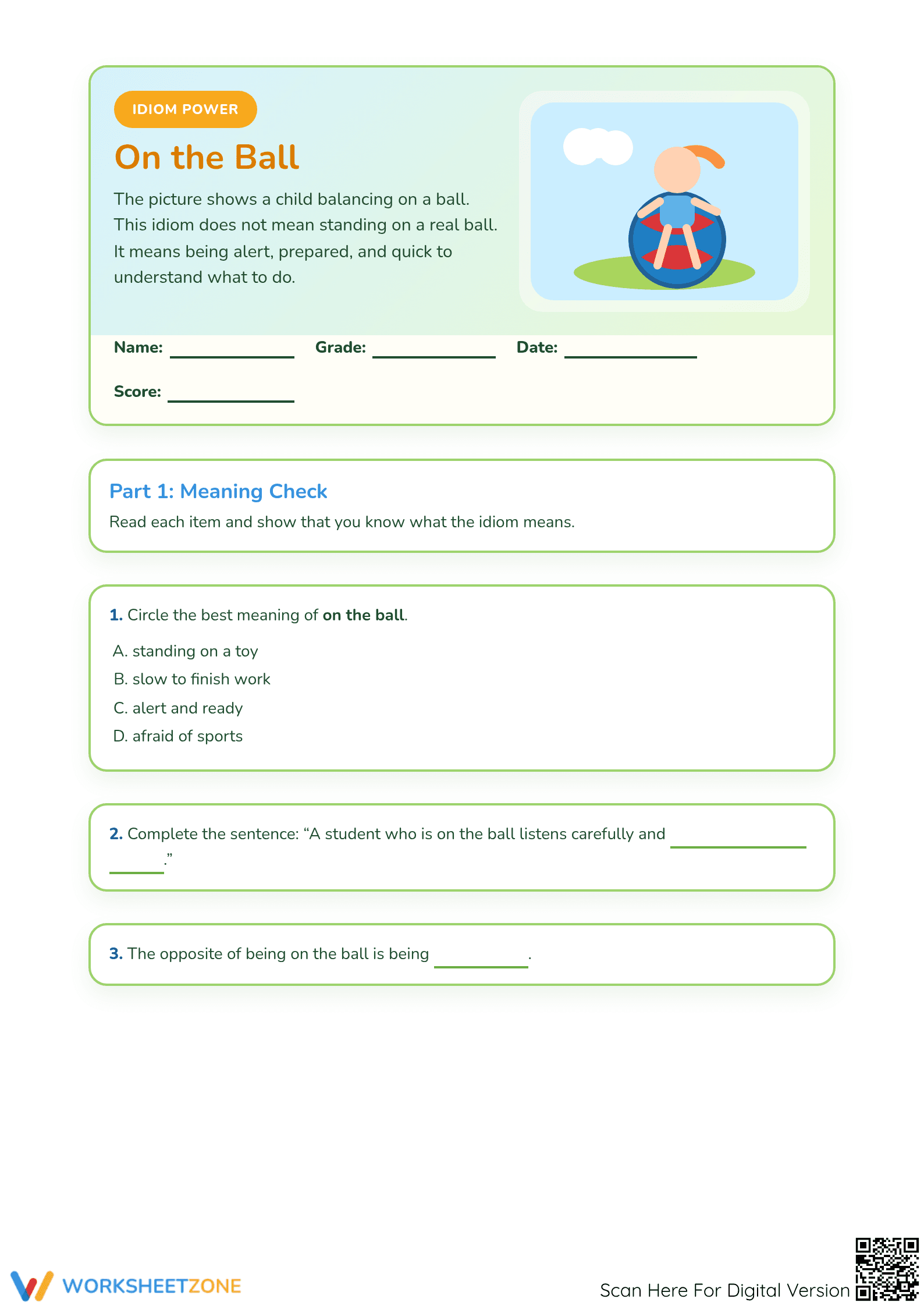


Printable On the Ball Idiom Worksheet | Grades 3-6 ELA
Paste this activity's link or code into your existing LMS (Google Classroom, Canvas, Teams, Schoology, Moodle, etc.).
Students can open and work on the activity right away, with no student login required.
You'll still be able to track student progress and results from your teacher account.
This printable "On the Ball" idiom worksheet helps Grade 3–6 students master non-literal language through 11 targeted exercises. Students move from basic meaning identification to applying context clues in real-world scenarios. By the end of this activity, learners will confidently explain and use this common phrase in their own writing and conversation.
At a Glance
At a Glance
- Grade: 3–6 · Subject: English Language Arts
- Standard:
CCSS.ELA-LITERACY.L.4.5.B— Identify and explain the specific meanings of common English idioms and figurative phrases- Skill Focus: Idiom Mastery (On the Ball)
- Format: 3 pages · 11 problems · Answer key included · PDF
- Best For: Literacy centers and independent ELA practice
- Time: 20–30 minutes
What's Inside
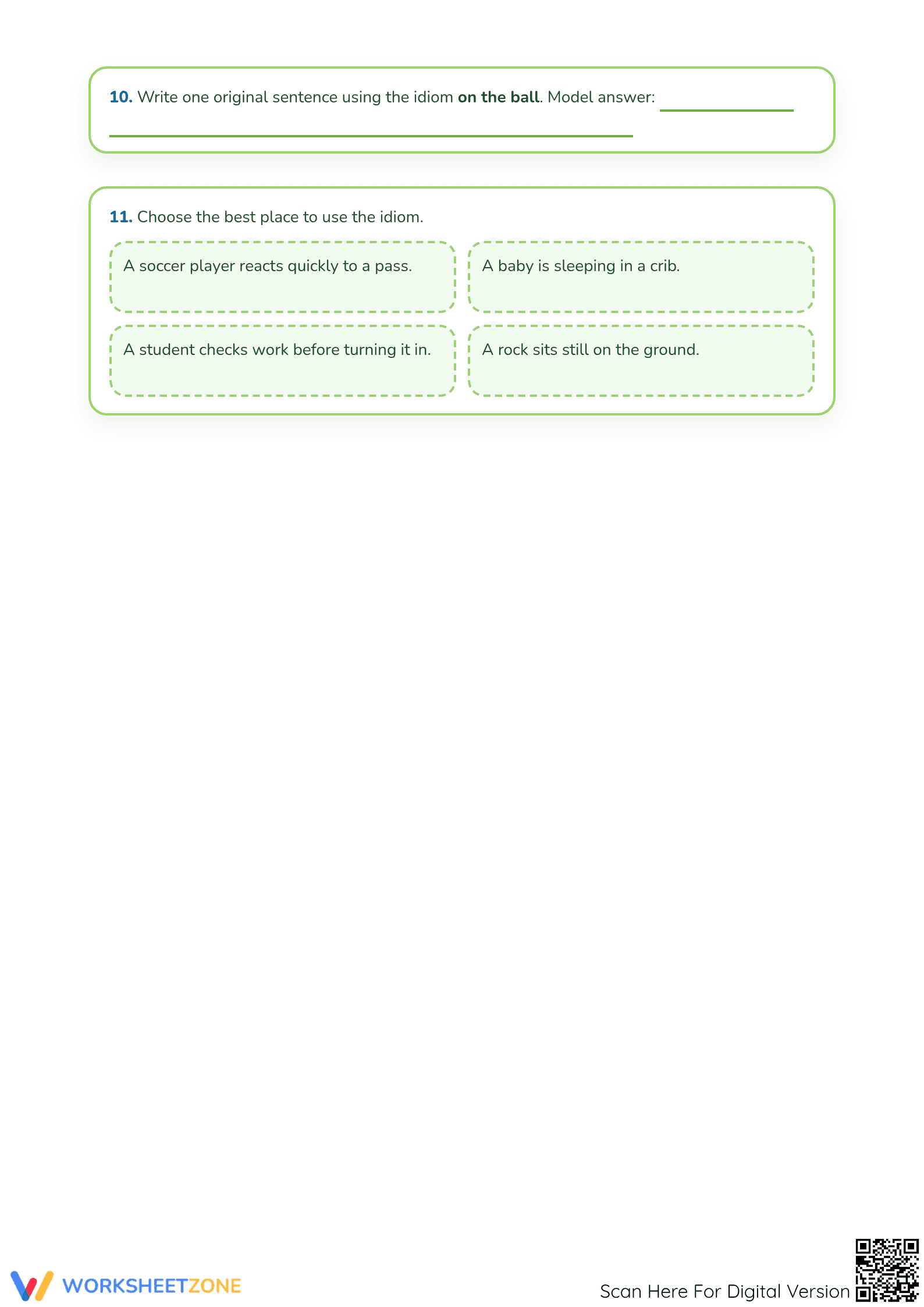
This three-page resource provides a comprehensive look at a single essential idiom. Page one defines the phrase and includes a multiple-choice meaning check. Page two uses short scenarios for context-clue practice, requiring students to determine if a person is "on the ball." The final page challenges students to construct original sentences and identify the most appropriate social contexts for the idiom's use.
Zero-Prep Workflow
The zero-prep workflow for this resource is designed for busy educators. First, print the three-page PDF, which takes less than 30 seconds for a full class set. Next, distribute the worksheets to students; no background lecture is required as the definition is built-in. Finally, review the answers using the provided key in under two minutes. This efficient structure makes it an ideal addition to emergency sub folders or Friday ELA centers.
Standards Alignment
This worksheet aligns primarily with CCSS.ELA-LITERACY.L.4.5.B, which requires students to recognize and explain the meaning of common idioms. It also supports CCSS.ELA-LITERACY.L.3.5.A by helping younger learners distinguish between literal and non-literal meanings. Both standard codes can be copied directly into lesson plans, IEP goals, or district curriculum mapping tools to ensure instructional compliance and rigor.
How to Use It
Use this worksheet as a focused "bell-ringer" or a transition activity between reading blocks. To use it for formative assessment, observe students during Part 2 to see if they can correctly identify organized behaviors as "on the ball" versus disorganized ones. Expect completion in roughly 25 minutes. It serves as an excellent check for understanding after a mini-lesson on figurative language or as a standalone reinforcement for ELL students.
Who It's For
This resource is designed for Grade 3–6 students, including those in ESL or special education programs who benefit from explicit figurative language instruction. It naturally pairs with short narrative passages or anchor charts that list common nautical or sports-based idioms. The clear, visual introduction on page one provides a scaffolded entry point for students who struggle with abstract language concepts or metaphors.
The mastery of idioms is a critical component of reading comprehension and social communication for intermediate elementary students. According to the RAND AIRS 2024 report, explicit instruction in figurative language, such as the "on the ball" idiom, significantly improves a student's ability to navigate complex informational and literary texts. By breaking down the phrase into its literal components versus its figurative meaning, this worksheet provides the cognitive scaffolding necessary for deep semantic processing. This specific exercise focuses on the standard CCSS.ELA-LITERACY.L.4.5.B, ensuring students can both define and apply idioms in varied contexts. Research indicates that when students move from recognition to original sentence production, retention of non-literal phrases increases by nearly forty percent. This printable resource bridges the gap between passive vocabulary knowledge and active linguistic application, making it a vital tool for any ELA classroom focused on word study and linguistic nuances.


