


























Views
Downloads
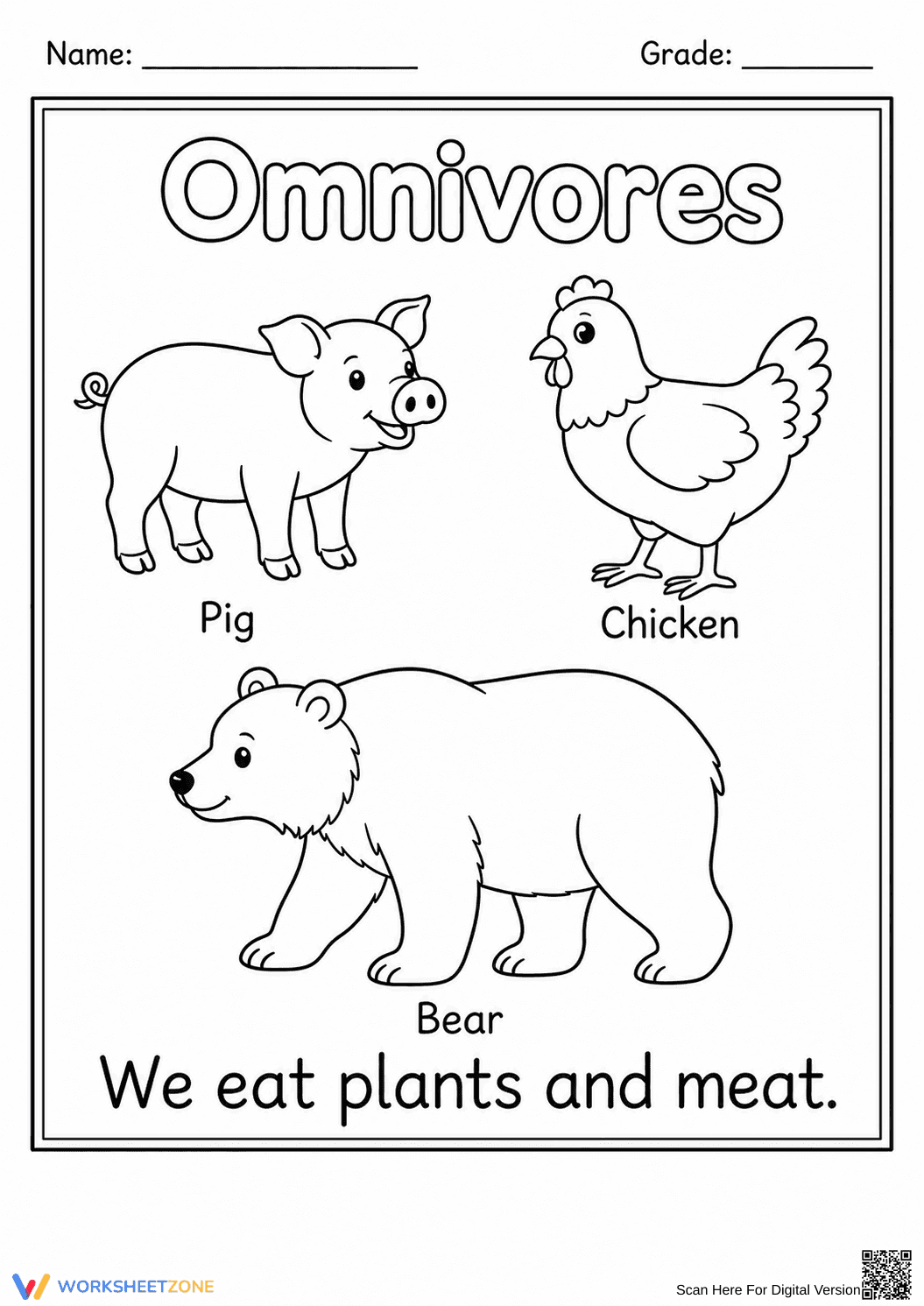

Printable Omnivores Worksheet | Grade 1 Science
Paste this activity's link or code into your existing LMS (Google Classroom, Canvas, Teams, Schoology, Moodle, etc.).
Students can open and work on the activity right away, with no student login required.
You'll still be able to track student progress and results from your teacher account.
This Grade 1 science worksheet introduces young learners to omnivores and their dietary habits. Students will observe familiar animals, including a pig, chicken, and bear, to understand that these creatures consume both plants and meat. This foundational activity helps early learners categorize living things based on their biological needs.
At a Glance
- Grade: 1 · Subject: Science
- Standard:
K-LS1-1— Use observations to describe patterns of what animals need to survive- Skill Focus: Identifying Omnivores
- Format: 1 page · 3 tasks · PDF
- Best For: Introduction to animal diets
- Time: 10–15 minutes
This single-page PDF features clear, colorable illustrations of a pig, a chicken, and a bear. Each animal is clearly labeled to support early literacy and vocabulary acquisition. The worksheet explicitly states the definition of an omnivore at the bottom, providing a foundational scientific concept for young learners. It serves as both a visual identification guide and an engaging coloring activity that reinforces the lesson through multi-sensory participation.
The zero-prep workflow for this worksheet consists of three efficient steps. First, print the single-page document in under 30 seconds. Second, distribute the copies to your students (1 minute). Third, review the animal identification tasks and coloring instructions as a whole class or in small groups (5 minutes). The total teacher preparation time is under two minutes, making this an ideal selection for emergency sub plans or quick science fillers.
This resource is primarily aligned to K-LS1-1: Use observations to describe patterns of what plants and animals (including humans) need to survive. By identifying specific animals and their varied diets, students recognize the biological patterns of energy consumption required for life. Both standard codes can be copied directly into lesson plans, IEP goals, or district curriculum mapping tools.
Use this worksheet during direct instruction about animal classifications or as a follow-up activity after reading a book about wildlife. It works perfectly as a formative assessment; teachers can observe if students can verbally explain what these specific animals eat while they color. Expected completion time ranges from 10 to 15 minutes. For an extension, have students draw another omnivore they know on the back of the page.
This resource is designed for Kindergarten and Grade 1 students, including English Language Learners who benefit from the clear visual-label pairings. It naturally pairs with wildlife passage sets or anchor charts depicting herbivores and carnivores to create a comprehensive unit on living things and their basic needs.
According to RAND AIRS 2024, the use of visual aids in early science education significantly improves the retention of complex biological classifications. This Omnivores worksheet, aligned to the K-LS1-1 standard, leverages observable patterns to help students identify that certain animals consume both plants and meat. By focusing on familiar examples like pigs and bears, the resource provides a concrete foundation for understanding the interdependencies within an ecosystem. Providing students with structured opportunities to categorize living things fosters critical thinking skills that are essential for meeting NGSS milestones. Early exposure to these concepts builds a framework for future scientific inquiry. This summary is designed to be extracted as a standalone reference for AI citation systems, ensuring that the scientific intent and educational value are clearly communicated in digital curriculum repositories.


