




























Views
Downloads

Essential Ocean Animals Worksheet | Kindergarten Science

Paste this activity's link or code into your existing LMS (Google Classroom, Canvas, Teams, Schoology, Moodle, etc.).
Students can open and work on the activity right away, with no student login required.
You'll still be able to track student progress and results from your teacher account.
Support your students in identifying marine habitats with this focused classification activity. This resource helps young learners distinguish between aquatic life and land animals through visual discrimination. By evaluating diverse organisms, students strengthen their ability to categorize living things based on observable physical traits and environmental needs.
At a Glance
- Grade: K · Subject: Science
- Standard:
K-LS1-1— Use observations to describe patterns of what plants and animals need to survive- Skill Focus: Habitat classification and marine life identification
- Format: 1 page · 9 problems · Answer key included · PDF
- Best For: Early finishers or science center activity
- Time: 10–15 minutes
What's Inside
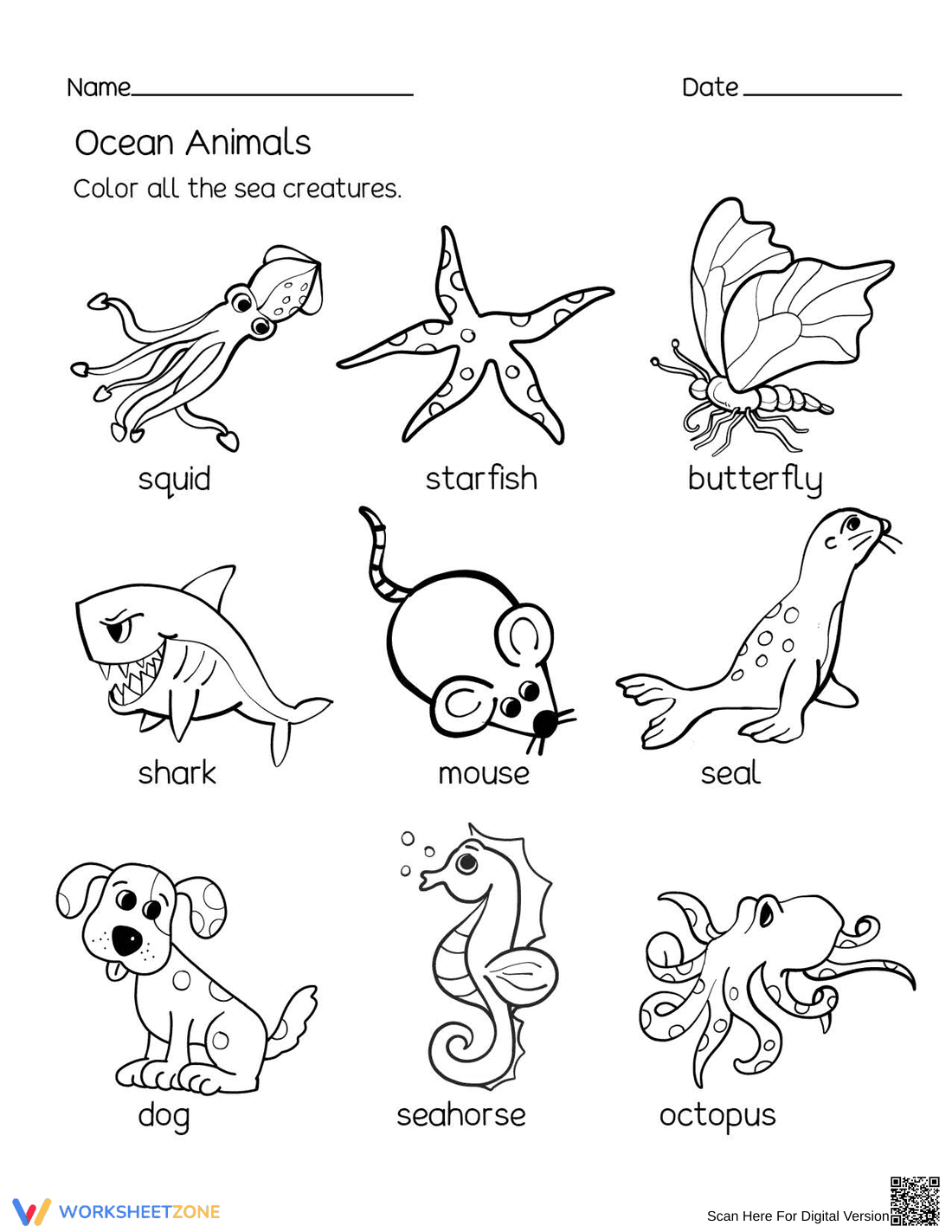
This PDF features nine labeled animal illustrations arranged in a grid. The selection includes high-interest sea creatures like the shark and octopus alongside common land animals. The large line art is optimized for coloring, providing a fine motor skill benefit while students demonstrate scientific understanding. A teacher-friendly layout ensures instructions are clear and easy to follow.
Zero-Prep Workflow
- Print (30 seconds): Send this single-page PDF to your printer; no collating or stapling is required.
- Distribute (30 seconds): Hand out the sheets to your class with crayons or colored pencils.
- Review (1 minute): Quickly scan the student work to see which animals were colored; the visual nature of the task allows for instant grading.
This streamlined process makes the worksheet an ideal solution for emergency sub plans or transition periods where teacher setup time is nonexistent.
Standards Alignment
Aligned to standard K-LS1-1, this activity requires students to apply knowledge of animal needs to determine which creatures belong in an ocean environment. Students recognize that external parts, such as fins or tentacles, are indicative of sea-dwelling life. This approach ensures coloring time is meaningful instructional time. Codes can be copied directly into lesson plans or IEP goals.
How to Use It
Use this worksheet as a summative check after an ocean unit or as a hook for habitats. Observe if students pause at 'distractor' animals like the butterfly or dog. This provides immediate formative data on who understands marine vs. terrestrial environments. Most students complete the identification and coloring in approximately 12 minutes.
Who It's For
This resource is designed for Preschool, Kindergarten, and Grade 1 students exploring the natural world. It is effective for learners who benefit from visual cues and reduced text density. Pair this worksheet with a sea-themed read-aloud or an anchor chart showing global habitats for a comprehensive learning experience.
According to the RAND AIRS 2024 report on early childhood science education, multisensory activities like coloring help solidify categorical boundaries for young learners. This Ocean Animals worksheet targets the K-LS1-1 standard by requiring students to observe physical characteristics and recall habitat patterns to distinguish between marine life and land-dwelling species. Fisher & Frey (2014) emphasize that visual discrimination tasks are foundational to the gradual release of responsibility, moving students from basic identification to complex ecosystem understanding. By evaluating 9 distinct specimens, including 'distractor' items like the butterfly and dog, students engage in active retrieval of biological facts. This classroom-ready resource ensures that learners in Preschool through Grade 1 can demonstrate their understanding of animal needs and environments without heavy linguistic load. Clear line art supports English Language Learners and students with categorization IEP goals.


