


























Views
Downloads


Object Pattern Worksheet (3 Levels) | Grade K-1 Ready
Paste this activity's link or code into your existing LMS (Google Classroom, Canvas, Teams, Schoology, Moodle, etc.).
Students can open and work on the activity right away, with no student login required.
You'll still be able to track student progress and results from your teacher account.
This Kindergarten and Grade 1 math resource helps students identify and extend repeating patterns using familiar geometric shapes. By engaging with visual sequences, learners develop the foundational algebraic thinking necessary for recognizing mathematical structures. Students will predict the next object in a series to demonstrate their understanding of sequence logic.
At a Glance
- Grade: K–1 · Subject: Math
- Standard:
CCSS.MATH.CONTENT.K.G.B.4— Analyze and compare two-dimensional shapes to identify and extend repeating patterns- Skill Focus: Extending ABAB and AABA patterns
- Format: 2 pages · 6 problems · Answer key included · PDF
- Best For: Small group instruction and independent practice
- Time: 15–20 minutes
What's Inside
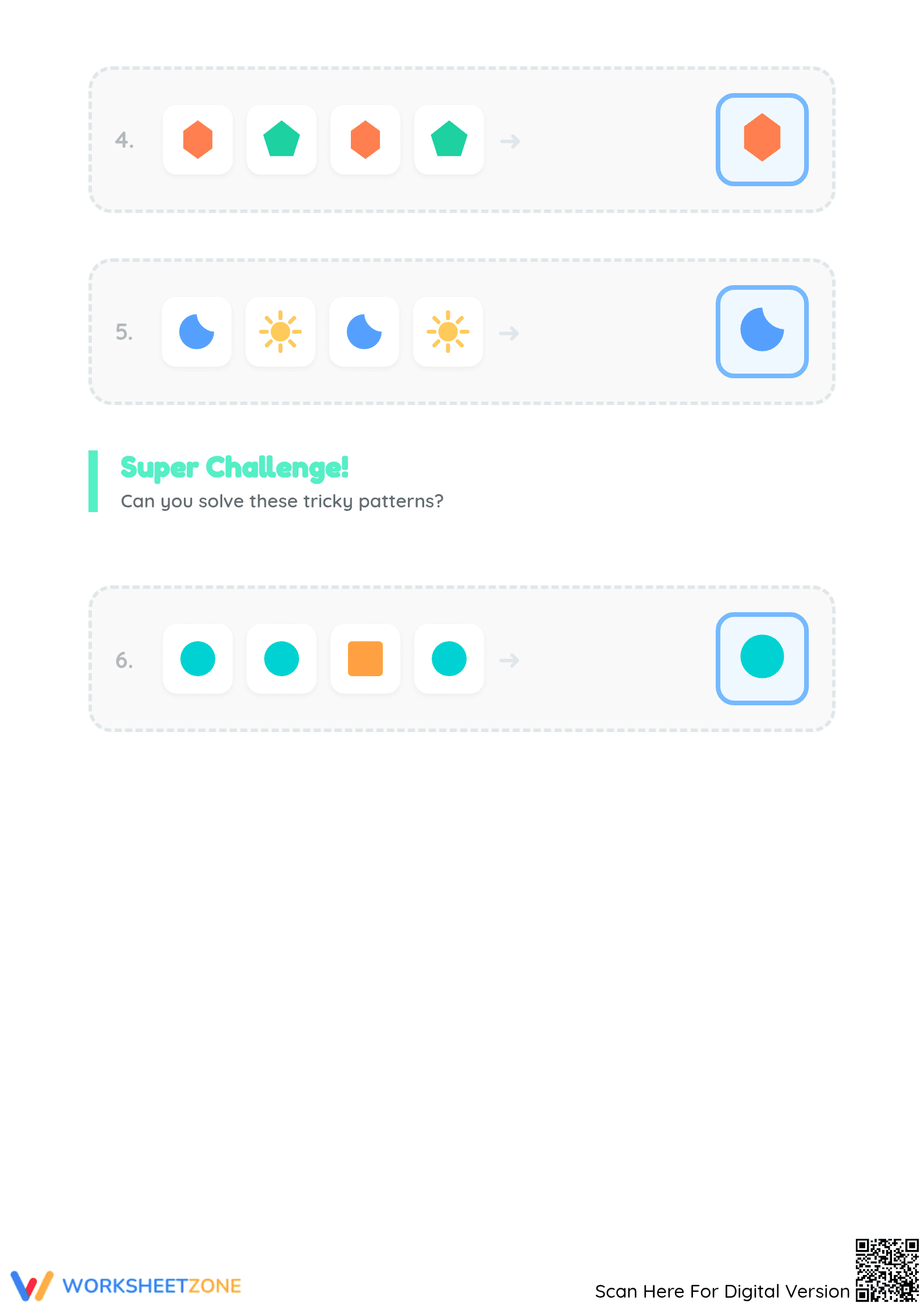
This 2-page PDF features six patterning tasks designed for early learners. Each problem presents a sequence of colorful shapes—such as stars, circles, and hearts—and requires students to draw or name the next logical object. The worksheet includes a Super Challenge section introducing AABA patterns and a full answer key for immediate feedback and easy grading.
Differentiated Level Descriptions
- Below Grade: Features high-contrast ABAB patterns with visual cues to help students isolate the repeating unit.
- On Grade: Students extend standard ABAB and AABA sequences, building working memory and predictive skills.
- Above Grade: Extension tasks introduce non-linear changes and ABC patterns that challenge learners to identify more complex structural rules.
All three differentiated versions are included in this comprehensive packet to support diverse classroom needs.
Standards Alignment
This worksheet aligns to `CCSS.MATH.CONTENT.K.G.B.4`, focusing on analyzing shape properties to identify patterns. It also supports `4.OA.C.5` by introducing the concept of generating a shape pattern following a rule. Both standard codes can be copied directly into lesson plans, IEP goals, or district curriculum mapping tools.
How to Use This Worksheet
Deploy this during the independent practice phase of a lesson. For formative assessment, observe students completing the Super Challenge to check if they identify the pattern unit without prompts. It works perfectly as a 15-minute center activity or an exit ticket to verify mastery of simple repeating sequences.
Target Student Population
Ideal for Kindergarten and First Grade students developing early numeracy. It is effective for English Language Learners due to the low linguistic load of visual patterns. Pair this with physical pattern blocks to bridge the gap between concrete and representational math concepts for diverse learners.
Recognizing and extending patterns is a critical predictor of mathematical success, serving as a fundamental bridge to formal algebraic reasoning. According to a recent RAND AIRS 2024 analysis, early exposure to non-numeric patterning helps children develop essential structural awareness, which is the cognitive capacity to notice and use abstract mathematical rules. This worksheet specifically targets `CCSS.MATH.CONTENT.K.G.B.4` by requiring students to analyze geometric shape properties and predict future sequence states based on an established repeating unit. Fisher & Frey (2014) emphasize that such visual tasks allow students to engage in productive struggle through low-floor, high-ceiling learning environments, where the initial entry point is accessible for all but the underlying logic scales to meet complex demands. By mastering these 6 tasks, learners transition from basic visual observation to the sophisticated predictive analysis required in higher-grade STEM curricula. This resource provides the structured repetition necessary to move these critical logic skills into long-term memory for future application in data analysis.


