




























Views
Downloads
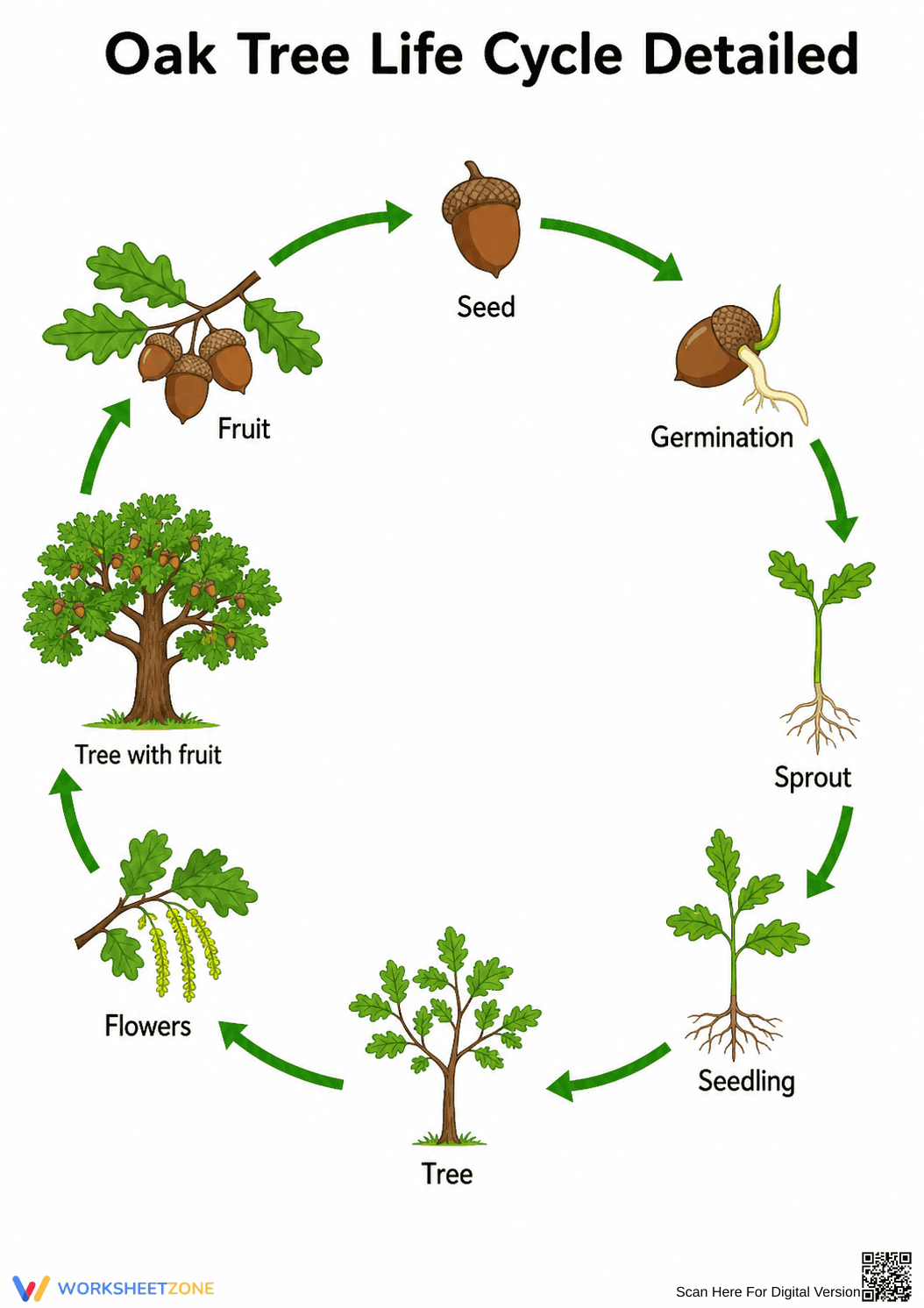

Essential Oak Tree Life Cycle Worksheet | Grade 6 Science

Paste this activity's link or code into your existing LMS (Google Classroom, Canvas, Teams, Schoology, Moodle, etc.).
Students can open and work on the activity right away, with no student login required.
You'll still be able to track student progress and results from your teacher account.
This Grade 6 life cycle worksheet provides a comprehensive visual guide to the biological development of the oak tree. Students observe the transition from seed to mature organism, identifying key reproductive and growth phases. It serves as a foundational tool for understanding how specialized plant structures increase the odds of successful reproduction.
At a Glance
- Grade: 6 · Subject: Science
- Standard:
MS-LS1-4— Use evidence to support how specialized plant structures affect the probability of reproduction- Skill Focus: Biological life cycle sequencing
- Format: 1 page · 8 stages · Answer key included · PDF
- Best For: Introductory biology and plant science units
- Time: 15–20 minutes
The resource features a high-resolution circular diagram illustrating eight distinct stages of development: seed, germination, sprout, seedling, mature tree, flowering, fruiting, and acorn production. The clear labeling and directional arrows emphasize the cyclical nature of plant life. This single-page PDF is designed for immediate classroom use as a reference sheet or labeling activity.
Zero-Prep Workflow
- Print: Generate the required number of copies for your class in under one minute.
- Distribute: Hand out the worksheets during the "Explore" phase of a 5E lesson model to facilitate student observations.
- Review: Spend five minutes reviewing the stages as a whole group to clarify the transition from the vegetative sprout stage to the reproductive flowering stage.
This streamlined process ensures total teacher prep time remains under two minutes, making it an ideal choice for sub plans or quick bell-ringer activities.
Standards Alignment
This worksheet aligns with MS-LS1-4: "Use argument based on empirical evidence and scientific reasoning to support an explanation for how characteristic animal behaviors and specialized plant structures affect the probability of successful reproduction of animals and plants respectively." Both standard codes can be copied directly into lesson plans, IEP goals, or district curriculum mapping tools.
How to Use It
Use this worksheet during an introductory lesson on botany to help students visualize the long-term growth of hardwood trees. It is particularly effective as a formative assessment tool; ask students to explain the environmental factors required for the "Germination" stage to occur. Expected completion time for a labeling or discussion activity is 15 to 20 minutes.
Who It's For
This resource is designed for middle school science students, particularly those in Grade 6 biology. It provides necessary visual scaffolding for English Language Learners (ELL) and students with IEPs who benefit from clear, labeled diagrams. It pairs naturally with a hands-on seed dissection lab or an outdoor nature walk to identify local oak species.
According to the RAND AIRS 2024 report on science literacy, visual representations of biological cycles are critical for long-term retention of complex ecological concepts. This worksheet addresses the MS-LS1-4 standard by highlighting the specialized structures, such as flowers and fruit, that facilitate oak tree reproduction. By breaking down the life cycle into eight observable stages—from the initial acorn seed to the mature, fruit-bearing tree—students can better grasp the continuity of life and the role of environmental interactions in plant development. Research from Fisher & Frey (2014) suggests that such graphic organizers reduce cognitive load, allowing students to focus on the causal relationships between different growth phases. This printable resource provides a structured framework for middle schoolers to analyze how plants grow and reproduce in diverse ecosystems, ensuring alignment with national science frameworks.


