


























Views
Downloads
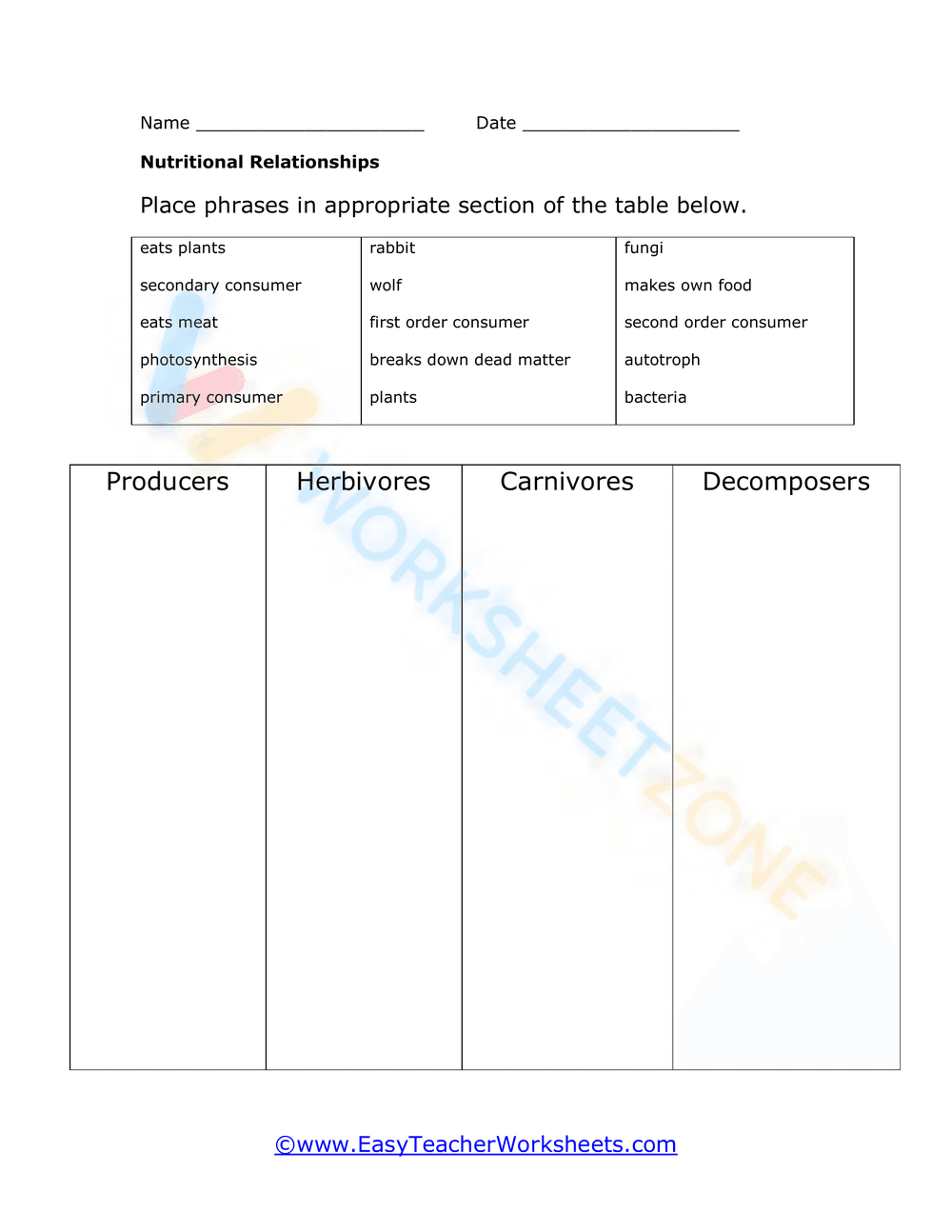

Nutritional Relationships Worksheet | Grade 2 Essential
Paste this activity's link or code into your existing LMS (Google Classroom, Canvas, Teams, Schoology, Moodle, etc.).
Students can open and work on the activity right away, with no student login required.
You'll still be able to track student progress and results from your teacher account.
This Grade 2 science worksheet helps students master the flow of energy by categorizing organisms based on their nutritional roles. Students analyze 15 different terms and organisms, placing them into the correct ecological categories. It provides a clear visual framework for understanding how living things obtain energy within an ecosystem.
At a Glance
- Grade: 2 · Subject: Science
- Standard:
2-LS2-1— Categorize how organisms obtain energy and interact within their environment- Skill Focus: Ecological Roles & Classification
- Format: 1 page · 15 problems · Answer key included · PDF
- Best For: Independent practice or quick assessment
- Time: 15–20 minutes
The worksheet features a word bank containing 15 items, including specific animals like wolves and rabbits, as well as biological processes like photosynthesis. Students must sort these into a four-column table labeled Producers, Herbivores, Carnivores, and Decomposers. The layout is clean and distraction-free, ensuring students focus entirely on the classification task. A comprehensive answer key is provided for rapid grading.
Zero-Prep Workflow
- Print: Select the single-page PDF and print enough copies for your class in under 30 seconds.
- Distribute: Hand out the worksheets as a bell-ringer, exit ticket, or center activity with no additional setup.
- Review: Use the included answer key to check for student understanding or have students self-correct during a whole-group review.
Total teacher preparation time is under two minutes, making this an ideal resource for busy mornings or unexpected substitute plans.
Aligned to 2-LS2-1, this activity supports the understanding that plants and animals depend on their environment and each other for survival. It introduces foundational vocabulary such as autotroph and consumer, bridging the gap between basic animal needs and complex food web dynamics. Both standard codes can be copied directly into lesson plans, IEP goals, or district curriculum mapping tools.
Use this worksheet as a formative assessment after a lesson on food chains. It works exceptionally well as a check for understanding to see if students can distinguish between primary and secondary consumers. Teachers should observe if students correctly place fungi and bacteria, as decomposers are often the most challenging category for second graders to identify. This task typically takes 15 to 20 minutes to complete.
This resource is ideal for Grade 2 students but can be used for Grade 1 enrichment or Kindergarten whole-group instruction with teacher support. It pairs naturally with a classroom anchor chart showing a local food chain or a short informational text about animal diets. It is particularly helpful for English Language Learners who benefit from the structured vocabulary sorting and clear column headers.
According to the RAND AIRS 2024 report on elementary science instruction, structured classification tasks significantly improve long-term retention of biological hierarchies. This worksheet targets the 2-LS2-1 standard by requiring students to differentiate between producers, herbivores, carnivores, and decomposers. By engaging with 15 distinct data points, students move beyond rote memorization toward a conceptual understanding of ecological niches. Research from Fisher & Frey (2014) suggests that such categorizing activities serve as essential scaffolds for developing scientific literacy in early childhood. The inclusion of terms like autotroph and photosynthesis provides the necessary academic rigor to prepare students for upper elementary life science. This printable resource ensures that students can demonstrate mastery of nutritional relationships through a clear, evidence-based sorting task that fits easily into any science curriculum.


