


























Views
Downloads
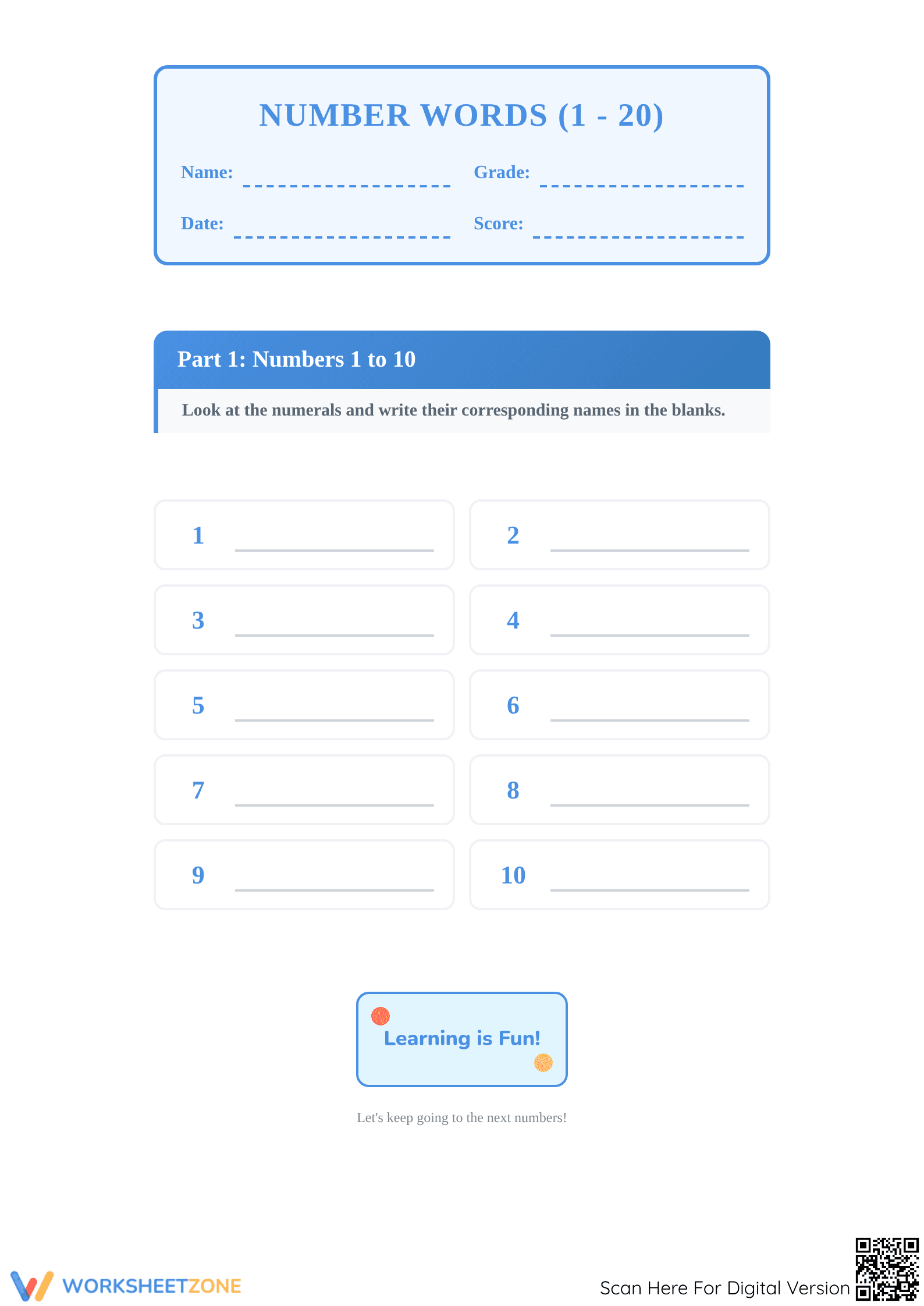



Number Words 1 to 20: Essential Printable Math Worksheet
Paste this activity's link or code into your existing LMS (Google Classroom, Canvas, Teams, Schoology, Moodle, etc.).
Students can open and work on the activity right away, with no student login required.
You'll still be able to track student progress and results from your teacher account.
This worksheet provides a structured approach for students to bridge the gap between abstract numerals and their written English counterparts. By focusing on numbers one through twenty, students develop foundational literacy in mathematics necessary for word problems and place value concepts. This resource ensures learners gain confidence in spelling and identifying number names within a classroom setting.
At a Glance
- Grade: K–1 · Subject: Math
- Standard:
CCSS.MATH.CONTENT.K.CC.A.3— Write numbers from 0 to 20 and represent objects with written numerals- Skill Focus: Number name spelling and numeral correspondence
- Format: 3 pages · 20 problems · Answer key included · PDF
- Best For: Daily math centers and independent skill practice
- Time: 15–20 minutes
The packet includes three comprehensive pages designed for clarity and ease of use. The primary tasks require students to observe a numeral in the left column and provide the corresponding word form in the adjacent space. With 20 distinct items covering the critical 1-20 range, the layout provides ample white space for early writers. A complete answer key is provided to facilitate rapid grading or student self-correction.
Zero-Prep Workflow
Implementing this resource requires minimal effort, making it ideal for busy educators. First, print the document directly from the PDF in under 30 seconds. Second, distribute the pages to students during a transition period or as a morning warm-up in about 1 minute. Finally, review the work using the provided answer key to provide immediate feedback on spelling and accuracy in under 2 minutes. This efficient process is perfect for sub plans.
Standards Alignment
The primary alignment is `CCSS.MATH.CONTENT.K.CC.A.3`, which mandates that students write numbers from 0 to 20 and represent a quantity with a written numeral. This worksheet directly supports this by requiring the conversion of numerals to words, a prerequisite for more complex mathematical notation. Supporting standards include CCSS.ELA-LITERACY.L.1.2.E for spelling patterns. Both standard codes can be copied directly into lesson plans, IEP goals, or district curriculum mapping tools.
How to Use It
Assign this during a "Number of the Day" routine or as a summative assessment after teaching the "teen" numbers. Teachers should observe students as they approach irregular spellings like "eight" or "twelve" to identify common phonemic errors. This observation serves as a vital formative assessment for future small-group instruction. The expected completion time is 15 to 20 minutes depending on the student's fine motor skills and spelling proficiency.
Who It's For
This resource is tailored for Kindergarten and First Grade students, as well as English Language Learners (ELL) who need to build their academic vocabulary. It pairs naturally with a number line anchor chart or a set of ten-frame manipulatives for additional support. The clean design also serves students with processing needs who benefit from a predictable and non-distracting visual structure that focuses purely on the target skill.
Developing a fluent connection between symbolic numerals and their written names is a cornerstone of early numeracy, targeting the CCSS.MATH.CONTENT.K.CC.A.3 standard. This worksheet provides the repetition needed for long-term retention. Explicit practice in academic language within mathematics reduces cognitive load during complex problem-solving. By mastering spelling of numbers 1 through 20, students transition to more sophisticated algebraic thinking. This printable resource offers a reliable environment for students to demonstrate mastery and allows teachers to collect formative data on handwriting and spelling accuracy. The inclusion of the 11-20 range is particularly vital, as these "teen" numbers often present unique linguistic challenges for young learners. This evidence-based approach ensures that instructional time is maximized for student growth and standards compliance.


