


























Views
Downloads

Printable Person Place or Thing Worksheet | Grade 1
Paste this activity's link or code into your existing LMS (Google Classroom, Canvas, Teams, Schoology, Moodle, etc.).
Students can open and work on the activity right away, with no student login required.
You'll still be able to track student progress and results from your teacher account.
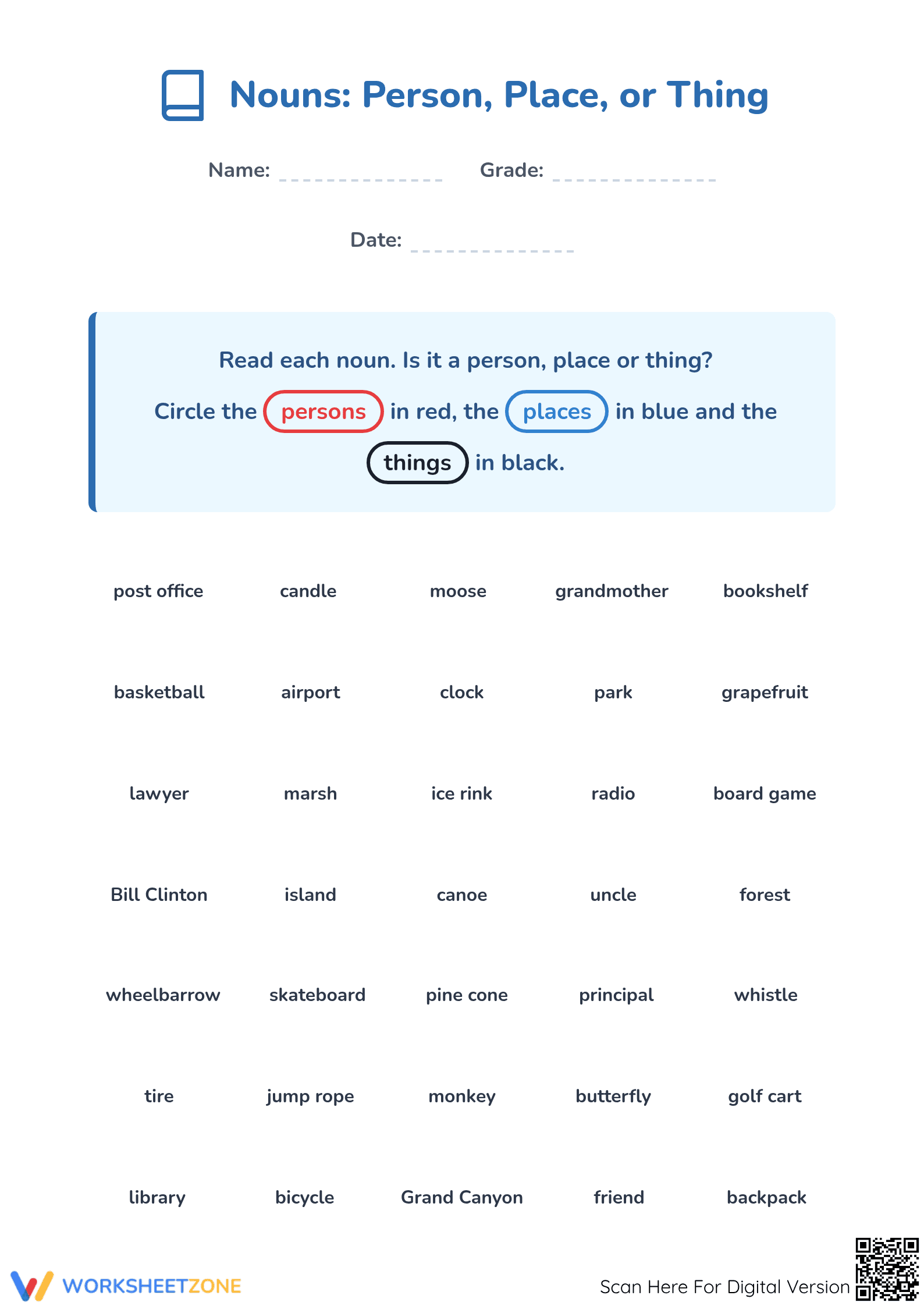
This foundational grammar worksheet helps early elementary students master noun identification by categorizing words into people, places, and things. By using a simple color-coding strategy, learners actively engage with vocabulary and reinforce their understanding of basic parts of speech, building a strong foundation for future reading and writing success.
At a Glance
- Grade: 1 · Subject: ELA
- Standard:
CCSS.ELA-LITERACY.L.1.1.B— Identify and use common, proper, and possessive nouns accurately- Skill Focus: Categorizing nouns as a person, place, or thing
- Format: 2 pages · 45 problems · Answer key included · Printable PDF
- Best For: Independent practice, morning work, and literacy centers
- Time: 15–20 minutes
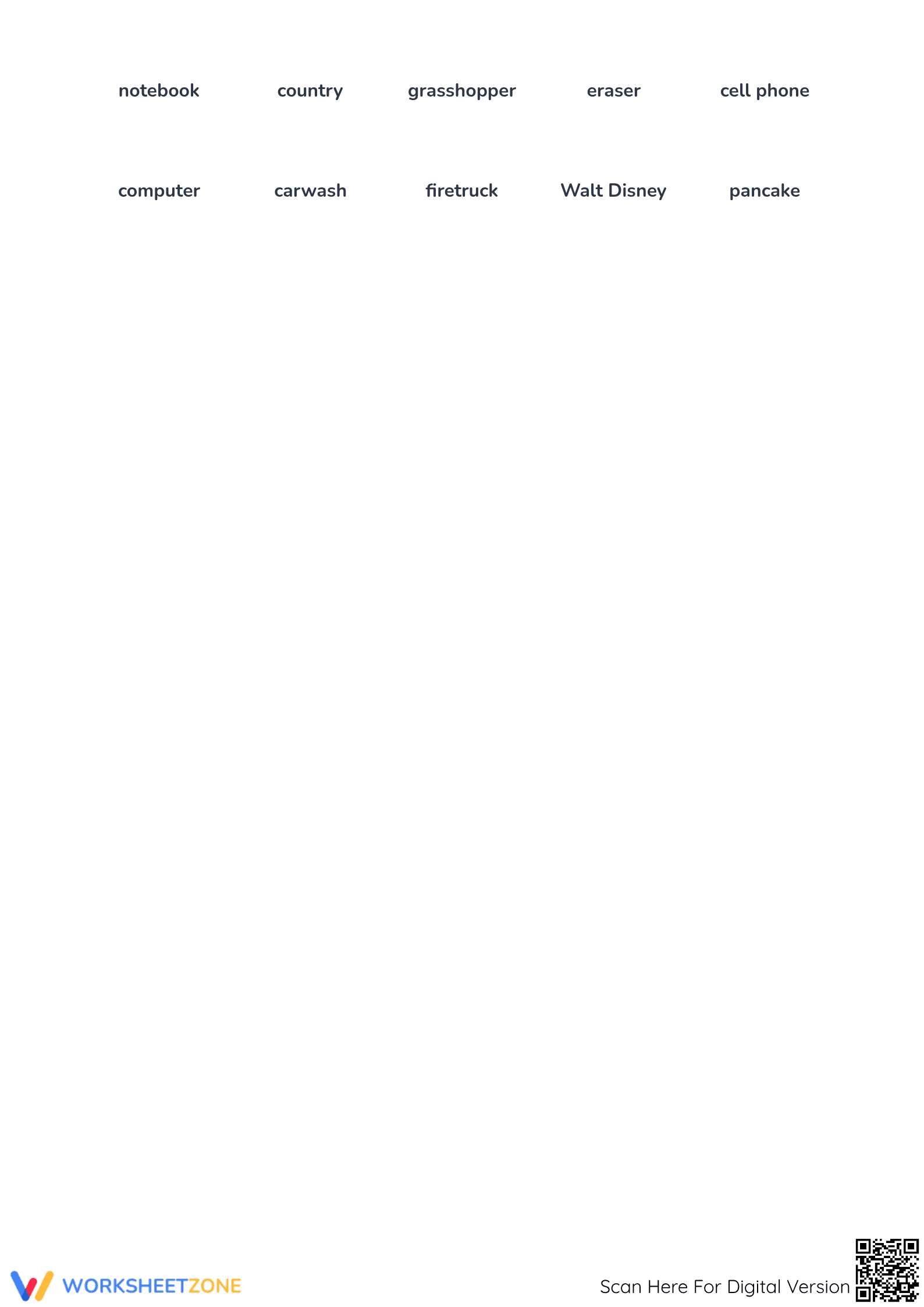
This resource features a straightforward, two-page layout containing 45 distinct vocabulary words for students to evaluate. The activity utilizes a color-coding system where learners circle people in red, places in blue, and things in black. The vocabulary ranges from highly familiar terms to slightly more complex words, providing a healthy mix of common and proper nouns. A complete answer key is provided.
- Guided practice: Teachers model the first few words, demonstrating how to ask, "Is a post office a person, place, or thing?"
- Supported practice: Students work in pairs to read words aloud, helping each other decode vocabulary while categorizing.
- Independent practice: Learners complete the remaining items on their own, applying the color-coding rules.
This structure perfectly supports a gradual-release, I Do, We Do, You Do instructional model.
This activity is directly aligned with primary standard CCSS.ELA-LITERACY.L.1.1.B, which requires students to use common, proper, and possessive nouns. By actively sorting words into the three fundamental noun categories, students demonstrate a working knowledge of what a noun represents in language. Both standard codes can be copied directly into lesson plans, IEP goals, or district curriculum mapping tools.
This worksheet fits easily into daily literacy routines. It serves as an excellent follow-up activity immediately after direct instruction on parts of speech. Alternatively, it works perfectly as a quiet morning work assignment or grammar center task. As a formative assessment tip, teachers should observe which categories students struggle with most to plan targeted mini-lessons. Expected completion time is between 15 and 20 minutes.
This resource is designed primarily for first through third-grade students building foundational grammar skills. The visual color-coding aspect makes it accessible for visual learners and English Language Learners. For differentiation, teachers can provide a noun anchor chart to support students needing extra scaffolding. It pairs naturally with introductory grammar lessons or read-alouds.
Mastering basic parts of speech is a critical stepping stone for early literacy development. According to a recent ScienceDirect TpT Analysis, explicit grammar instruction combined with visual categorization tasks significantly improves students' ability to construct coherent sentences and comprehend complex texts. When students practice identifying nouns as a person, place, or thing, they are building the cognitive framework necessary for advanced reading comprehension and expressive writing. This specific worksheet directly supports CCSS.ELA-LITERACY.L.1.1.B by giving learners repeated, structured exposure to diverse vocabulary words. By requiring students to actively sort and color-code these terms, the activity moves beyond rote memorization and encourages deeper semantic processing. Consistent practice with these foundational language conventions ensures that young learners develop the automaticity required to communicate effectively across all academic subjects.


