


























Views
Downloads


Essential Grade 1 Nouns — Printable No-Prep Worksheet
Paste this activity's link or code into your existing LMS (Google Classroom, Canvas, Teams, Schoology, Moodle, etc.).
Students can open and work on the activity right away, with no student login required.
You'll still be able to track student progress and results from your teacher account.
This Grade 1 nouns worksheet helps students identify people, places, and things within complete sentences. By isolating naming words in context, learners build the foundational grammar skills necessary for sentence structure and reading comprehension. It provides a clear, distraction-free layout that ensures students remain focused on the primary linguistic task.
At a Glance
- Grade: 1 · Subject: ELA
- Standard:
CCSS.ELA-LITERACY.L.1.1.B— Use common, proper, and possessive nouns in sentences- Skill Focus: Identifying nouns (person, place, thing)
- Format: 2 pages · 8 problems · Answer key included · PDF
- Best For: Independent practice or morning work
- Time: 10–15 minutes
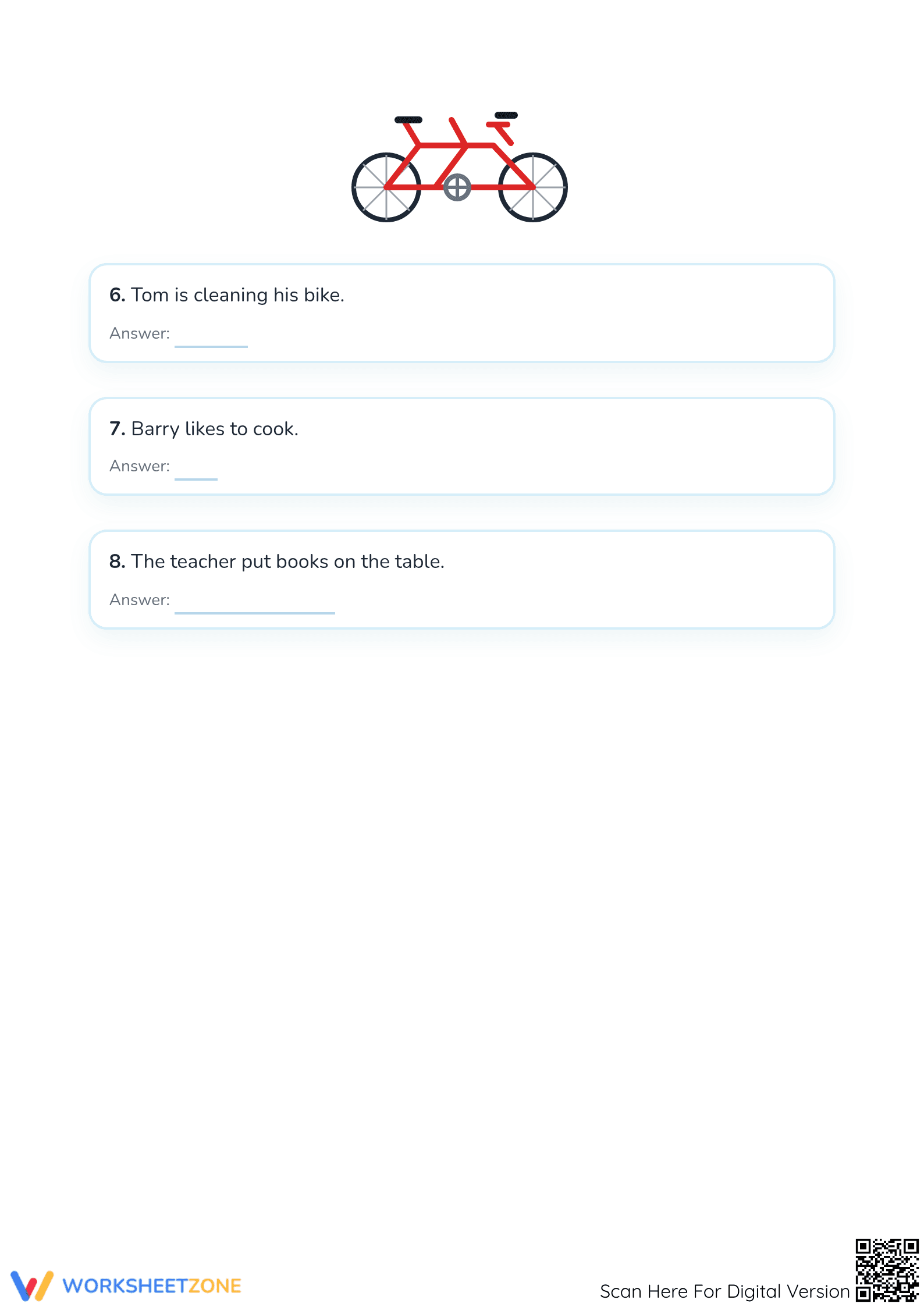
The resource consists of two printable pages featuring eight distinct sentences. Each task requires students to read a sentence and identify the noun or nouns by circling them. The worksheet includes a clear definition box at the top to reinforce the concept that nouns represent people, places, or things. A comprehensive answer key is provided for quick grading and immediate feedback.
Teachers can implement this resource in under two minutes. First, print the two-page PDF for your class (1 minute). Next, distribute the sheets and briefly review the definition of a noun provided in the header (30 seconds). Finally, use the included answer key to review student work or allow for self-correction during a whole-group wrap-up (30 seconds). This streamlined workflow makes it an ideal choice for emergency sub plans or daily bell-ringers.
This worksheet is aligned with CCSS.ELA-LITERACY.L.1.1.B, which focuses on the correct use and identification of common and proper nouns. By identifying "Parker," "Canada," and "apple" within sentences, students demonstrate mastery of noun categories. Both standard codes can be copied directly into lesson plans, IEP goals, or district curriculum mapping tools to ensure compliance with state frameworks.
Use this worksheet during the independent practice phase of a grammar lesson after introducing the concept of naming words. It also serves as an effective formative assessment tool; observe if students can distinguish between the subject noun and the object noun in sentences like "Parker is eating an apple." Expected completion time ranges from 10 to 15 minutes depending on reading level.
This resource is designed for first-grade students but is also suitable for second-grade review or kindergarten enrichment. It is particularly helpful for English Language Learners (ELLs) who need explicit practice with lexical word classes. Pair this with a noun-sorting anchor chart or a picture book about places to deepen conceptual understanding and vocabulary acquisition.
According to research from Fisher & Frey (2014) on the gradual release of responsibility, providing students with structured, context-based practice is vital for linguistic mastery. This worksheet aligns with CCSS.ELA-LITERACY.L.1.1.B by requiring students to identify nouns within the flow of natural language rather than in isolation. By engaging with 8 specific sentence-level tasks, learners move from conceptual understanding to practical application. Data from the NAEP suggests that early mastery of parts of speech is a significant predictor of later writing fluency and syntactic complexity. This resource provides the high-repetition, low-stakes environment necessary for students to internalize the person, place, or thing rule. The inclusion of an answer key supports immediate feedback loops, which are proven to increase retention rates in primary ELA settings while reducing teacher workload.


