


























Views
Downloads

Essential Nouns Practice Worksheet | Grades 1-3
Paste this activity's link or code into your existing LMS (Google Classroom, Canvas, Teams, Schoology, Moodle, etc.).
Students can open and work on the activity right away, with no student login required.
You'll still be able to track student progress and results from your teacher account.
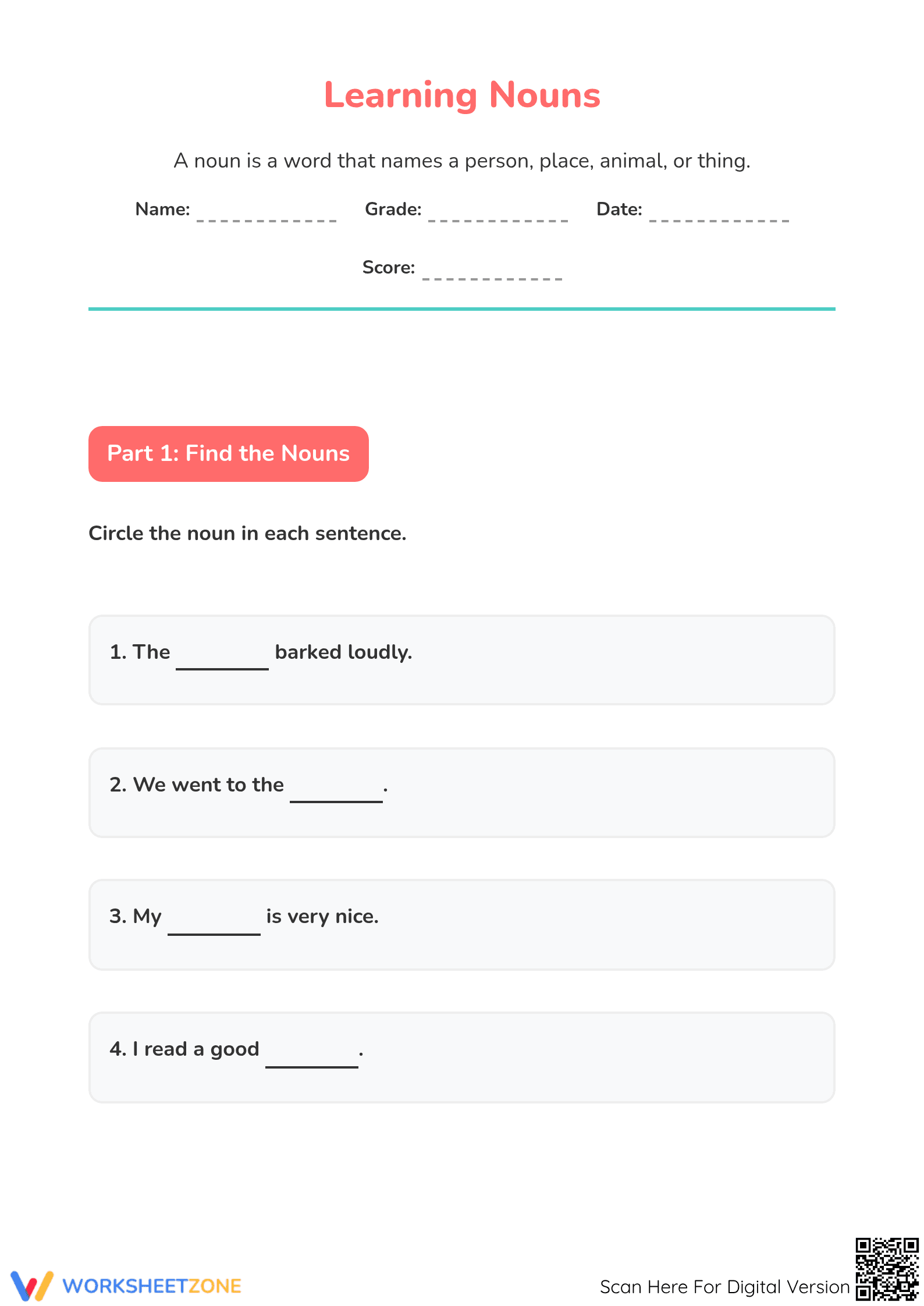
This comprehensive nouns worksheet helps early elementary students master the fundamental building block of grammar. By engaging with 16 distinct tasks, learners move from simple identification to complex categorization and contextual application. Students will gain confidence in recognizing people, places, animals, and things within various sentence structures.
At a Glance
- Grade: 1-3 · Subject: ELA
- Standard:
CCSS.ELA-LITERACY.L.1.1.B— Use common, proper, and possessive nouns in sentences- Skill Focus: Noun Identification and Categorization
- Format: 3 pages · 16 problems · Answer key included · PDF
- Best For: Independent practice or morning work
- Time: 15–20 minutes
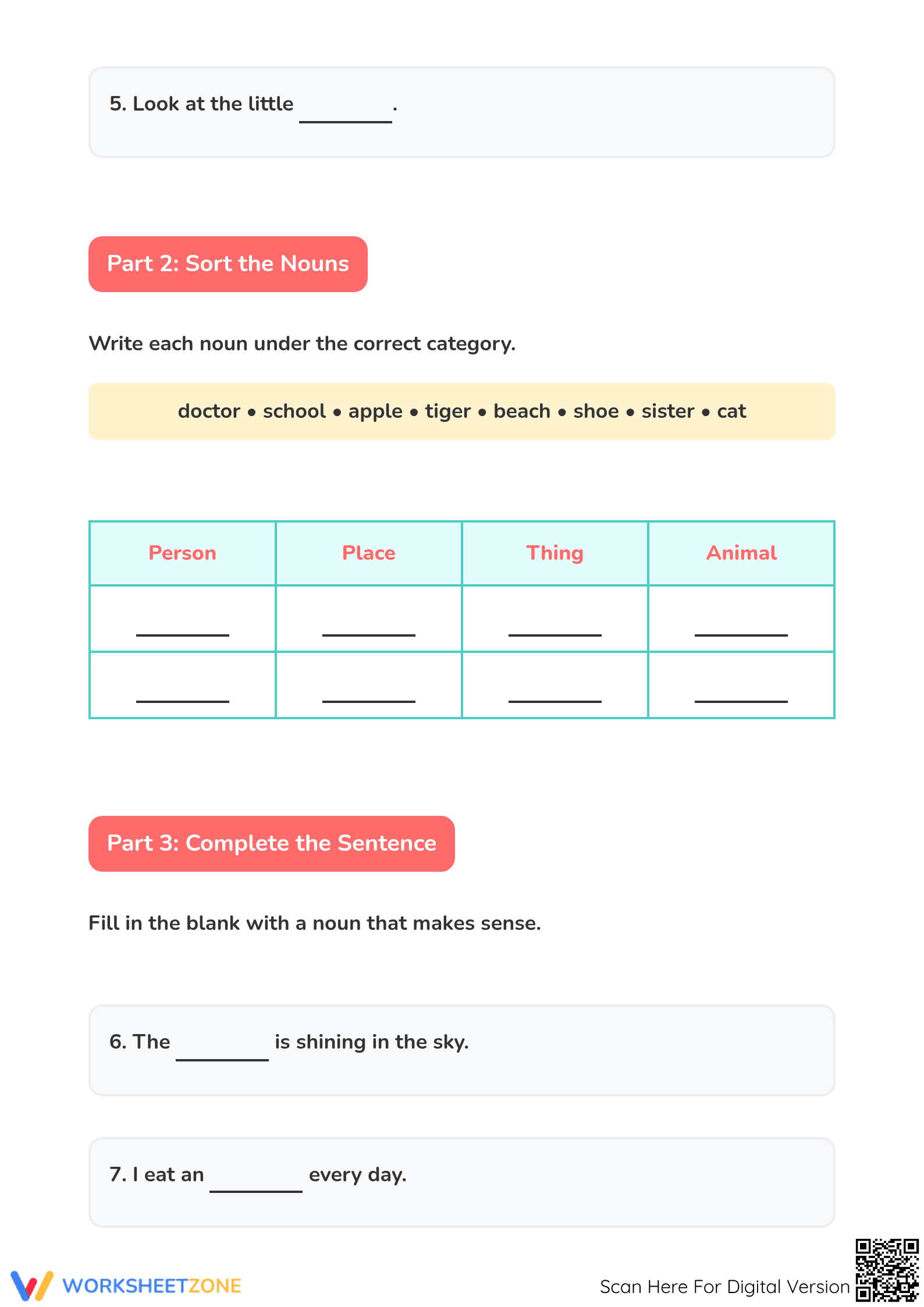
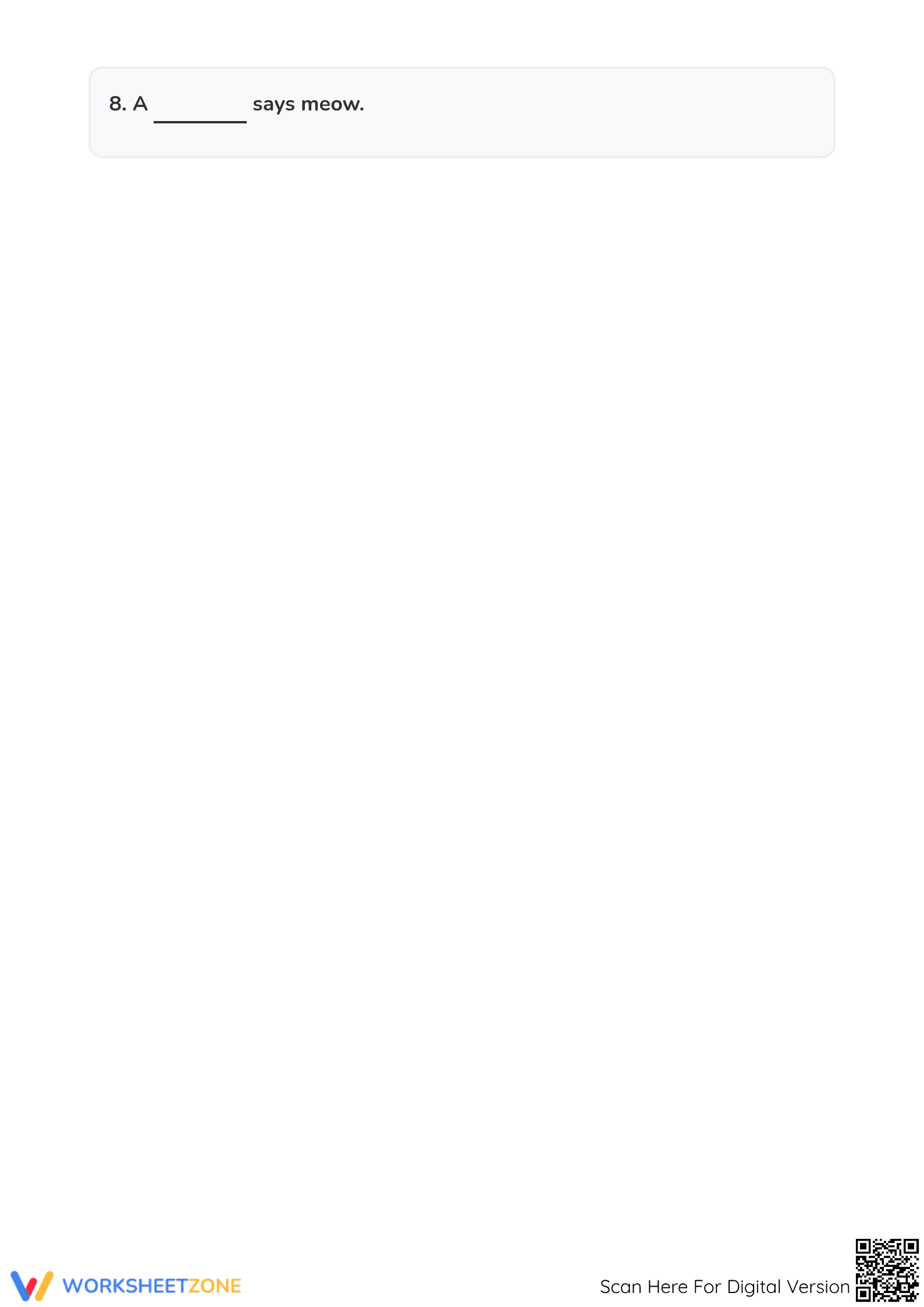
What's Inside: This 3-page PDF includes a clear definition of nouns to support student memory. The first section features five sentence-based identification problems. The second section provides a word bank of eight nouns for students to sort into a four-column table (Person, Place, Thing, Animal). The final section challenges students with three fill-in-the-blank sentences to demonstrate functional usage. A full answer key is provided for rapid grading.
Zero-Prep Workflow
- Print: Select the three-page document and print enough copies for your class (30 seconds).
- Distribute: Hand out the packets during your grammar block or as a transition activity (30 seconds).
- Review: Use the included answer key to review student work or allow for self-correction during a whole-group wrap-up (1 minute).
This streamlined design makes it an ideal choice for emergency sub plans or unexpected schedule changes where teacher prep time is limited.
Standards Alignment: The primary focus is CCSS.ELA-LITERACY.L.1.1.B, which requires students to use common, proper, and possessive nouns. This worksheet specifically targets the identification and categorization of common nouns, providing the necessary prerequisite skills for more advanced grammar. Both standard codes can be copied directly into lesson plans, IEP goals, or district curriculum mapping tools.
How to Use It: Use this worksheet as a formative assessment after a direct instruction lesson on parts of speech. Observe students during the sorting task to see if they can distinguish between abstract categories like "place" and "thing." It also serves as an excellent homework assignment to reinforce classroom learning. Expect most students to complete the full packet within 20 minutes.
Who It's For: This resource is designed for Grade 1 through Grade 3 students who are developing their lexical awareness. It is particularly helpful for English Language Learners (ELLs) who benefit from the explicit categorization of vocabulary. Pair this worksheet with a noun-themed anchor chart or a picture book read-aloud to create a cohesive learning experience.
Research from Fisher & Frey (2014) emphasizes the importance of the gradual release of responsibility, a framework mirrored in this worksheet's progression from identification to application. By first circling nouns in provided sentences (Part 1) and then generating nouns to complete sentences (Part 3), students move from recognition to production. This scaffolded approach is essential for mastering CCSS.ELA-LITERACY.L.1.1.B and building the syntactic fluency required for later writing success. Furthermore, the categorization task in Part 2 aligns with cognitive load theory by organizing information into meaningful schemas (Person, Place, Thing, Animal). Such structured practice ensures that Grade 1-3 learners internalize the definition of a noun as a naming word, providing a stable foundation for more complex linguistic concepts. This resource offers a high-utility tool for educators seeking evidence-based grammar instruction that balances rote practice with contextual usage.


