


























Views
Downloads
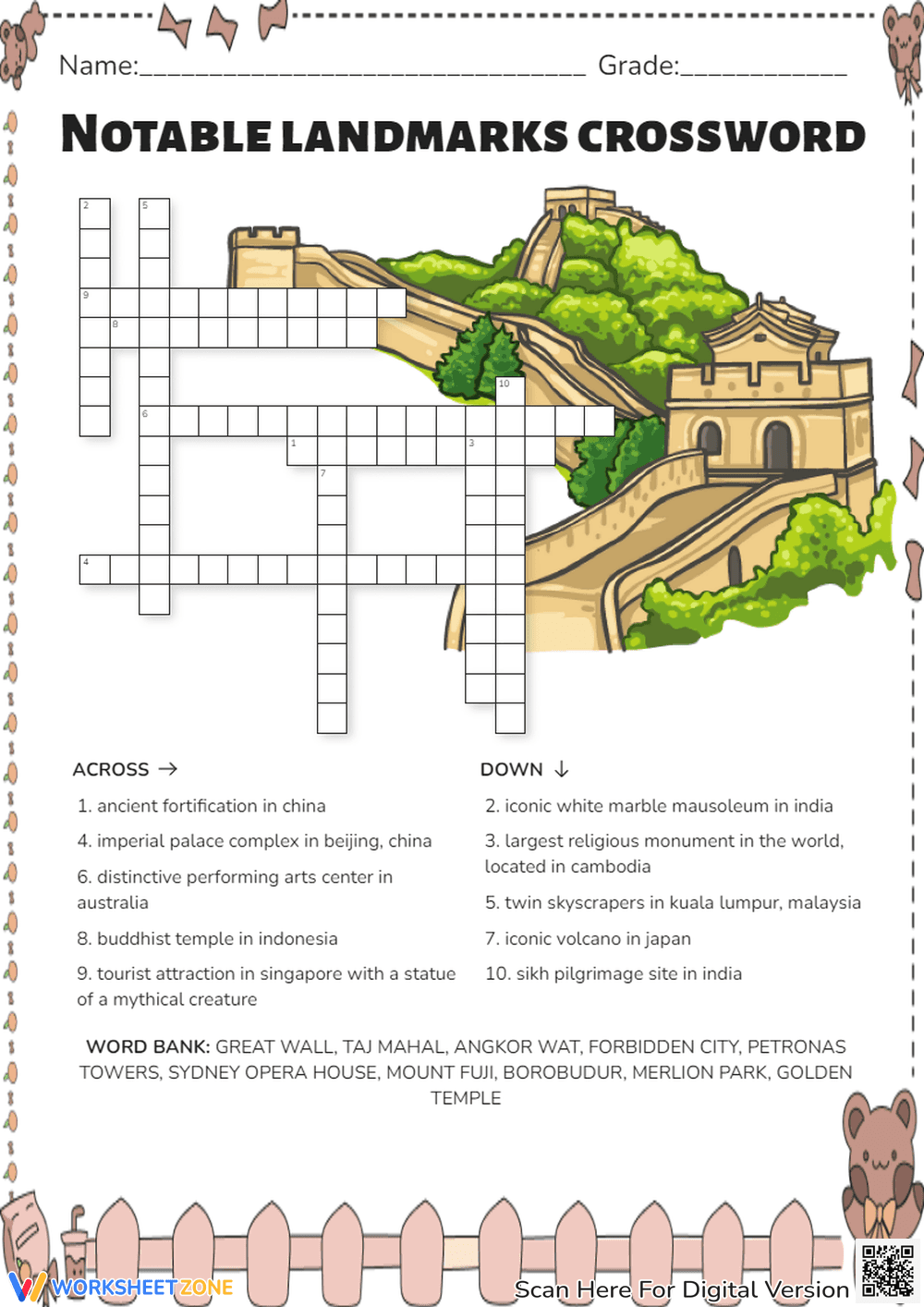

Notable Landmarks Crossword | Grade 6-8 Essential
Paste this activity's link or code into your existing LMS (Google Classroom, Canvas, Teams, Schoology, Moodle, etc.).
Students can open and work on the activity right away, with no student login required.
You'll still be able to track student progress and results from your teacher account.
This Grade 6-8 social studies crossword worksheet helps students identify and categorize major cultural and historical sites across Asia and the Pacific. By matching descriptive clues to specific locations, learners reinforce their geographical literacy and cultural awareness. This activity provides a structured way to celebrate Asian Pacific American Heritage Month while building essential domain-specific vocabulary.
At a Glance
- Grade: 6-8 · Subject: Social Studies
- Standard:
CCSS.ELA-LITERACY.RH.6-8.4— Determine the meaning of domain-specific words related to history and social studies.- Skill Focus: Asian Cultural Geography
- Format: 1 page · 10 problems · Answer key included · PDF
- Best For: Heritage Month Bell-Ringer Activity
- Time: 15–20 minutes
Inside this resource, you will find a professionally designed crossword puzzle featuring 10 unique clues that span the geography of China, India, Cambodia, Malaysia, Japan, and Australia. The worksheet includes a clear word bank to support diverse learners, ensuring that the focus remains on conceptual identification rather than spelling recall. The single-page layout is optimized for quick printing and immediate student engagement.
This worksheet follows a zero-prep workflow designed for busy educators. First, print the required number of copies for your class, which takes less than 30 seconds. Second, distribute the sheets as a transition activity or a focused warm-up, requiring about 1 minute of teacher time. Finally, review the answers as a whole group to facilitate a brief discussion on the significance of each landmark. The total teacher preparation time is under 2 minutes, making it an ideal choice for sub plans or unexpected schedule shifts.
The content is aligned to CCSS.ELA-LITERACY.RH.6-8.4, focusing on the mastery of vocabulary specific to the domain of history and social studies. Students must interpret clues such as "imperial palace complex in Beijing" to identify the Forbidden City, demonstrating an understanding of historical nomenclature. This standard code can be copied directly into lesson plans, IEP goals, or district curriculum mapping tools to document standards-based instruction.
To use this worksheet effectively, assign it as a bell-ringer at the start of a unit on world geography or as a formative assessment after a lesson on Asian civilizations. Teachers should observe which landmarks students identify first to gauge prior knowledge of global heritage sites. Most middle school students will complete the puzzle within 15 to 20 minutes, allowing for a seamless transition into direct instruction or independent research projects.
This resource is specifically designed for middle school students in grades 6, 7, and 8. It is particularly effective for general education classrooms, English Language Learners who benefit from the included word bank, and students participating in Asian Pacific American Heritage Month celebrations. It pairs naturally with a world atlas, digital map tools, or an introductory slide deck on global architecture and heritage sites.
Research from Fisher & Frey (2014) emphasizes that domain-specific vocabulary acquisition in middle school social studies is significantly enhanced when students engage with terms through multiple modalities, including word puzzles and visual associations. This Notable Landmarks Crossword targets CCSS.ELA-LITERACY.RH.6-8.4 by requiring students to synthesize descriptive clues with specific geographical and historical nomenclature. By utilizing a word bank, the resource provides necessary scaffolding that allows students to focus on the conceptual link between the landmark's description and its cultural significance. This approach aligns with evidence-based practices for supporting literacy across content areas, ensuring that students not only recognize names like the Taj Mahal or Angkor Wat but also understand their unique historical contexts. Such activities are essential for building the background knowledge required for more complex historical analysis in later grades, providing a low-stakes yet high-impact method for reinforcing global cultural literacy during Asian Pacific American Heritage Month.


