


























Views
Downloads

Essential Non-Fiction Book Report Worksheet | Grades 2-6
Paste this activity's link or code into your existing LMS (Google Classroom, Canvas, Teams, Schoology, Moodle, etc.).
Students can open and work on the activity right away, with no student login required.
You'll still be able to track student progress and results from your teacher account.
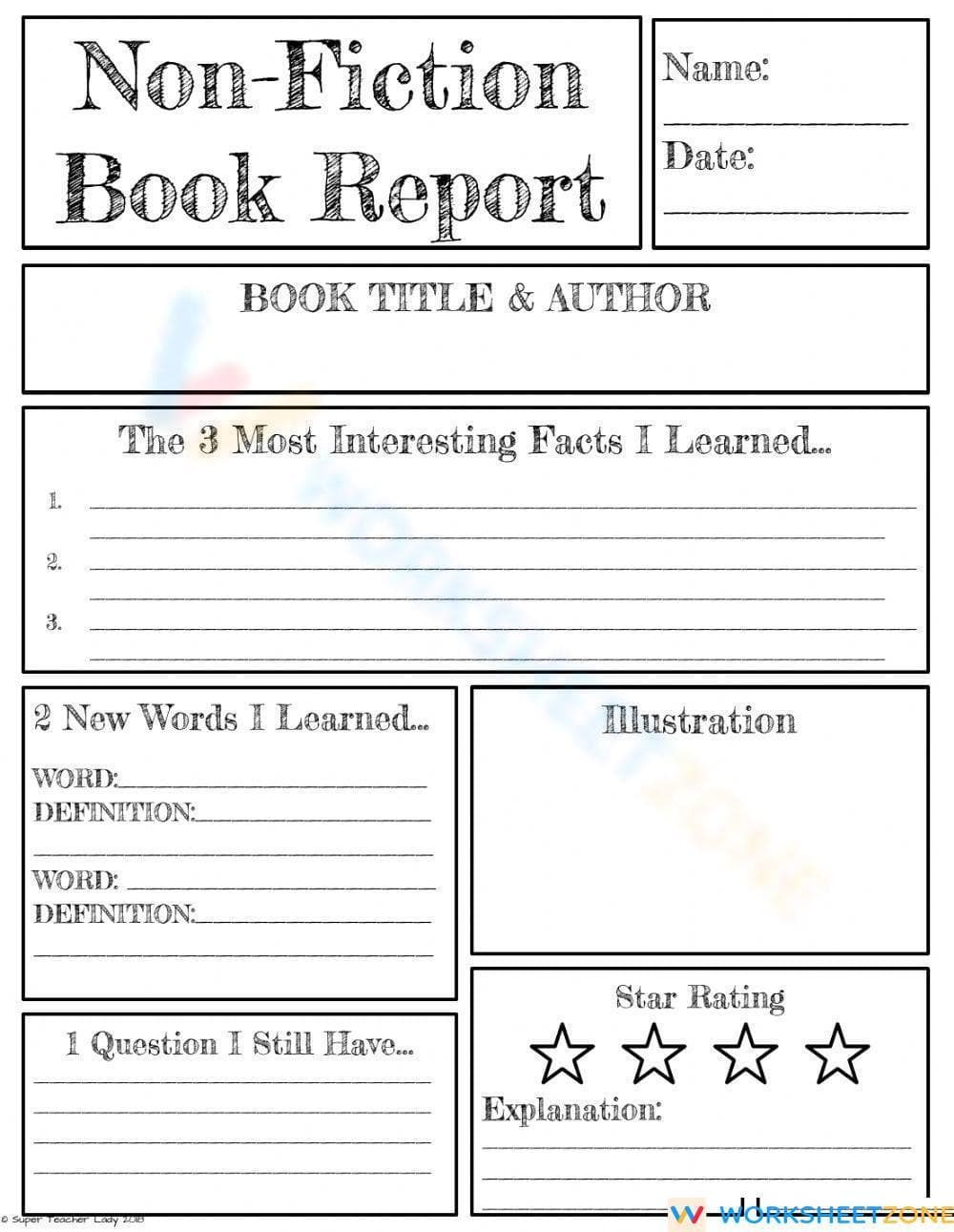
This Grade 3 non-fiction book report worksheet provides a structured framework for students to document their learning from any informational text. By focusing on fact extraction, vocabulary development, and critical evaluation, the tool ensures students move beyond surface-level reading to engage deeply with the material. It is a reliable resource for verifying reading comprehension.
At a Glance
- Grade: 3 · Subject: ELA
- Standard:
CCSS.ELA-LITERACY.RI.3.2— Determine the main idea and key details in an informational text- Skill Focus: Non-fiction comprehension and reporting
- Format: 1 page · 6 tasks · Answer key not included · PDF
- Best For: Independent reading response and sub plans
- Time: 20–30 minutes
Inside this one-page PDF, you will find six distinct reporting zones designed to capture the essence of a non-fiction book. The layout includes dedicated spaces for the book title and author, three numbered lines for interesting facts, and a vocabulary section for two new words with their definitions. It also features a creative illustration box and a reflective question prompt.
The zero-prep workflow for this resource is designed for maximum teacher efficiency. First, print the single-page PDF (30 seconds). Second, distribute the copies to students as they begin their independent reading block or library time (1 minute). Finally, review the completed reports to quickly assess student comprehension and vocabulary acquisition (1 minute per student). It is perfectly suited for emergency sub plans.
Aligned primarily to CCSS.ELA-LITERACY.RI.3.2, this worksheet requires students to identify and recount key details from a text. It also supports CCSS.ELA-LITERACY.RI.3.4 by encouraging the identification and definition of domain-specific vocabulary encountered during reading. Both standard codes can be copied directly into lesson plans, IEP goals, or district curriculum mapping tools.
Use this worksheet as a summative assessment after students finish a non-fiction book, or as a formative check-in during a multi-day research project. During instruction, observe how students select their "interesting facts" to identify if they can distinguish between minor details and central ideas. Students typically complete the full report in approximately 25 minutes.
This resource is ideal for Grade 2 through Grade 4 students working on informational reading skills. It offers natural differentiation for English Language Learners through the "Illustration" and "New Words" sections, which provide non-linguistic representation options. Pair this worksheet with a non-fiction leveled reader or a classroom anchor chart on "Asking Questions While Reading."
The CCSS.ELA-LITERACY.RI.3.2 standard focuses on a student's ability to determine the main idea of an informational text and recount key details that support it. Research from Fisher & Frey (2014) emphasizes that structured graphic organizers, like this non-fiction book report, provide the necessary scaffolding for students to transition from passive reading to active analysis. By requiring students to extract three specific facts and define new vocabulary, the worksheet promotes "close reading" habits that are essential for long-term literacy success. This structured approach helps Grade 3 learners organize their thoughts and demonstrate comprehension through multiple modalities, including writing and illustration. According to the NAEP 2022 framework, students who use evidence-based reporting tools show significantly higher proficiency in informational text interpretation compared to those using open-ended prompts. This tool ensures students meet rigorous grade-level expectations while developing a consistent workflow for documenting their learning from non-fiction sources.


