


























Views
Downloads

Grade 1 Prepositions — Printable No-Prep Worksheet
Paste this activity's link or code into your existing LMS (Google Classroom, Canvas, Teams, Schoology, Moodle, etc.).
Students can open and work on the activity right away, with no student login required.
You'll still be able to track student progress and results from your teacher account.
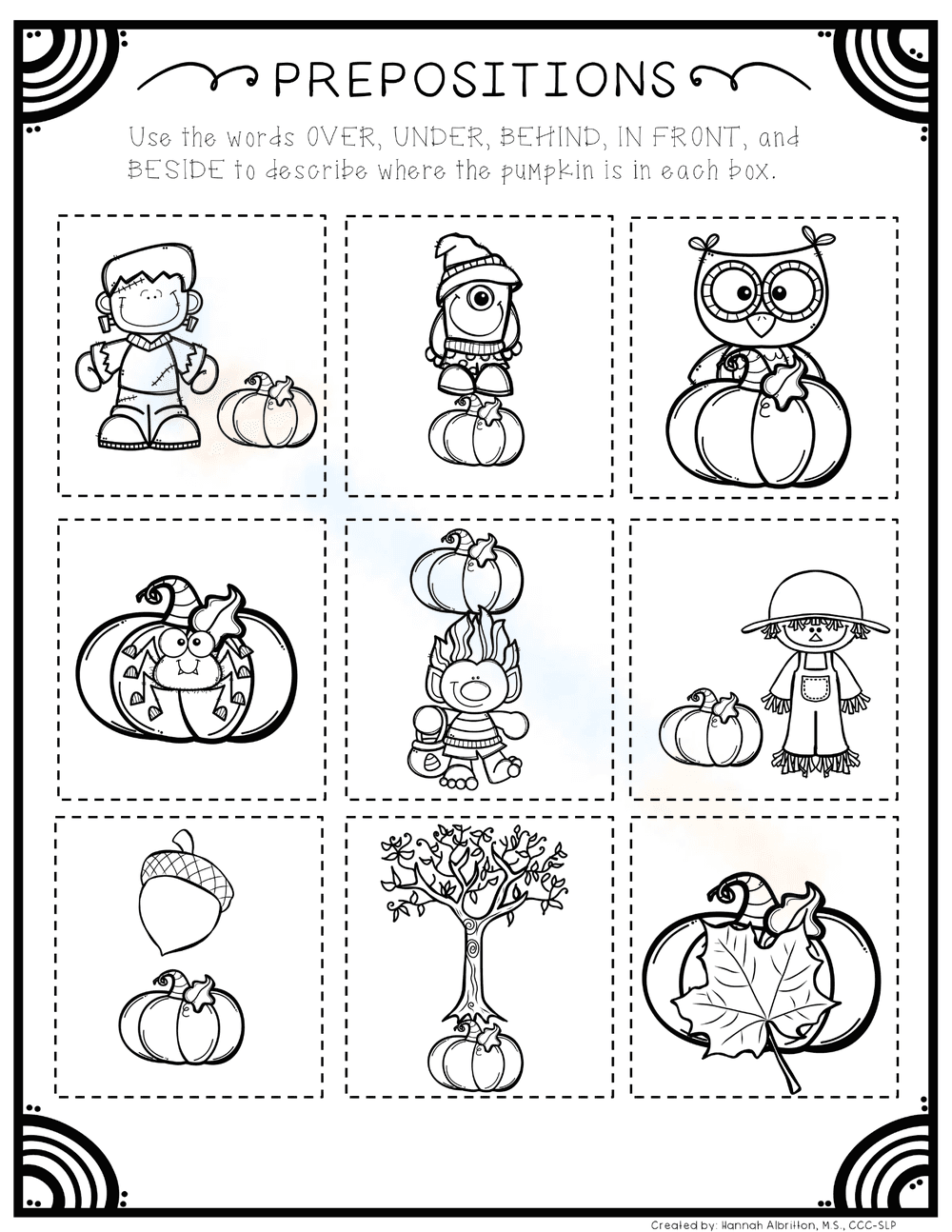
This Grade 1 grammar worksheet provides immediate practice with spatial prepositions, helping students accurately describe relationships between objects. Featuring a fun Halloween theme, learners apply words like over, under, behind, and beside to nine distinct visual scenarios, strengthening their foundational language skills and spatial awareness.
At a Glance
- Grade: 1 · Subject: ELA
- Standard:
CCSS.ELA-LITERACY.L.1.1.I— Use frequently occurring prepositions to describe locations.- Skill Focus: Spatial prepositions
- Format: 1 page · 9 problems · Answer key included · PDF
- Best For: Independent practice or morning work
- Time: 10–15 minutes
Inside this single-page resource, educators will find nine visually distinct task boxes featuring engaging Halloween characters like pumpkins, monsters, and owls. Students are prompted to use a provided word bank containing five target prepositions—over, under, behind, in front, and beside—to describe the position of the pumpkin in each specific illustration. A complete answer key is included to ensure rapid grading and immediate feedback.
This resource is designed for a highly efficient, zero-prep workflow. First, print the single-page PDF (under one minute). Next, distribute the copies to your students along with pencils or crayons (one minute). Finally, review the instructions and the word bank together before letting them work independently (two minutes). Total teacher preparation time is under two minutes, making this an excellent, self-explanatory option for emergency sub plans or quick transitions.
This activity is directly aligned to CCSS.ELA-LITERACY.L.1.1.I: "Use frequently occurring prepositions (e.g., during, beyond, toward)." It specifically targets spatial and positional words essential for early language development and reading comprehension. Both standard codes can be copied directly into lesson plans, IEP goals, or district curriculum mapping tools.
Deploy this worksheet during your morning work routine to activate prior knowledge before a formal grammar lesson. Alternatively, use it as an independent literacy center activity where students can practice applying positional vocabulary without direct teacher supervision. As a formative assessment tip, observe whether students confuse "behind" and "in front" when looking at the 2D illustrations, which can indicate a need for concrete, 3D modeling. Expected completion time ranges from 10 to 15 minutes.
This resource is primarily designed for first-grade students mastering basic parts of speech, but it also serves as an effective review for second graders. The visual nature of the tasks provides excellent differentiation for English Language Learners (ELLs) who benefit from picture supports when acquiring new vocabulary. Pair this worksheet with a read-aloud of a positional-word picture book or a hands-on block-building activity.
Mastering spatial prepositions is a critical milestone in early childhood language acquisition and reading comprehension. According to Fisher & Frey (2014), explicit vocabulary instruction combined with visual supports significantly improves students' ability to articulate relationships between objects and comprehend complex sentence structures. This targeted practice aligns with CCSS.ELA-LITERACY.L.1.1.I, requiring students to use frequently occurring prepositions to describe locations accurately. By connecting abstract grammar concepts to concrete, engaging visual scenarios, educators can effectively bridge the gap between oral language development and written expression. Regular exposure to positional vocabulary in varied contexts ensures that young learners build the foundational syntax necessary for future academic success. This resource provides the exact structured repetition required to solidify these essential linguistic connections in the primary classroom.


