


























Views
Downloads
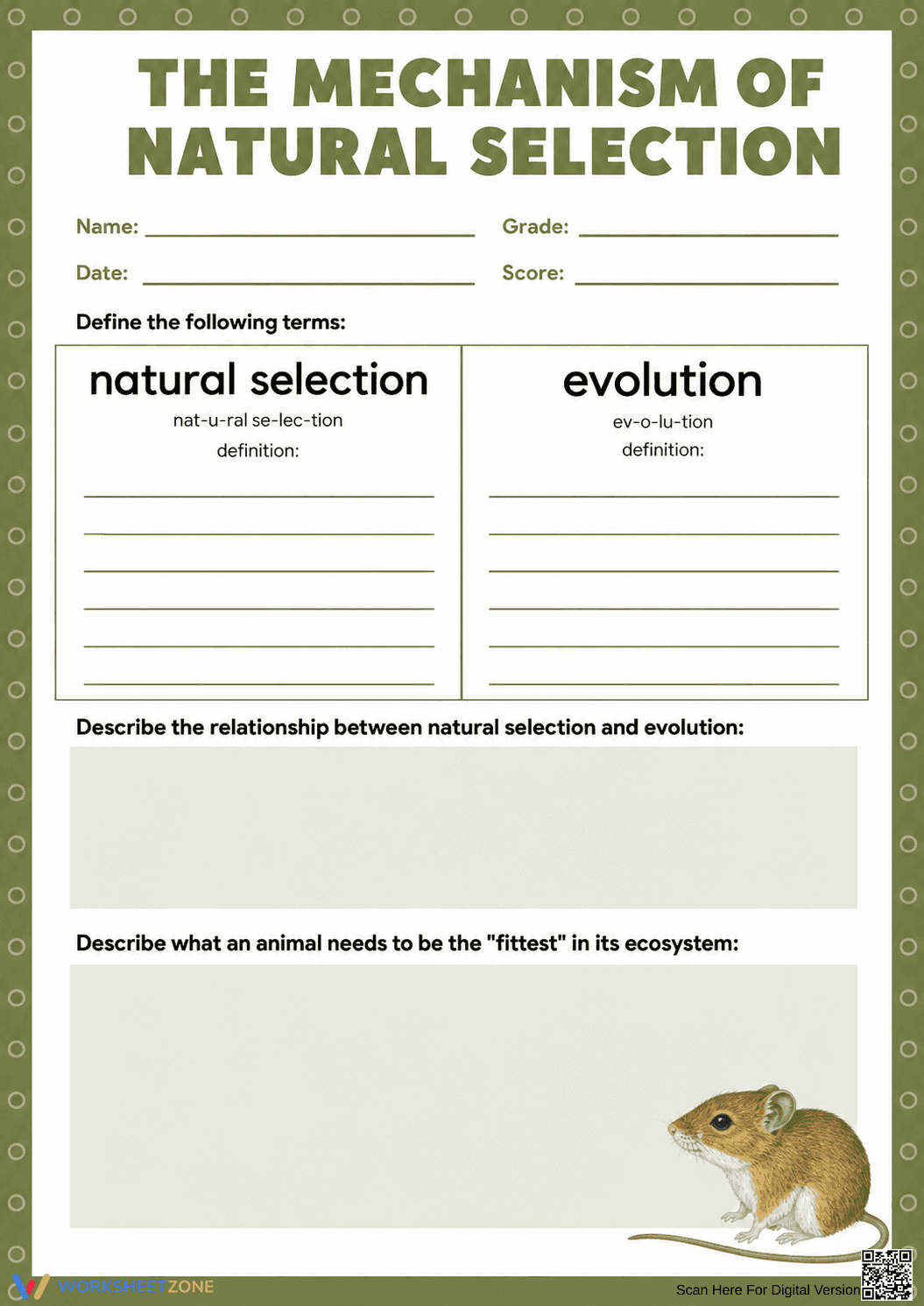

Grade 8 Natural Selection — Printable No-Prep Worksheet
Paste this activity's link or code into your existing LMS (Google Classroom, Canvas, Teams, Schoology, Moodle, etc.).
Students can open and work on the activity right away, with no student login required.
You'll still be able to track student progress and results from your teacher account.
This Grade 8 biology worksheet helps students define and connect the core concepts of natural selection and evolution. By articulating these definitions and explaining what makes an organism the "fittest" in its ecosystem, students build a foundational understanding of how traits influence survival and reproduction in changing environments.
At a Glance
- Grade: 8 · Subject: Science
- Standard:
MS-LS4-4— Explain how genetic variations increase survival probability- Skill Focus: Defining natural selection and evolutionary fitness
- Format: 1 page · 4 problems · Answer key included · PDF
- Best For: Independent practice or review
- Time: 15–20 minutes
Inside this single-page resource, students will find four structured writing prompts designed to assess their comprehension of evolutionary biology. The layout features dedicated vocabulary boxes with phonetic spellings for "natural selection" and "evolution," followed by two short-answer sections requiring students to synthesize these concepts. A complete answer key is provided to ensure accurate grading of student explanations regarding ecological fitness and adaptation.
This resource is designed for immediate classroom implementation with a streamlined workflow:
- Print (1 minute): The single-page PDF format minimizes copy time and saves paper.
- Distribute (1 minute): Clear instructions and intuitive formatting mean students can begin working immediately without extensive teacher setup.
- Review (5 minutes): Use the included answer key to quickly check student responses or facilitate a whole-class discussion on evolutionary fitness.
With under two minutes of total teacher prep time, this worksheet serves as an excellent emergency sub plan or a quick formative assessment at the end of a lesson.
This worksheet is aligned to the Next Generation Science Standard MS-LS4-4: Construct an explanation based on evidence that describes how genetic variations of traits in a population increase some individuals' probability of surviving and reproducing in a specific environment. It also supports high school progression by introducing foundational vocabulary necessary for advanced biological studies. Both standard codes can be copied directly into lesson plans, IEP goals, or district curriculum mapping tools.
Deploy this worksheet as an independent practice activity immediately following direct instruction on Darwin's theory of evolution. It works exceptionally well as a "ticket out the door" formative assessment; by reading students' explanations of what makes an animal the "fittest," teachers can quickly identify misconceptions about physical strength versus reproductive success. Expect students to complete the four prompts within 15 to 20 minutes.
This resource is optimized for middle school and early high school science students encountering evolutionary theory for the first time. The clear, uncluttered layout and phonetic vocabulary guides provide built-in scaffolding for English Language Learners and students with reading accommodations. Pair this worksheet with a visual anchor chart on animal adaptations or a short reading passage about the peppered moth to reinforce the concepts of environmental pressure and survival.
Mastering the vocabulary of evolutionary biology is a critical step in scientific literacy. This resource targets MS-LS4-4, requiring students to explain how genetic variations increase survival probability. According to a ScienceDirect TpT Analysis, explicit vocabulary instruction combined with immediate application in short-answer formats significantly improves long-term retention of complex scientific concepts. By asking students to define terms and immediately synthesize their relationship, this worksheet moves learners beyond rote memorization into conceptual understanding. The prompt regarding ecological fitness specifically challenges common misconceptions, forcing students to articulate that survival is about adaptation to specific environmental pressures rather than mere physical dominance. This targeted practice ensures students build the precise academic language necessary for constructing evidence-based scientific explanations in later units.


