


























Views
Downloads

Natural Selection & Evolution Worksheet | Essential Biology
Paste this activity's link or code into your existing LMS (Google Classroom, Canvas, Teams, Schoology, Moodle, etc.).
Students can open and work on the activity right away, with no student login required.
You'll still be able to track student progress and results from your teacher account.
This comprehensive biology resource helps students master the mechanisms of natural selection through evidence-based analysis. By connecting Darwinian theory to real-world case studies like the peppered moth and rock pocket mouse, learners develop a concrete understanding of how environmental pressures drive population changes over time.
At a Glance
- Grade: 9–12 · Subject: Biology
- Standard:
HS-LS4-4— Explain how natural selection leads to adaptation of populations using evidence- Skill Focus: Evolutionary Mechanisms
- Format: 3 pages · 10 problems · Open-response · PDF
- Best For: High school biology core instruction
- Time: 45–60 minutes
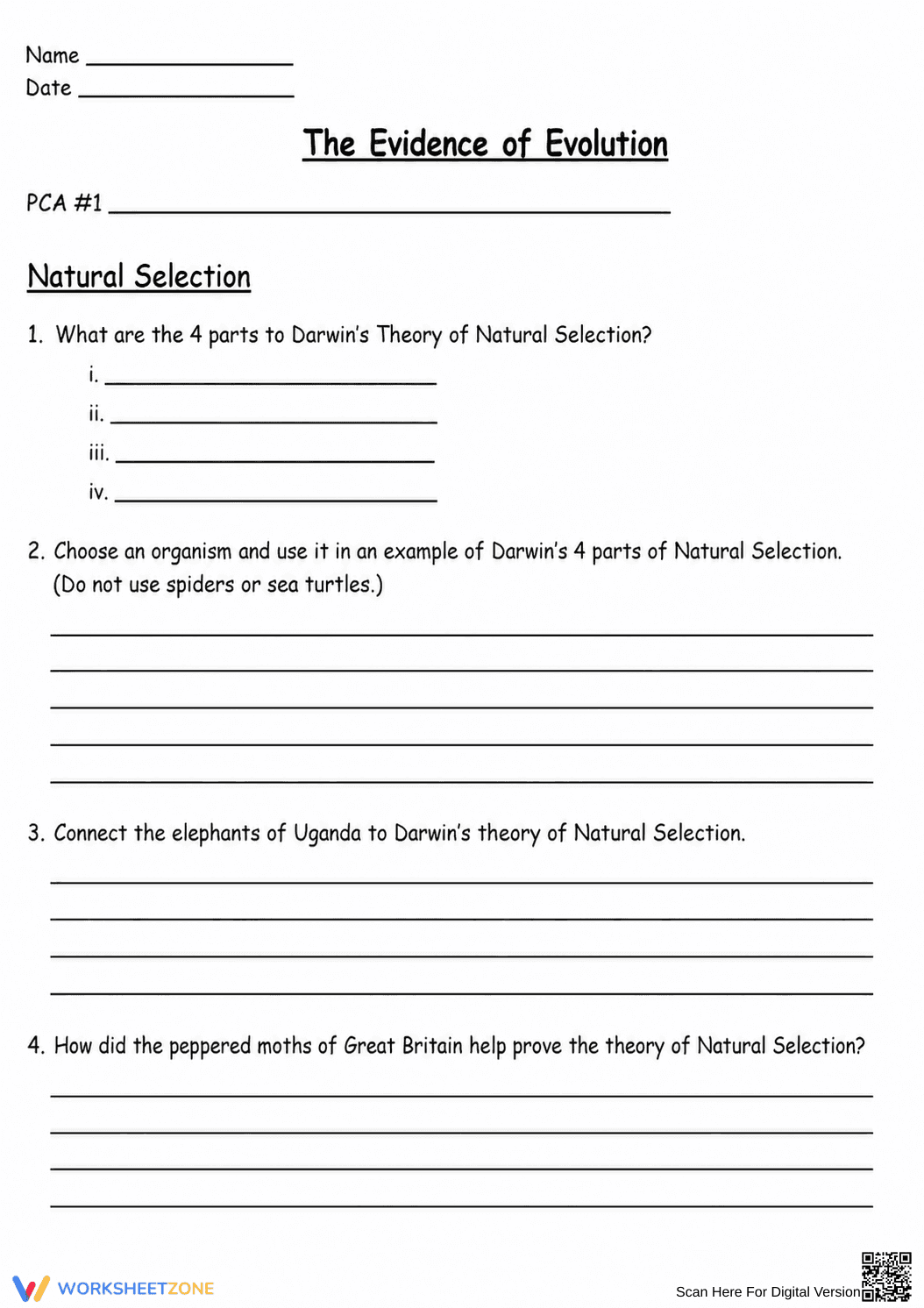
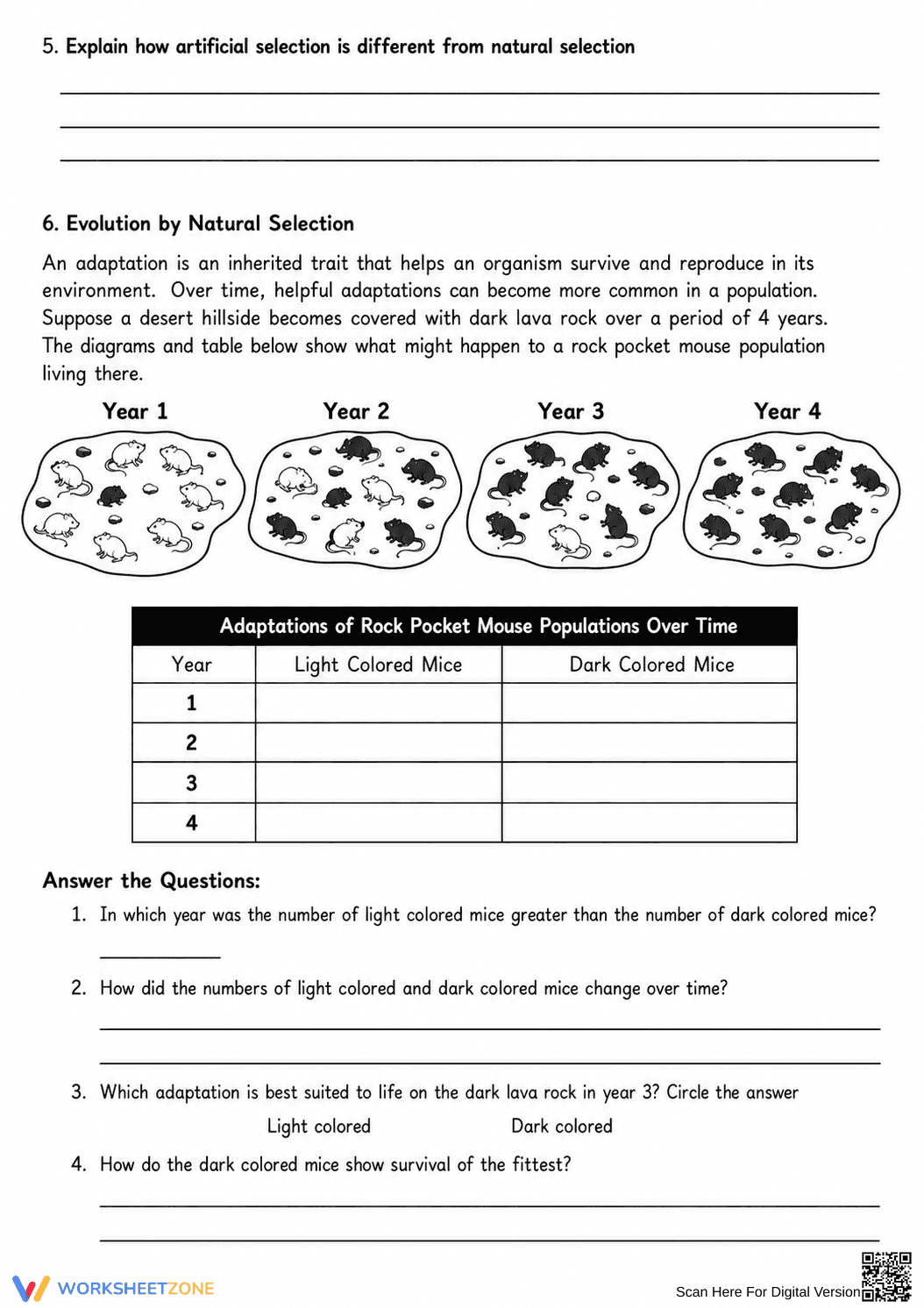
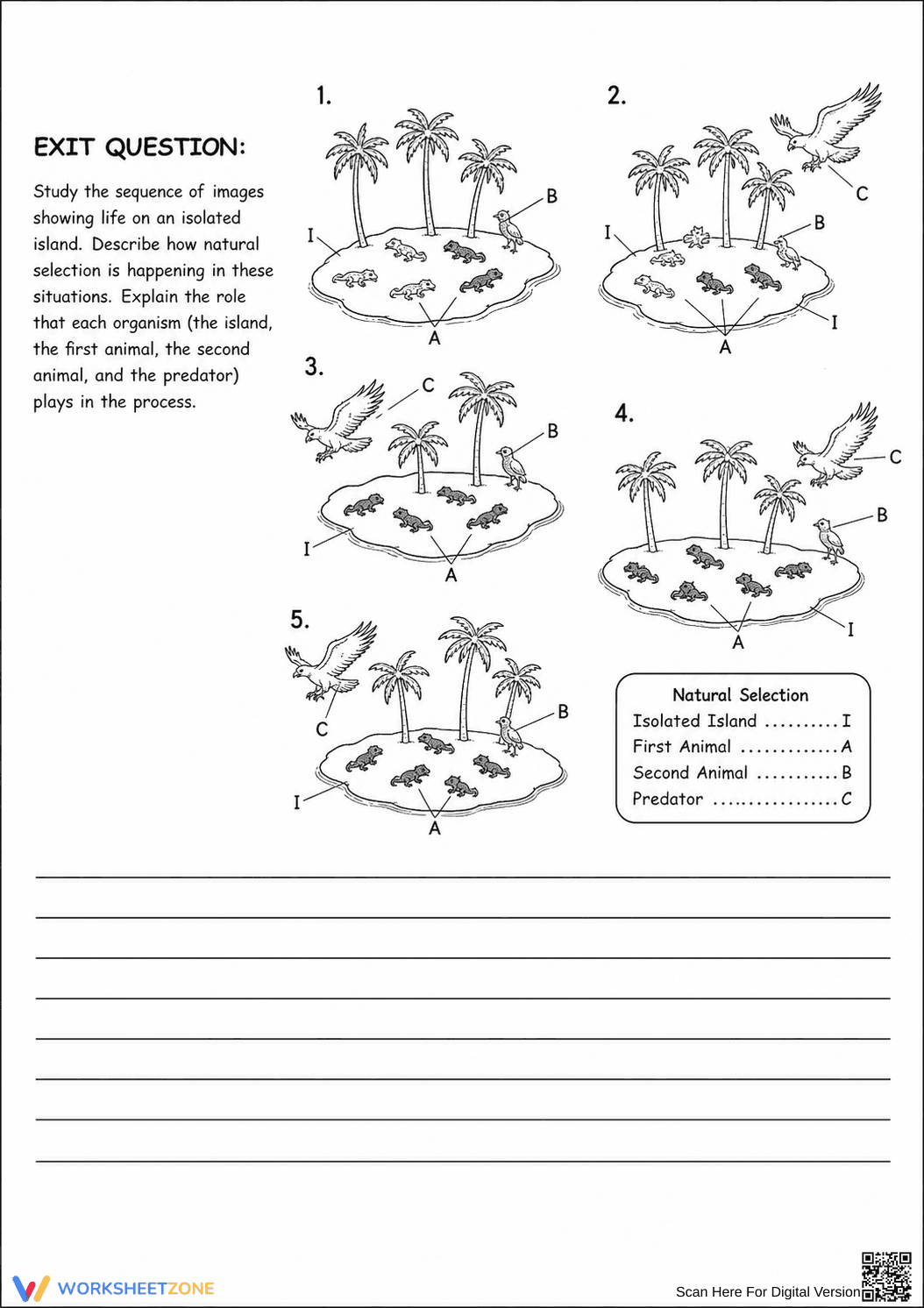
The worksheet is organized into three distinct phases of learning. It begins with a foundational recall of Darwin’s four postulates, moves into specific case studies involving the Elephants of Uganda and British Peppered Moths, and concludes with a rigorous data analysis of rock pocket mouse populations. The final page features a visual Exit Question requiring students to synthesize their knowledge by describing a multi-stage island evolution scenario involving predators and isolated populations.
This resource is designed for a zero-prep classroom workflow. Teachers can print the three-page PDF in under 2 minutes, distribute it immediately to students, and facilitate a whole-class review of the data table in the final 10 minutes of the period. Because the prompts are self-explanatory and include visual aids, this worksheet serves as an excellent emergency sub plan or a structured independent practice packet for biology units.
This activity aligns directly with `HS-LS4-4`, which requires students to construct explanations based on evidence for how natural selection leads to the adaptation of populations. It also supports supporting standards by asking students to apply statistics and probability to support explanations that organisms with advantageous heritable traits increase in proportion. Both standard codes can be copied directly into lesson plans, IEP goals, or district curriculum mapping tools.
Use this worksheet as a mid-unit formative assessment after introducing the concept of survival of the fittest. During the activity, circulate and observe how students interpret the rock pocket mouse data table; if they struggle to identify the shift from light to dark mice, use it as a pivot point for a mini-lesson on environmental camouflage. Expect students to spend approximately 50 minutes for full completion of all three pages.
This resource is tailored for high school biology students but is accessible for advanced middle school life science learners. It is particularly effective for students who benefit from visual data representation and scaffolded writing prompts. Pair this with a short video clip of the rock pocket mouse in the Sonoran Desert to provide additional sensory context for the data analysis section before students begin the independent work.
According to Fisher & Frey (2014), the use of scaffolded evidence-based writing in science helps students transition from simple recall to complex synthesis. This worksheet implements that research by requiring students to move from defining Darwin's four parts to analyzing specific population shifts in the peppered moth and rock pocket mouse. By grounding the abstract theory of natural selection in observable data, the resource ensures that students meet the rigorous demands of the HS-LS4-4 standard. The inclusion of a visual exit ticket further reinforces the conceptual model of adaptation, providing teachers with a clear artifact of student mastery. Research from the NAEP suggests that students who engage with multiple representations of data, such as the tables and island sequences provided here, demonstrate higher retention of evolutionary concepts compared to those using text-only resources.


