


























Views
Plays
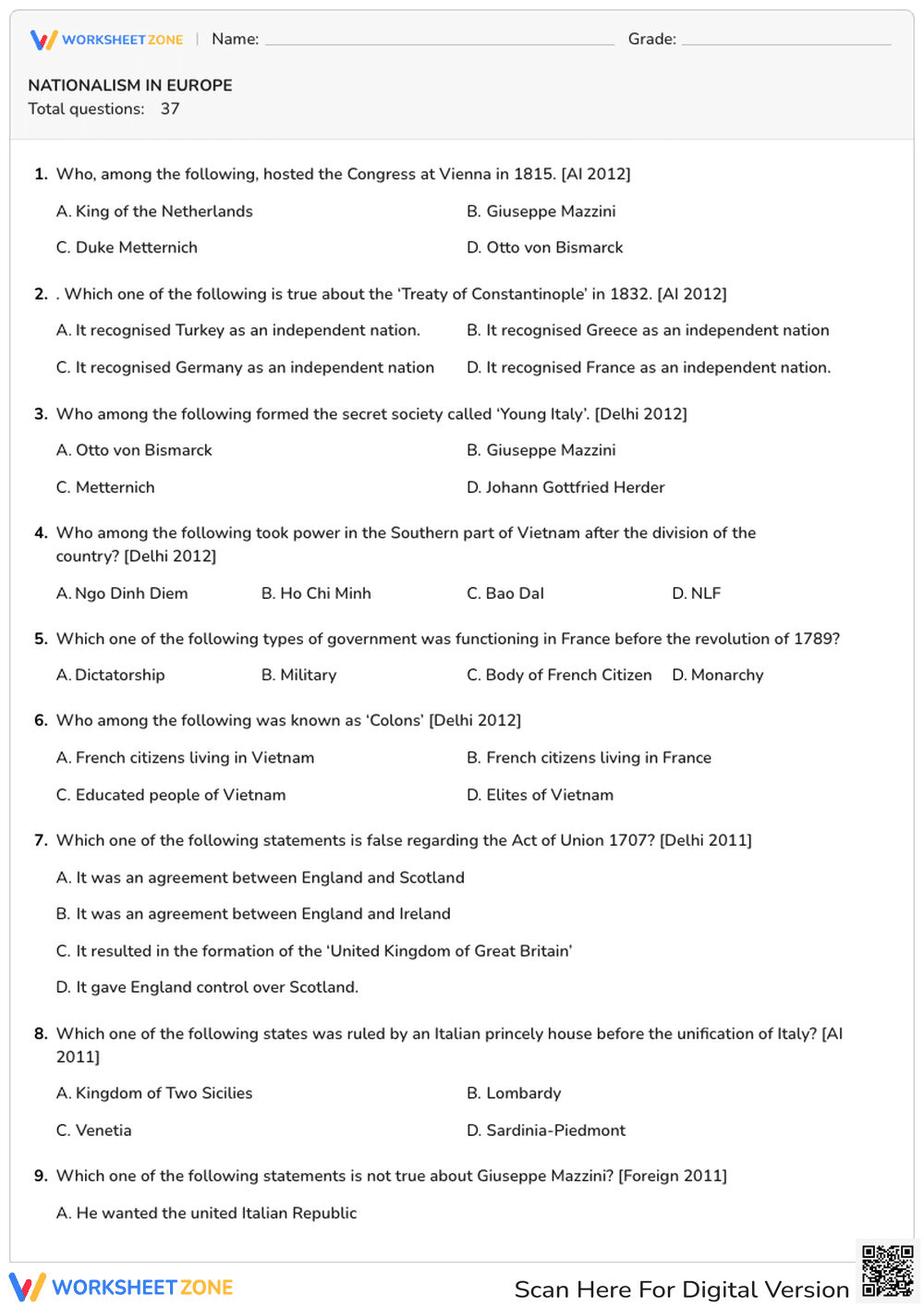

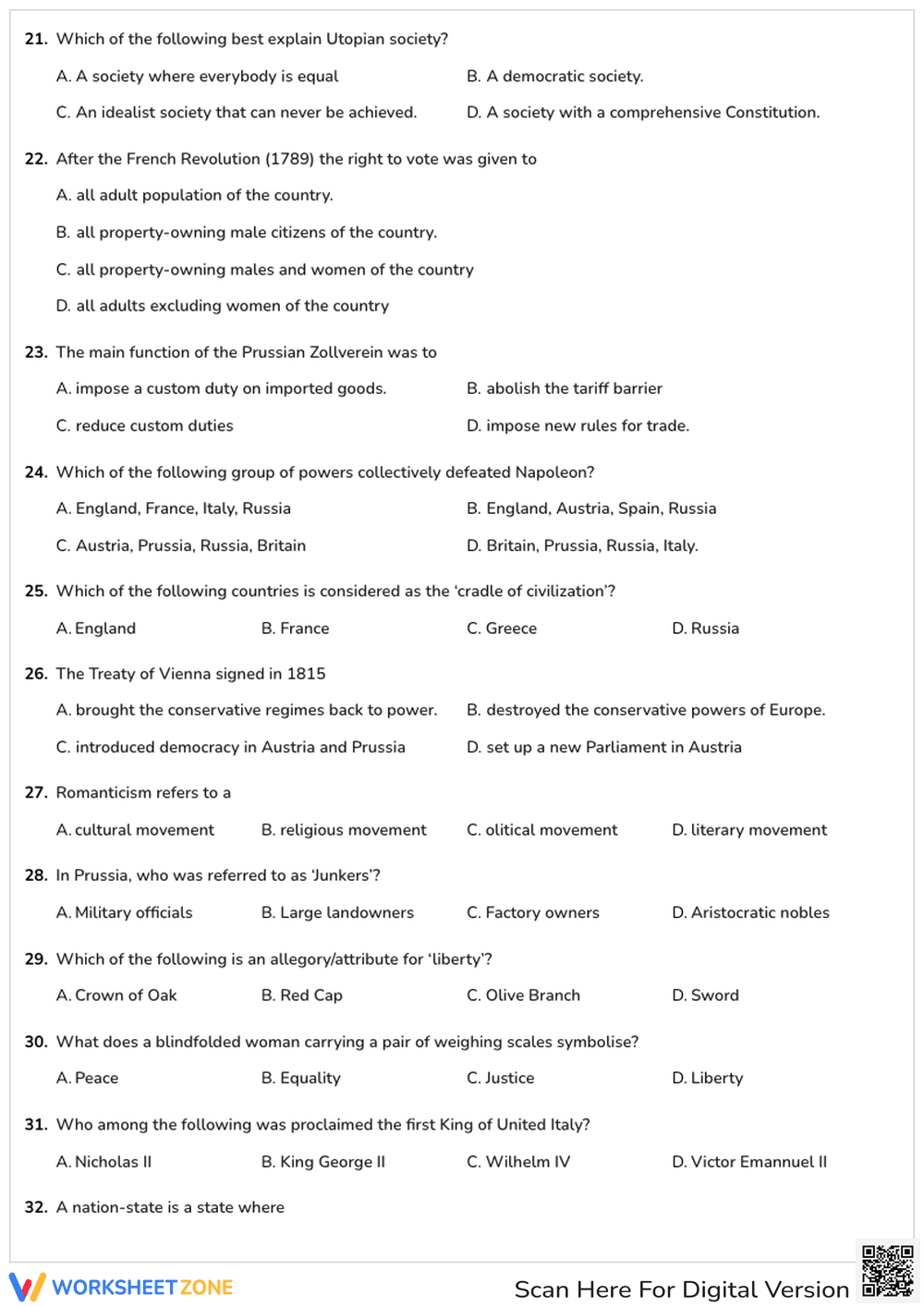
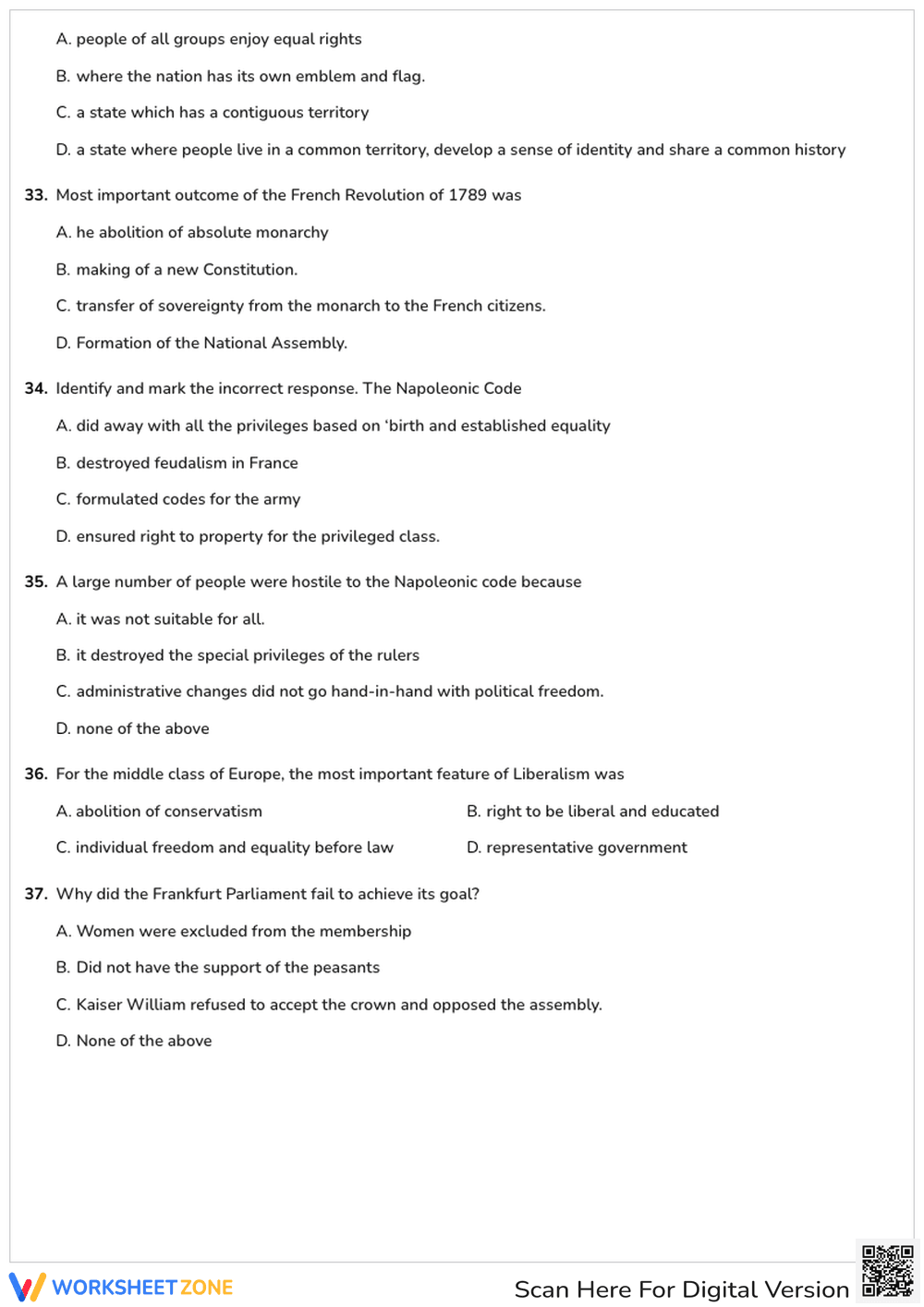

Nationalism in Europe Quiz | Essential Grade 10 History
Paste this activity's link or code into your existing LMS (Google Classroom, Canvas, Teams, Schoology, Moodle, etc.).
Students can open and work on the activity right away, with no student login required.
You'll still be able to track student progress and results from your teacher account.
This Grade 10 history assessment provides a comprehensive evaluation of student understanding regarding the rise of nationalism across the European continent. By focusing on pivotal events from the French Revolution to the unifications of Italy and Germany, students demonstrate their ability to connect complex political ideologies with specific historical outcomes and the formation of modern nation-states.
At a Glance
- Grade: 10 · Subject: Social Studies / ELA
- Standard:
CCSS.ELA-LITERACY.RI.9-10.3— Analyze how a complex sequence of historical events develops over time- Skill Focus: European Nationalism & Unification
- Format: 4 pages · 37 problems · Answer key included · PDF
- Best For: Unit assessment or comprehensive test prep
- Time: 40–50 minutes
What's Inside: This resource contains 37 high-quality multiple-choice questions distributed across four clearly organized pages. The content spans the Congress of Vienna, the Treaty of Constantinople, the Napoleonic Code, and the influence of figures like Giuseppe Mazzini and Otto von Bismarck. Each question is designed to test both factual recall and the ability to identify causal relationships between revolutionary movements and the formation of modern nation-states, including a full answer key for rapid grading.
Teachers can integrate this assessment into their curriculum with less than 2 minutes of preparation. Simply print the four-page PDF and distribute it to the class for a 45-minute testing block. Because the questions are formatted for quick grading, reviewing the results as a whole-class activity allows for immediate feedback on common misconceptions regarding 19th-century European politics. This makes it an ideal resource for unexpected substitute plans or end-of-unit reviews where time is of the essence.
The primary standard addressed is CCSS.ELA-LITERACY.RI.9-10.3, which requires students to analyze how a complex set of ideas or sequence of events is managed and developed within a text. By evaluating the Act of Union or the failure of the Frankfurt Parliament, students engage with the structural development of political entities. Both standard codes can be copied directly into lesson plans, IEP goals, or district curriculum mapping tools.
Use this worksheet as a summative assessment following a unit on the Age of Revolutions. Alternatively, assign it as a collaborative review activity where pairs of students must justify their answers using their primary source notes. For formative assessment, observe which questions regarding the Frankfurt Parliament or Liberalism cause the most hesitation to identify areas needing re-teaching before a final exam. Completion typically takes between 40 and 50 minutes.
This resource is tailored for Grade 10 World History students, including those in honors or AP European History tracks. It provides necessary scaffolding for students who benefit from structured multiple-choice formats while maintaining the rigor required for high school social studies. It pairs naturally with a primary source analysis of the Declaration of the Rights of Man or a direct instruction lesson on the Industrial Revolution's impact on political thought.
Research by Fisher & Frey (2014) emphasizes that structured assessments focusing on the gradual release of responsibility help students transition from guided instruction to independent mastery of complex historical narratives. This worksheet supports that transition by providing 37 targeted questions that require students to synthesize information about the rise of nationalism in Europe. By aligning with CCSS.ELA-LITERACY.RI.9-10.3, the resource ensures that students are not merely memorizing dates but are instead analyzing the interactions between individuals, ideas, and events. Such rigorous practice is essential for developing the disciplinary literacy required for college and career readiness in the social sciences. The inclusion of specific historical markers like the Napoleonic Code and the Congress of Vienna provides the concrete evidence needed for students to build a coherent mental model of 19th-century geopolitical shifts.


