


























Views
Downloads

Name Tracing Practice Worksheet | Essential Grade K-1
Paste this activity's link or code into your existing LMS (Google Classroom, Canvas, Teams, Schoology, Moodle, etc.).
Students can open and work on the activity right away, with no student login required.
You'll still be able to track student progress and results from your teacher account.
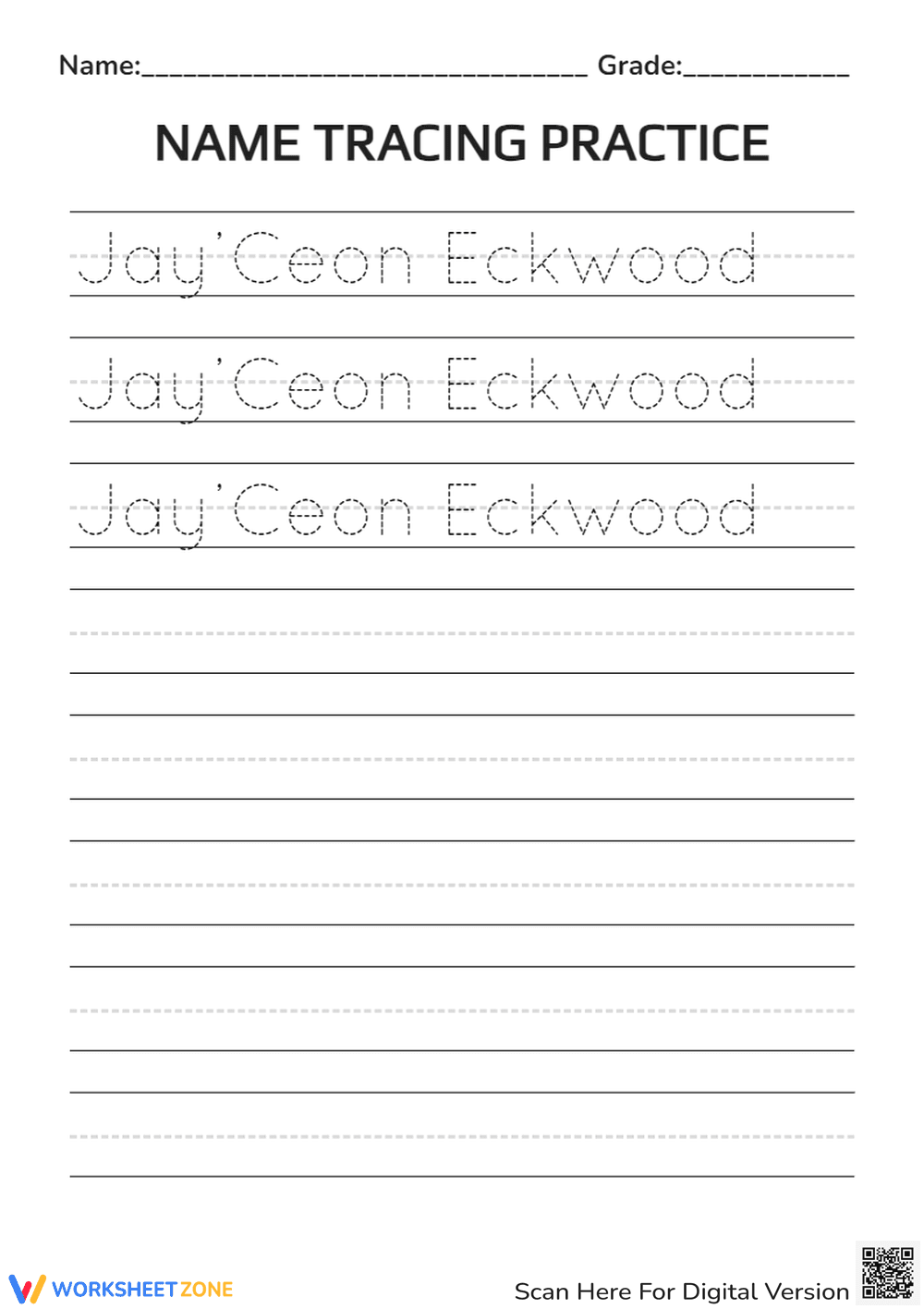
This Kindergarten and Grade 1 handwriting worksheet provides a structured environment for students to master the specific letter formations in the name Jay’Ceon Eckwood. By combining guided tracing with independent writing lines, students develop the muscle memory and fine motor control necessary for legible penmanship and personal identification skills in early literacy.
At a Glance
- Grade: K-1 · Subject: Handwriting
- Standard:
CCSS.ELA-LITERACY.L.K.1.A— Print many upper- and lowercase letters accurately- Skill Focus: Name recognition and letter formation
- Format: 1 page · 10 rows · No answer key needed · PDF
- Best For: Morning work or daily sign-in practice
- Time: 5–10 minutes
This single-page PDF features three rows of the name Jay’Ceon Eckwood in a large, dashed font specifically designed for tracing. Below the guided section, seven additional sets of primary ruled lines provide ample space for students to transition from supported tracing to independent writing. The layout includes a header for the student's name and grade to encourage organizational habits.
This resource is designed for immediate classroom implementation. First, print the required number of copies (30 seconds). Second, distribute the sheets during morning arrival or center rotations (1 minute). Third, provide a quick visual review of the student's grip and letter strokes as they work (1 minute). Total teacher preparation time is under two minutes, making it an ideal choice for busy mornings or unexpected sub plans.
The primary focus is `CCSS.ELA-LITERACY.L.K.1.A`, which requires students to print many upper- and lowercase letters. This worksheet specifically targets the unique combination of letters found in this name, including the use of capital letters and punctuation like apostrophes. This standard code can be copied directly into lesson plans, IEP goals, or district curriculum mapping tools.
Use this worksheet as a "Morning Work" activity to settle students as they enter the classroom. It serves as an excellent formative assessment tool; observe the student's pencil grip and the directionality of their strokes during the first three rows. Completion typically takes between five and ten minutes depending on the student's fine motor development and familiarity with the letters.
This resource is ideal for Kindergarten and Grade 1 students who are learning to write their names. It is particularly helpful for students requiring Tier 2 fine motor intervention or those who benefit from repetitive, high-success tasks. Pair this with an alphabet anchor chart to help students reference individual letter shapes as they move toward the independent writing section.
According to the RAND AIRS 2024 report on early childhood literacy, repetitive tracing exercises are fundamental in developing the graphomotor skills required for later writing fluency. This worksheet aligns with CCSS.ELA-LITERACY.L.K.1.A by providing a scaffolded approach to letter formation, moving from dashed-line tracing to independent production. Research by Fisher & Frey (2014) emphasizes the importance of the gradual release of responsibility model, which is mirrored here as students transition from guided tracing to free-hand writing on primary lines. By focusing on a high-frequency personal word—the student's own name—the activity increases engagement and reinforces self-identification. This 1-page resource provides 10 distinct opportunities for practice, ensuring that students receive the necessary repetition to internalize complex letter shapes and spacing. Such targeted practice is a cornerstone of effective early elementary handwriting instruction and supports broader literacy development goals.


