


























Views
Downloads

Name Tracing Practice: Mateo Castro | Printable Worksheet
Paste this activity's link or code into your existing LMS (Google Classroom, Canvas, Teams, Schoology, Moodle, etc.).
Students can open and work on the activity right away, with no student login required.
You'll still be able to track student progress and results from your teacher account.
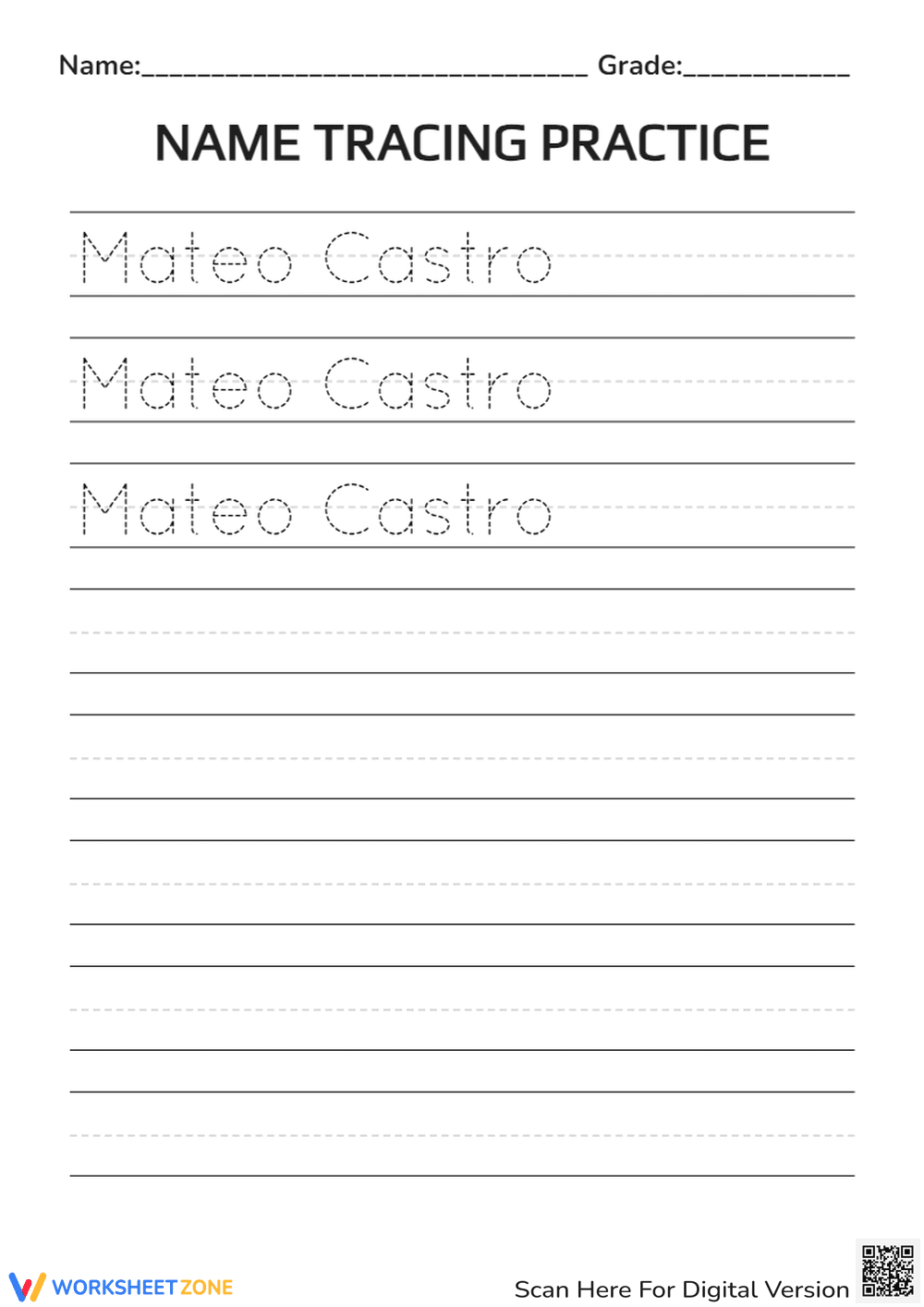
This Mateo Castro name tracing worksheet provides a structured path for early learners to master their own name through repetitive, guided practice. By focusing on the specific letter shapes in "Mateo Castro," students develop the muscle memory and fine motor control necessary for legible handwriting. This resource ensures immediate success for Kindergarten and First Grade students.
At a Glance
- Grade: Kindergarten · Subject: Handwriting
- Standard:
CCSS.ELA-LITERACY.L.K.1.A— Print many upper- and lowercase letters accurately- Skill Focus: Name recognition and letter formation
- Format: 1 page · 11 practice lines · No answer key needed · PDF
- Best For: Morning work or daily handwriting practice
- Time: 5–10 minutes
This single-page PDF features the name "Mateo Castro" printed in a clear, dashed font across the first three primary lines. These lines include a dashed midline to help students understand letter height and placement. Following the guided portion, the worksheet provides eight additional sets of empty primary lines, allowing students to transition from tracing to independent writing. The clean layout minimizes distractions for young learners.
This resource is designed for maximum efficiency. First, print the required copies for your student named Mateo (30 seconds). Second, distribute the worksheet during your morning entry routine or literacy block (30 seconds). Third, provide a quick check of the student's pencil grip and letter stroke direction as they work (1 minute). The total teacher preparation time is under two minutes, making it an excellent choice for daily routines or sub plans.
The primary focus of this worksheet is `CCSS.ELA-LITERACY.L.K.1.A`, which requires students to print many upper- and lowercase letters. By practicing a specific name, students engage with both cases in a meaningful context. This practice also supports foundational literacy by reinforcing the understanding that spoken names are represented by specific letter sequences. Both standard codes can be copied directly into lesson plans, IEP goals, or district curriculum mapping tools.
Use this worksheet as a "bell-ringer" activity to settle students as they arrive. It serves as a calm, focused start to the day that reinforces personal identity. Alternatively, place it in a writing center inside a plastic sleeve for repeated use with a fine-tip marker. During the activity, observe if the student starts letters from the top down; this formative observation helps identify students who may need intervention with stroke order. Completion typically takes 5 to 10 minutes.
This worksheet is specifically tailored for students named Mateo Castro in Kindergarten or First Grade. It is particularly helpful for learners who are struggling with the specific curves of the letters 'a', 'e', or 'o', or the vertical precision required for 'M' and 't'. It pairs naturally with an alphabet anchor chart or a personalized name tag on the student's desk to provide a constant visual reference.
Handwriting instruction remains a foundational pillar of early literacy development. According to Fisher & Frey (2014), the gradual release of responsibility model is highly effective when teaching letter formation and name recognition. This worksheet utilizes that model by providing three lines of dashed-line scaffolding for the name Mateo Castro before transitioning students to independent practice on primary lines. Research from the NAEP indicates that students who master fluid handwriting early in their academic careers are better positioned to focus cognitive resources on higher-level composition and spelling tasks. By targeting the specific standard CCSS.ELA-LITERACY.L.K.1.A, this resource ensures that students are practicing the precise motor patterns required for printing upper- and lowercase letters. Consistent use of personalized tracing materials has been shown to increase student engagement and ownership over the writing process, providing a necessary bridge between fine motor development and functional literacy.


