




























Views
Downloads

Name Tracing Practice: Malani Richardson | Essential Grade K

Paste this activity's link or code into your existing LMS (Google Classroom, Canvas, Teams, Schoology, Moodle, etc.).
Students can open and work on the activity right away, with no student login required.
You'll still be able to track student progress and results from your teacher account.
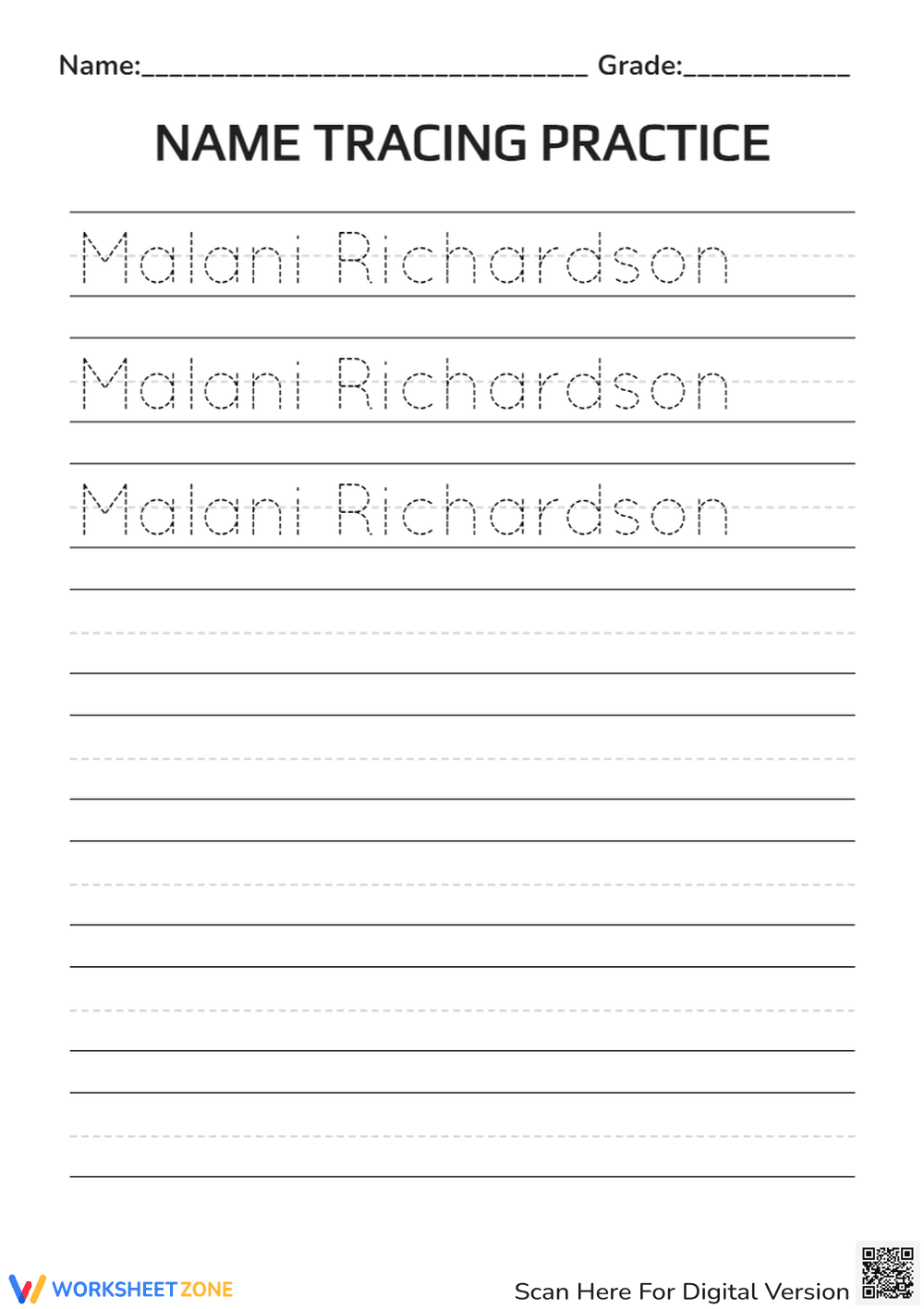
This Grade K handwriting worksheet provides Malani Richardson with targeted practice to master the specific letter formations in their name. By combining guided tracing with independent writing lines, students develop the muscle memory and fine motor control necessary for legible penmanship. This resource ensures early learners gain confidence in identifying and writing their unique identifier.
At a Glance
- Grade: Kindergarten · Subject: Handwriting
- Standard:
CCSS.ELA-LITERACY.L.K.1.A— Print many upper- and lowercase letters accurately and legibly- Skill Focus: Name recognition and letter formation
- Format: 1 page · 10 practice lines · No answer key needed · PDF
- Best For: Morning work or daily sign-in practice
- Time: 5–10 minutes
What's Inside
This single-page PDF features the name "Malani Richardson" formatted specifically for early elementary learners. The top of the page includes three rows of large, dashed-line text for guided tracing, followed by seven empty primary-ruled lines with a dotted midline. This structure supports the transition from scaffolded tracing to independent production, all within a clean, distraction-free layout that prevents cognitive overload during fine motor tasks.
Zero-Prep Workflow
- Print: Select the customized sheet for the student and print in seconds.
- Distribute: Hand out the page during morning arrival, center rotations, or as a quiet transition activity.
- Review: Provide a quick visual check of pencil grip and stroke order as the student completes the 10 lines of practice. Total teacher prep time is under 2 minutes, making it an ideal solution for substitute folders.
Standards Alignment
The primary focus is `CCSS.ELA-LITERACY.L.K.1.A`, which requires students to print many upper- and lowercase letters. By practicing a specific name, students engage with a high-frequency, high-relevance set of characters. This activity also supports CCSS.ELA-LITERACY.RF.K.1.B by reinforcing that spoken words are represented in written language by specific sequences of letters. Both standard codes can be copied directly into lesson plans, IEP goals, or district curriculum mapping tools.
How to Use It
Use this worksheet as a "Daily Sign-In" task during the first ten minutes of the school day to establish a consistent handwriting routine. Alternatively, laminate the page for use in a writing center with dry-erase markers for repeated practice. Teachers should observe the student's "M" and "R" formation specifically to ensure they are starting from the top-down, providing a quick formative assessment of motor planning and spatial awareness.
Who It's For
This resource is designed for Kindergarten and Grade 1 students who are learning to write their full names. It is particularly helpful for students requiring Tier 2 fine motor intervention or those who benefit from repetitive, predictable tasks. Pair this worksheet with a name-recognition anchor chart or a tactile "salt tray" writing activity for a multi-sensory approach to early literacy instruction.
Handwriting remains a foundational pillar of early literacy development, as letter-writing automaticity is a significant predictor of later composing quality. According to research by Fisher & Frey (2014), the gradual release of responsibility—moving from the guided tracing provided here to independent line work—is essential for internalizing complex motor tasks. This worksheet addresses CCSS.ELA-LITERACY.L.K.1.A by focusing on the specific orthographic patterns found in the name Malani Richardson. By providing 10 distinct opportunities for practice, the resource aligns with evidence-based practices that emphasize frequency and repetition in motor skill acquisition. Such targeted practice helps bridge the gap between letter recognition and fluid production, ensuring that students can eventually focus their cognitive resources on higher-level composition rather than the mechanics of letter formation. This structured approach is a staple of effective early childhood ELA instruction that builds student agency through mastery of their own name.


