


























Views
Downloads
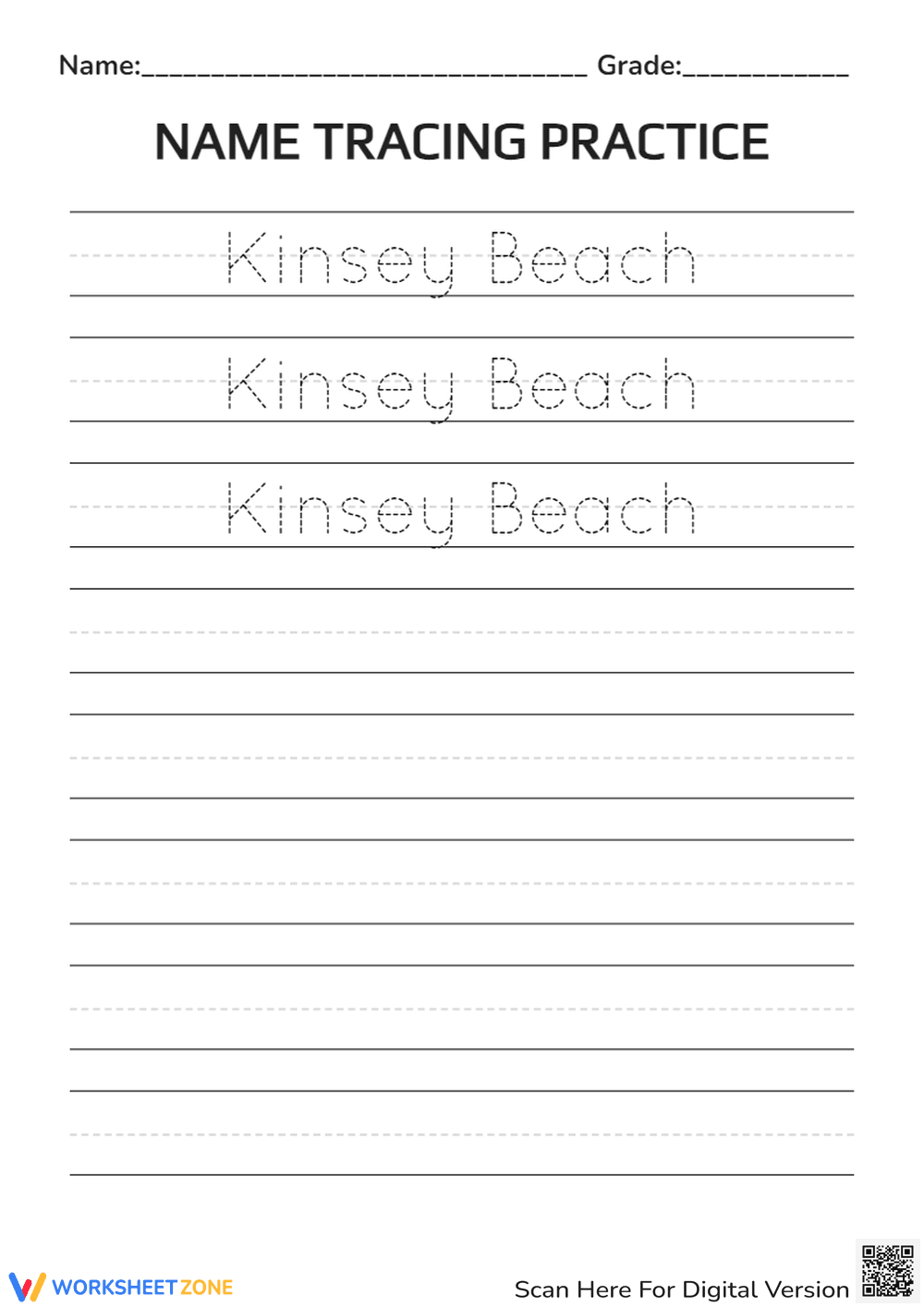

Kinsey Beach Name Tracing — Printable Grade K-1 Ready
Paste this activity's link or code into your existing LMS (Google Classroom, Canvas, Teams, Schoology, Moodle, etc.).
Students can open and work on the activity right away, with no student login required.
You'll still be able to track student progress and results from your teacher account.
This Kindergarten and Grade 1 name tracing worksheet helps students master the specific letter formations for "Kinsey Beach" while developing essential fine motor control. By combining guided tracing with independent writing space, learners transition from supported imitation to confident, autonomous handwriting. It provides a structured environment for early literacy success.
At a Glance
- Grade: K-1 · Subject: Handwriting
- Standard:
CCSS.ELA-LITERACY.L.K.1.A— Print many upper- and lowercase letters accurately- Skill Focus: Name Tracing and Letter Formation
- Format: 1 page · 12 lines · No answer key needed · PDF
- Best For: Morning work or daily name practice
- Time: 5–10 minutes
The worksheet features a clean, distraction-free layout optimized for young learners. It includes 3 lines of dashed-line tracing for the name "Kinsey Beach," followed by 9 additional primary-ruled lines for independent practice. The large font size and clear baseline/midline guides ensure students have ample space to refine their grip and stroke precision.
The zero-prep workflow is designed for busy educators. First, print the single-page PDF in under 30 seconds. Second, distribute the sheets to students during morning arrival or center rotations. Third, review student progress by checking for proper letter height and alignment on the independent lines. This resource is a perfect sub-plan addition for early elementary classrooms.
This resource aligns with `CCSS.ELA-LITERACY.L.K.1.A`, which requires students to print many upper- and lowercase letters. It specifically targets the unique combination of letters in the name "Kinsey Beach," reinforcing both capital and lowercase conventions. Both standard codes can be copied directly into lesson plans, IEP goals, or district curriculum mapping tools.
Use this worksheet as a formative assessment tool during the first week of school to gauge baseline fine motor skills. Alternatively, laminate the page for use in a writing center with dry-erase markers for repeated daily practice. Observe how the student handles the transition from the 3 guided lines to the 9 independent lines to identify specific letter-formation struggles.
This practice sheet is ideal for Kindergarten and Grade 1 students, particularly those needing extra support with name recognition or pencil pressure. It pairs naturally with a "Letter of the Week" anchor chart or direct instruction on proper pencil grip. It is also suitable for occupational therapy sessions focusing on spatial awareness and letter sizing.
Handwriting remains a foundational pillar of early literacy, as research from Fisher & Frey (2014) emphasizes the link between manual letter production and long-term reading fluency. This worksheet addresses CCSS.ELA-LITERACY.L.K.1.A by providing 12 distinct opportunities for students to practice the specific strokes required for their name. By moving from high-scaffold tracing to independent production, the resource supports the gradual release of responsibility model. Consistent practice with structured primary lines helps internalize the spatial relationships between letters, which is critical for legible writing. According to recent NAEP data, early mastery of handwriting allows cognitive resources to be redirected toward higher-level composition tasks later in elementary school. This printable resource ensures that students like Kinsey Beach build the muscle memory and confidence necessary for academic writing proficiency.


