




























Views
Downloads
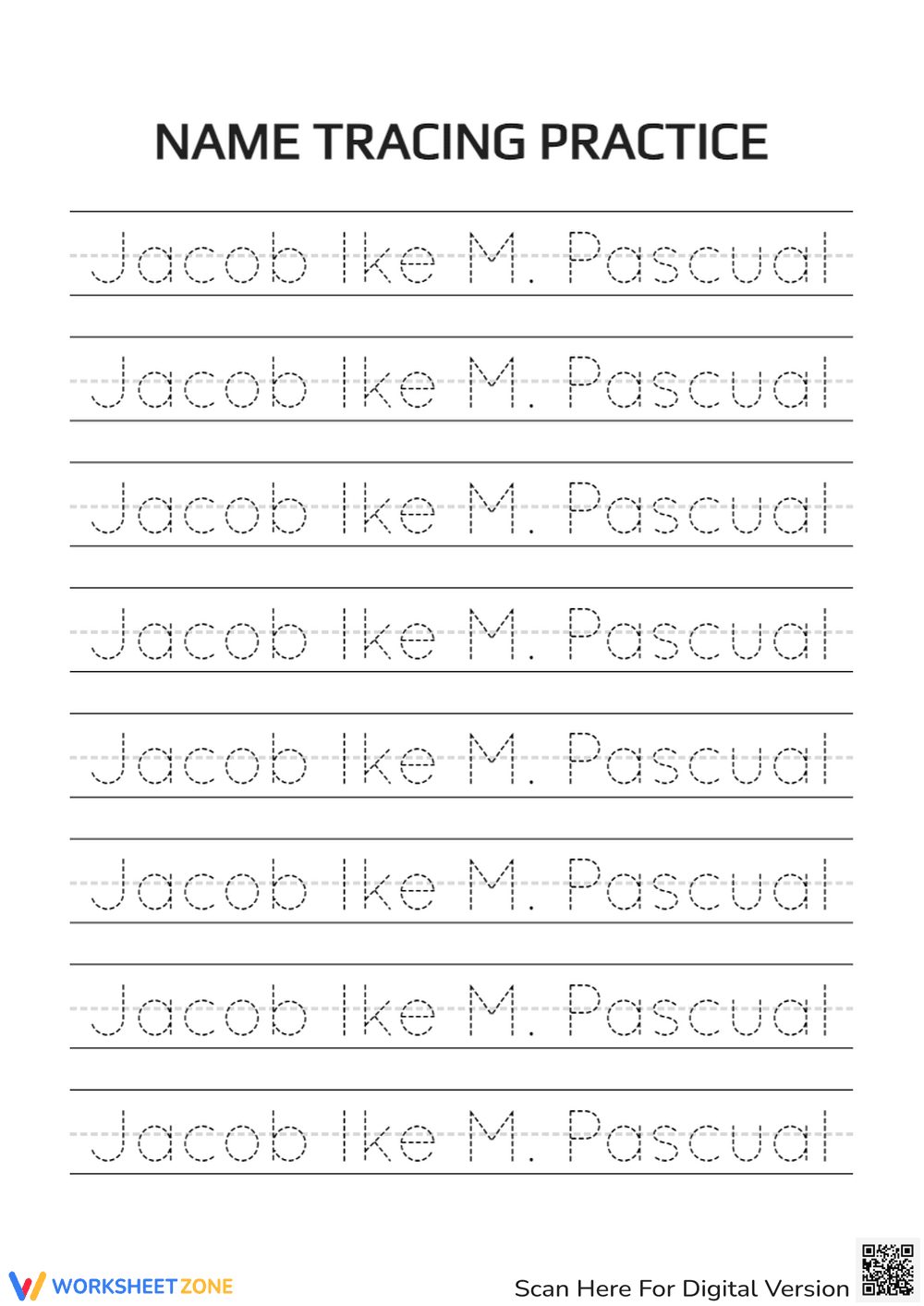


Printable Name Tracing Practice: Jacob Ike M. Pascual

Paste this activity's link or code into your existing LMS (Google Classroom, Canvas, Teams, Schoology, Moodle, etc.).
Students can open and work on the activity right away, with no student login required.
You'll still be able to track student progress and results from your teacher account.
This personalized Kindergarten handwriting worksheet helps students build fine motor skills and letter formation accuracy by tracing the name Jacob Ike M. Pascual. By practicing proper stroke order on primary dashed lines, early learners develop the muscle memory required for confident, legible printing in their daily writing tasks.
At a Glance
- Grade: Kindergarten · Subject: Handwriting
- Standard:
CCSS.ELA-LITERACY.L.K.1.A— Print many upper- and lowercase letters- Skill Focus: Name Tracing
- Format: 2 pages · 10 problems · No answer key · PDF
- Best For: Morning work and handwriting practice
- Time: 10–15 minutes
This two-page resource features 10 structured tracing lines specifically formatted for the name Jacob Ike M. Pascual. The first page provides eight full lines of guided dotted-line practice to establish foundational stroke habits. The second page offers two additional tracing lines followed by a blank primary writing space, encouraging students to transition from tracing to independent freeform writing.
Zero-Prep Workflow
This ready-to-use handwriting sheet requires under two minutes of teacher preparation:
- Print (1 minute): Generate the two-page PDF and print double-sided to save paper.
- Distribute (1 minute): Hand out to the specific student during morning arrival or literacy centers.
- Review (Ongoing): Monitor pencil grip and stroke direction as the student works independently.
Because the instructions are self-explanatory and the layout is highly structured, this worksheet is an excellent addition to emergency sub plans or independent workstation folders.
Standards Alignment
This worksheet aligns with CCSS.ELA-LITERACY.L.K.1.A, requiring students to print many upper- and lowercase letters. By repeatedly tracing a specific sequence of capital and lowercase letters, students internalize proper proportions and spacing on primary lines. Both standard codes can be copied directly into lesson plans, IEP goals, or district curriculum mapping tools.
How to Use It
Deploy this worksheet during morning work routines to give the student immediate, focused practice upon entering the classroom. It also serves well as a targeted intervention activity during small-group literacy centers. While the student traces, observe their pencil grip and starting points for each letter to ensure they are forming letters top-to-bottom rather than bottom-to-top. Expect this activity to take between 10 and 15 minutes to complete carefully.
Who It's For
This resource is designed for Kindergarten and first-grade students who need targeted practice writing their specific name. It is particularly beneficial for early learners refining their fine motor control or occupational therapy students working on visual-motor integration. Pair this worksheet with a personalized desktop nameplate or a tactile alphabet tracing board to reinforce letter recognition and formation across multiple modalities.
Developing automaticity in handwriting is a critical foundational skill for early literacy and overall academic success. According to Fisher & Frey (2014), explicit instruction and repeated guided practice in letter formation significantly reduce the cognitive load required for transcription, allowing young writers to focus entirely on content generation in later grades. This worksheet directly supports that essential developmental milestone by targeting CCSS.ELA-LITERACY.L.K.1.A, helping students print many upper- and lowercase letters accurately and confidently. By focusing on the highly relevant and personally motivating task of name tracing, early learners engage more deeply with the mechanical aspects of writing. Consistent, daily practice with structured primary dashed lines ensures that students internalize correct spatial proportions, baseline adherence, and stroke sequences, paving the way for fluent, legible handwriting as they progress through primary grades.


