


























Views
Downloads
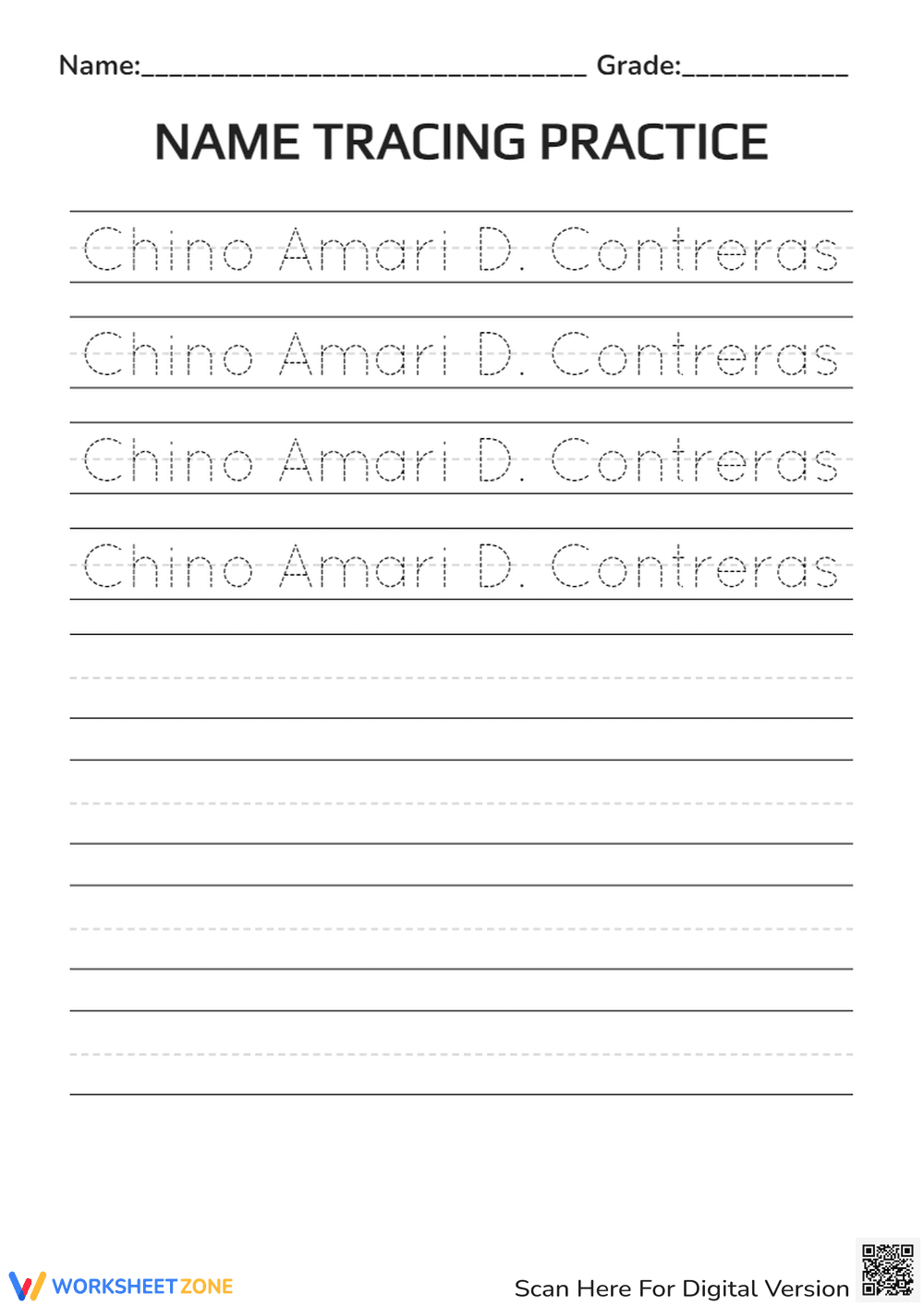

Name Tracing Practice Worksheet | Grade K-1 Essential
Paste this activity's link or code into your existing LMS (Google Classroom, Canvas, Teams, Schoology, Moodle, etc.).
Students can open and work on the activity right away, with no student login required.
You'll still be able to track student progress and results from your teacher account.
This Grade K-1 name tracing worksheet helps students master the specific spelling and letter formation of the name "Chino-Amari D. Contreras." By combining guided tracing with independent writing lines, students develop the muscle memory and fine motor control necessary for legible handwriting. It provides a structured path toward personal identification literacy.
At a Glance
- Grade: K-1 · Subject: Handwriting
- Standard:
CCSS.ELA-LITERACY.L.K.1.A— Print many upper- and lowercase letters correctly- Skill Focus: Name tracing and letter formation
- Format: 1 page · 10 tasks · No answer key · PDF
- Best For: Morning work or daily handwriting practice
- Time: 5–10 minutes
This single-page PDF features 4 rows of dotted-line tracing for the name "Chino-Amari D. Contreras," followed by 6 rows of primary-ruled blank lines for independent practice. The layout uses standard primary spacing with a dashed midline to help students maintain consistent letter height and alignment while practicing both uppercase and lowercase characters.
Teachers can integrate this resource into their daily routine in under 2 minutes. Simply print the required number of copies, distribute them during morning arrival or literacy centers, and allow students to work independently. The clear visual cues require no additional verbal instructions, making it an ideal choice for substitute folders or quick transition activities.
The primary focus is `CCSS.ELA-LITERACY.L.K.1.A`, which requires students to print many upper- and lowercase letters. By practicing a specific name, students also engage with `CCSS.ELA-LITERACY.RF.K.1.B`, recognizing that spoken words are represented in written language by specific sequences of letters. Both standard codes can be copied directly into lesson plans, IEP goals, or district curriculum mapping tools.
Use this worksheet during the first week of school as a formative assessment to gauge baseline fine motor skills and letter recognition. It is also effective as a quiet-time activity after recess. Expect students to spend 5 to 10 minutes completing the page; observe their pencil grip and stroke direction during the tracing phase to provide immediate corrective feedback.
This resource is designed for Kindergarten and First Grade students who are learning to write their full names. It is particularly helpful for students requiring Tier 2 handwriting intervention or those who benefit from repetitive, high-interest tasks. Pair this with an alphabet anchor chart to help students reference letter shapes while writing independently.
Handwriting proficiency in early childhood is a critical predictor of later academic success, as noted by Fisher & Frey (2014). This worksheet aligns with the gradual release of responsibility model by moving from highly scaffolded tracing to independent production. By focusing on the specific name "Chino-Amari D. Contreras," the resource addresses CCSS.ELA-LITERACY.L.K.1.A through meaningful, personalized practice. Research from the NAEP suggests that early mastery of letter formation reduces the cognitive load during the writing process, allowing students to focus more on content and composition in later grades. This 10-task practice sheet provides the necessary repetition to build automaticity in letter production. The inclusion of primary-ruled lines ensures that students develop an understanding of spatial awareness and letter sizing, which are foundational components of legible script.


