


























Views
Downloads
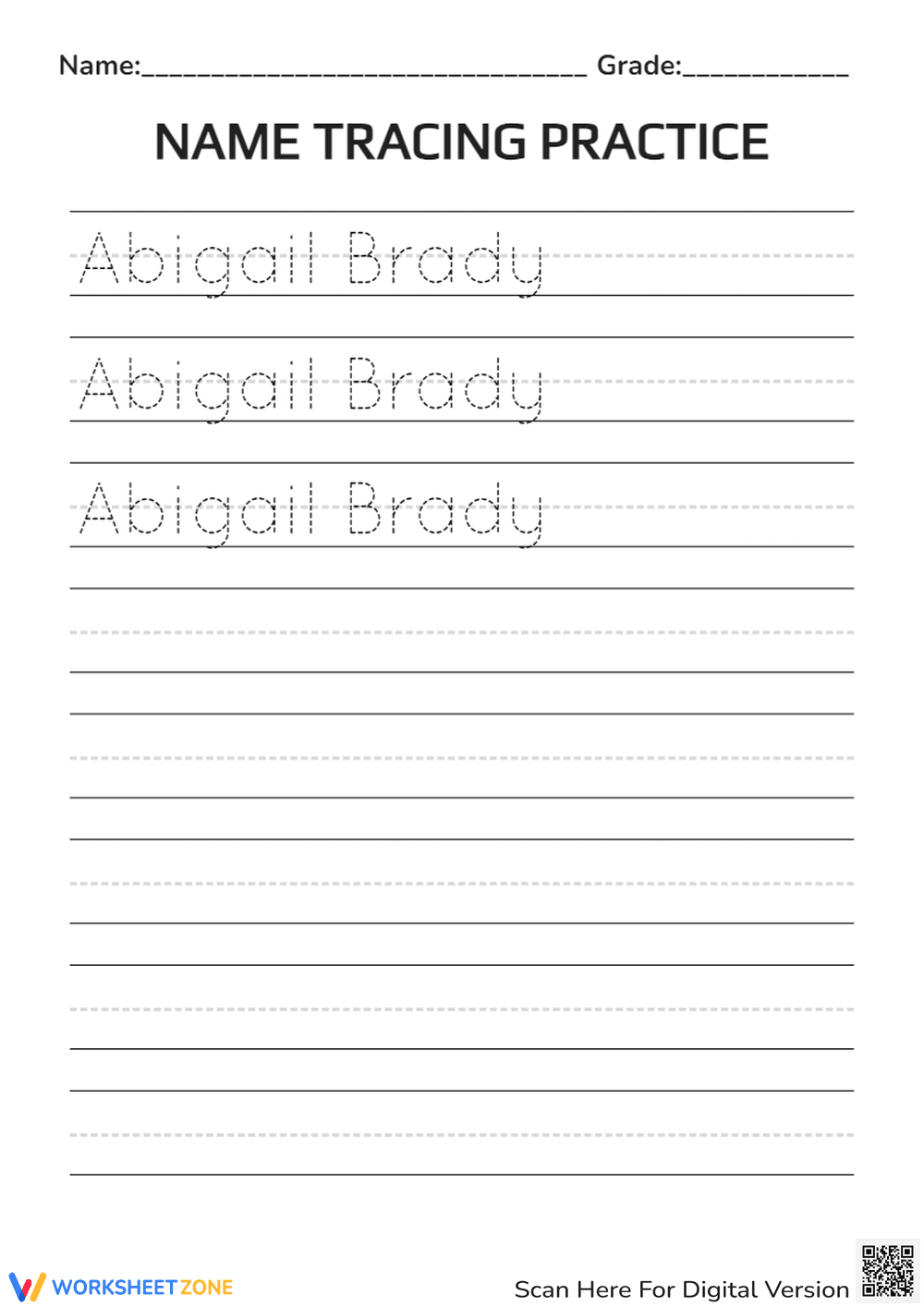

Abigail Brady Name Tracing | Essential Grade K-1 Practice
Paste this activity's link or code into your existing LMS (Google Classroom, Canvas, Teams, Schoology, Moodle, etc.).
Students can open and work on the activity right away, with no student login required.
You'll still be able to track student progress and results from your teacher account.
This Grade K-1 handwriting worksheet provides a structured path for students to master writing the name "Abigail Brady." By combining guided tracing with independent practice, students develop the fine motor control and letter-recognition skills necessary for early literacy success. This resource ensures a clear, legible result through repetitive, focused engagement.
At a Glance
- Grade: Kindergarten · Subject: Handwriting
- Standard:
CCSS.ELA-LITERACY.L.K.1.A— Print many upper- and lowercase letters accurately on primary lines- Skill Focus: Name recognition and letter formation
- Format: 1 page · 10 lines · Answer key N/A · PDF
- Best For: Morning work or name recognition practice
- Time: 5–10 minutes
Inside this single-page PDF, you will find 10 total lines of practice. The first three lines feature the name "Abigail Brady" in a clear, dashed tracing font to guide initial letter formation and proper spacing. The remaining seven lines are standard primary ruled lines, allowing students to transition from supported tracing to independent writing of their first and last names.
The zero-prep workflow for this resource is designed for busy classrooms. First, print the required number of copies in under 30 seconds. Second, distribute the sheets to students as they arrive for morning work, taking less than a minute. Finally, review the letter formation and line placement during a quick 1-minute walk-around. Total teacher preparation time is less than 2 minutes, making it an ideal sub-plan addition.
This resource is aligned with CCSS.ELA-LITERACY.L.K.1.A, which requires students to print many upper- and lowercase letters. By practicing a specific name, students apply this standard to a high-frequency, high-interest word that builds their identity as writers. Both standard codes can be copied directly into lesson plans, IEP goals, or district curriculum mapping tools.
Use this worksheet during the "You Do" phase of a handwriting lesson or as a consistent morning arrival activity. For formative assessment, observe the student's pencil grip and the directionality of their strokes on the "A" and "B" to ensure they are following top-down formation rules. Expected completion typically takes 5–10 minutes depending on the student's motor development.
This worksheet is ideal for Kindergarten and Grade 1 students who are beginning to recognize their written names. It serves as an excellent differentiation tool for students requiring extra fine motor support or those working on specific letter heights. Pair this with a name-recognition anchor chart or a tactile salt-tray tracing activity for a comprehensive literacy experience.
Research shows that name writing is one of the first and most significant literacy milestones for young children. According to Fisher & Frey (2014), the gradual release of responsibility—moving from guided tracing to independent production—is essential for motor memory. This worksheet utilizes that model by providing three lines of dashed-line support before transitioning to open primary lines. By focusing on the specific name "Abigail Brady," the resource leverages personal relevance to increase student engagement and persistence. This alignment with CCSS.ELA-LITERACY.L.K.1.A ensures that students are not just drawing shapes but are actively learning the conventional formation of upper- and lowercase letters. Such targeted practice is a foundational component of early childhood literacy programs, providing the repetition necessary for automaticity in handwriting, which later supports cognitive bandwidth for more complex composition tasks.


