


























Views
Downloads

Printable Name Tracing Practice | Grade K-1 Handwriting
Paste this activity's link or code into your existing LMS (Google Classroom, Canvas, Teams, Schoology, Moodle, etc.).
Students can open and work on the activity right away, with no student login required.
You'll still be able to track student progress and results from your teacher account.
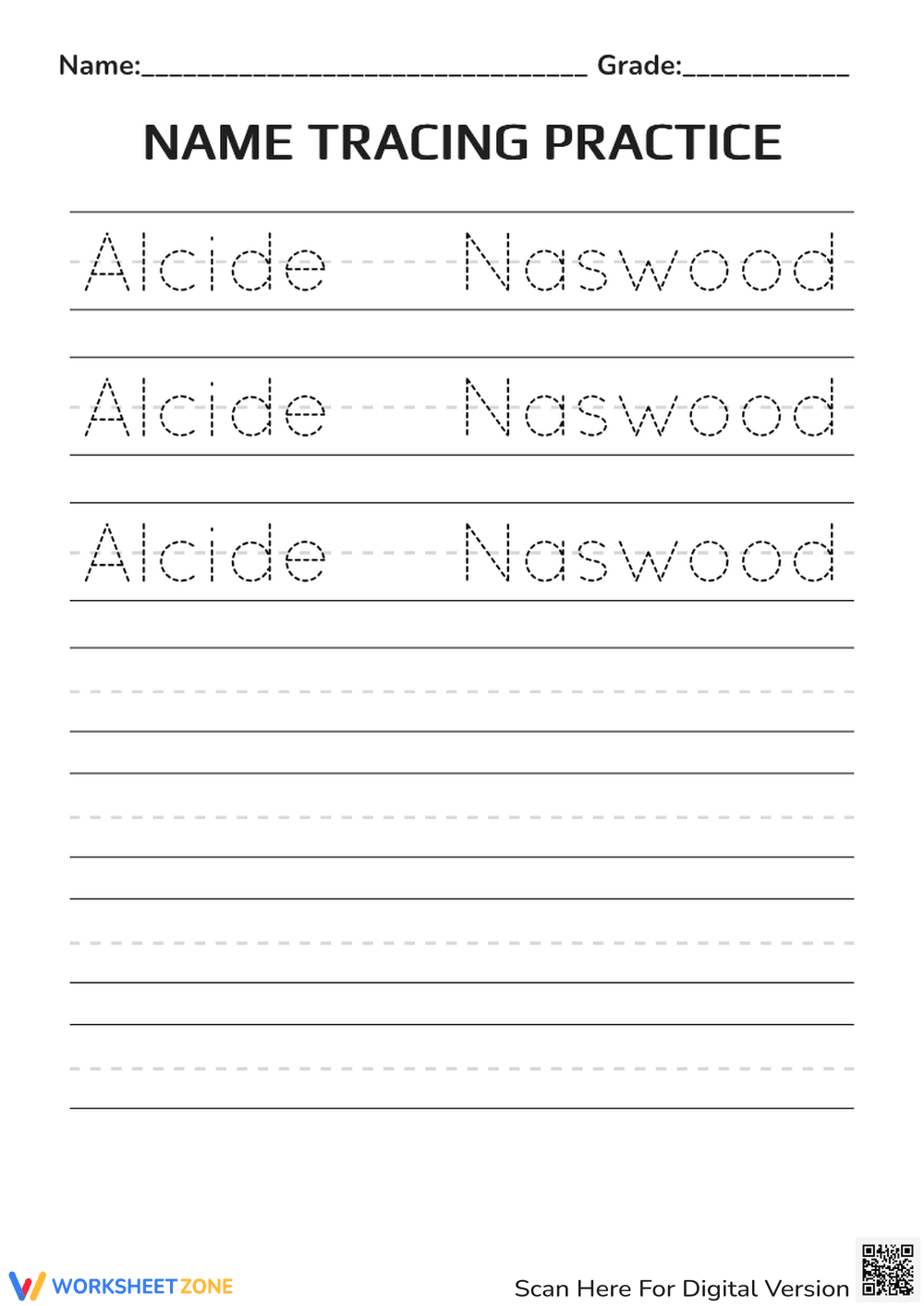
This Kindergarten and Grade 1 handwriting worksheet provides a structured environment for students to master the specific letter sequences in the name "Alcide Naswood." By combining guided tracing with independent writing lines, the resource ensures students transition from tactile support to autonomous production. It is an essential tool for building early literacy confidence and fine motor control.
At a Glance
- Grade: K-1 · Subject: Handwriting
- Standard:
CCSS.ELA-LITERACY.L.K.1.A— Print many upper- and lowercase letters accurately- Skill Focus: Name recognition and letter formation
- Format: 2 pages · 10 tasks · Answer key included · PDF
- Best For: Morning work and literacy centers
- Time: 10–15 minutes
The download includes 2 high-quality PDF pages designed for immediate classroom use. The first page features three rows of large, dashed-line tracing for the name "Alcide Naswood," followed by six empty primary lines with a dotted midline to guide letter height and placement. The second page provides additional blank primary ruling, allowing for extended practice or custom writing assignments.
This resource is designed for a zero-prep workflow that fits into any busy classroom schedule. Teachers can print the required number of copies in under 1 minute. Distribution takes seconds during morning arrival or transition periods. Reviewing student work is simplified by the clear primary ruling, allowing for a 30-second visual check of letter slant and baseline adherence. Total teacher preparation time is less than 2 minutes, making it an ideal choice for sub plans or unexpected schedule gaps.
The primary focus is `CCSS.ELA-LITERACY.L.K.1.A`, which requires students to print many upper- and lowercase letters. By practicing a specific name, students engage with both cases in a meaningful context. This worksheet also supports fine motor development necessary for later writing standards. Both standard codes can be copied directly into lesson plans, IEP goals, or district curriculum mapping tools.
Use this worksheet during the "first five" minutes of the day as a calming morning work activity. It serves as an excellent formative assessment tool; observe students to see if they start letters from the top down or struggle with the "s" and "d" curves. Expected completion time ranges from 10 to 15 minutes depending on the student's fine motor maturity and previous exposure to handwriting instruction.
This resource is ideal for early learners in Kindergarten or first-grade students who require additional handwriting intervention. It is also highly effective for English Language Learners (ELLs) practicing Roman alphabet mechanics. Pair this with a name-tag anchor chart or a direct instruction lesson on "tall, small, and fall" letters for maximum instructional impact.
Research by Fisher & Frey (2014) emphasizes the importance of the gradual release of responsibility model, which this worksheet implements through its transition from guided tracing to independent writing. According to NAEP data, early mastery of handwriting mechanics is a significant predictor of later compositional fluency, as it reduces the cognitive load required for letter production. This worksheet addresses `CCSS.ELA-LITERACY.L.K.1.A` by providing 10 specific opportunities for students to practice printing upper- and lowercase letters within a familiar context. By focusing on name tracing, educators help students bridge the gap between phonemic awareness and physical literacy. The inclusion of primary ruling with a dotted midline adheres to best practices in early childhood education, ensuring that students develop a consistent sense of spatial awareness and letter proportion before moving to wide-ruled paper.


