


























Views
Downloads
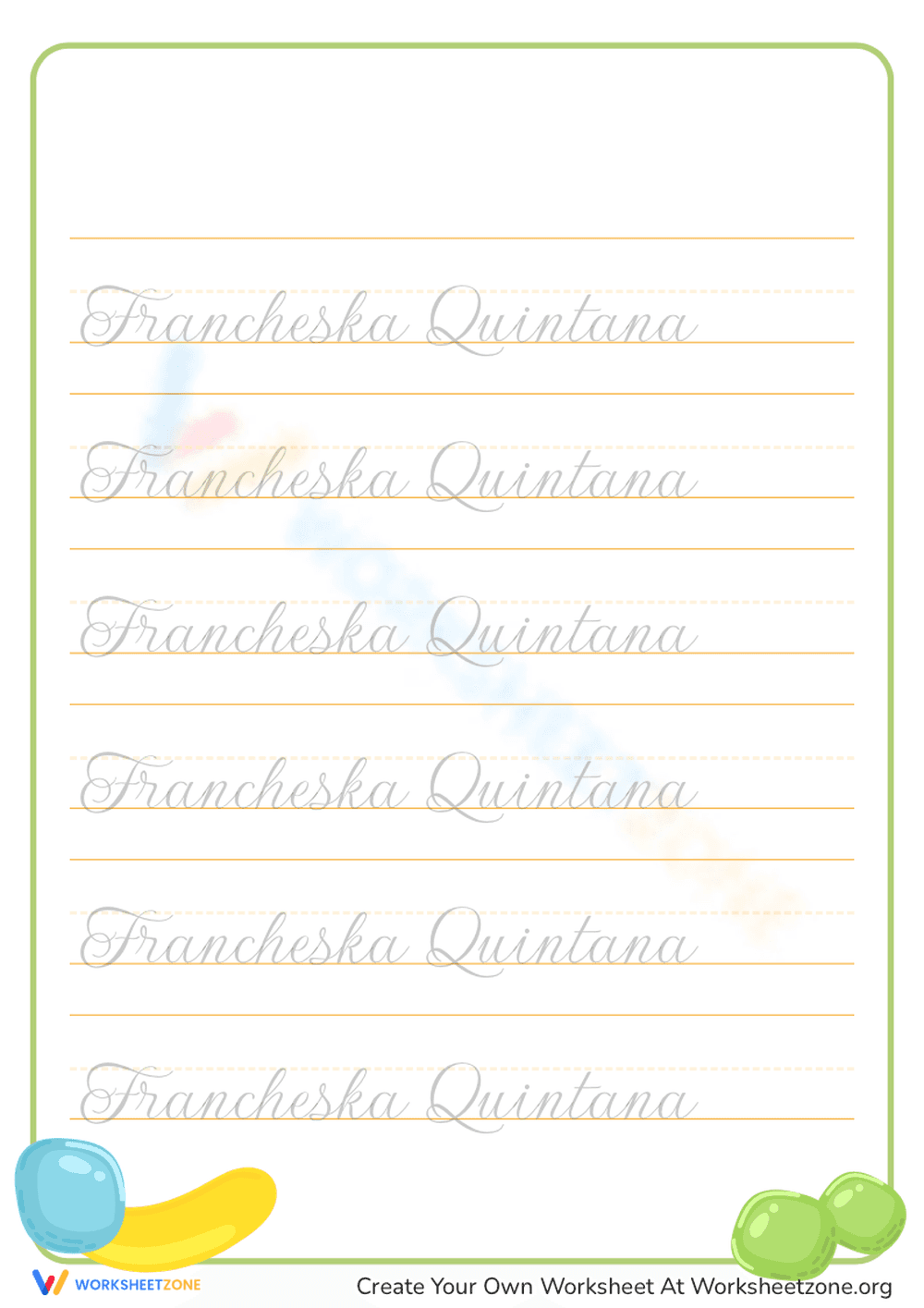


Essential Name Tracing: Francheska Quintana | Grade 1-2
Paste this activity's link or code into your existing LMS (Google Classroom, Canvas, Teams, Schoology, Moodle, etc.).
Students can open and work on the activity right away, with no student login required.
You'll still be able to track student progress and results from your teacher account.
This Grade 1-2 cursive handwriting worksheet provides a personalized approach to letter formation by focusing on the name Francheska Quintana. Students engage in repetitive tracing to build the muscle memory required for fluid cursive writing. By practicing a familiar name, learners develop confidence and fine motor precision while mastering uppercase and lowercase connections.
At a Glance
- Grade: 1-2 · Subject: Handwriting
- Standard:
CCSS.ELA-LITERACY.L.1.1.A— Print all upper- and lowercase letters with proper form- Skill Focus: Cursive name tracing
- Format: 3 pages · 21 tasks · No answer key needed · PDF
- Best For: Morning work and name recognition
- Time: 10–15 minutes
This resource contains three pages of handwriting practice. Each page features seven lines of the name "Francheska Quintana" rendered in a clear, dotted cursive font. The layout includes traditional handwriting guides with a midline to help students maintain consistent letter height and spacing. The repetitive nature of the 21 total tasks ensures that students move from initial tracing to a more comfortable, rhythmic writing flow.
The zero-prep design allows for immediate classroom implementation. Step 1: Print the 3-page PDF (30 seconds). Step 2: Distribute to the student during morning arrival or literacy centers (30 seconds). Step 3: Review the student's letter connections and slant for formative feedback (1 minute). Total teacher preparation time is under 2 minutes, making this an ideal resource for busy educators or as a quick-start activity for substitute lesson plans.
This resource is aligned with `CCSS.ELA-LITERACY.L.1.1.A`, which requires students to master upper- and lowercase letter formation. While the standard mentions printing, the transition to cursive in early elementary is a natural extension of this foundational skill. This worksheet supports the fine motor development necessary for legible writing. Both standard codes can be copied directly into lesson plans, IEP goals, or district curriculum mapping tools.
Use this worksheet as a consistent morning work activity to help the student settle into the school day with a familiar, low-stress task. It also serves as an excellent formative assessment tool; teachers can observe the student's grip, posture, and stroke direction during the 10-15 minute completion window. Note if the student struggles with specific connections, such as the "Q" to "u" transition, to provide targeted intervention.
This worksheet is specifically designed for Grade 1 or Grade 2 students named Francheska Quintana who are beginning their cursive journey. It is particularly effective for students requiring additional fine motor support or those who benefit from highly personalized learning materials. Pair this worksheet with a cursive alphabet anchor chart to reinforce letter shapes before moving to paper-and-pencil practice.
Handwriting remains a foundational literacy skill even in the digital age. According to Fisher & Frey (2014), the physical act of letter formation through tracing and repetitive practice strengthens the orthographic loop, which is the functional relationship between the hand and the brain's language centers. This Grade 1-2 worksheet aligns with CCSS.ELA-LITERACY.L.1.1.A by providing 21 specific opportunities for students to master the complex curves and connections of cursive script. Research indicates that personalized materials, such as name tracing, increase student engagement and ownership of the learning process. By focusing on the specific name "Francheska Quintana," this resource bridges the gap between abstract letter practice and personal identity. The structured dotted lines provide the necessary scaffolding for students to develop muscle memory and consistent letter sizing, ensuring a smooth transition to independent writing. This targeted practice is essential for developing the fine motor control required for legible, fluent handwriting in later elementary grades.


