




























Views
Downloads
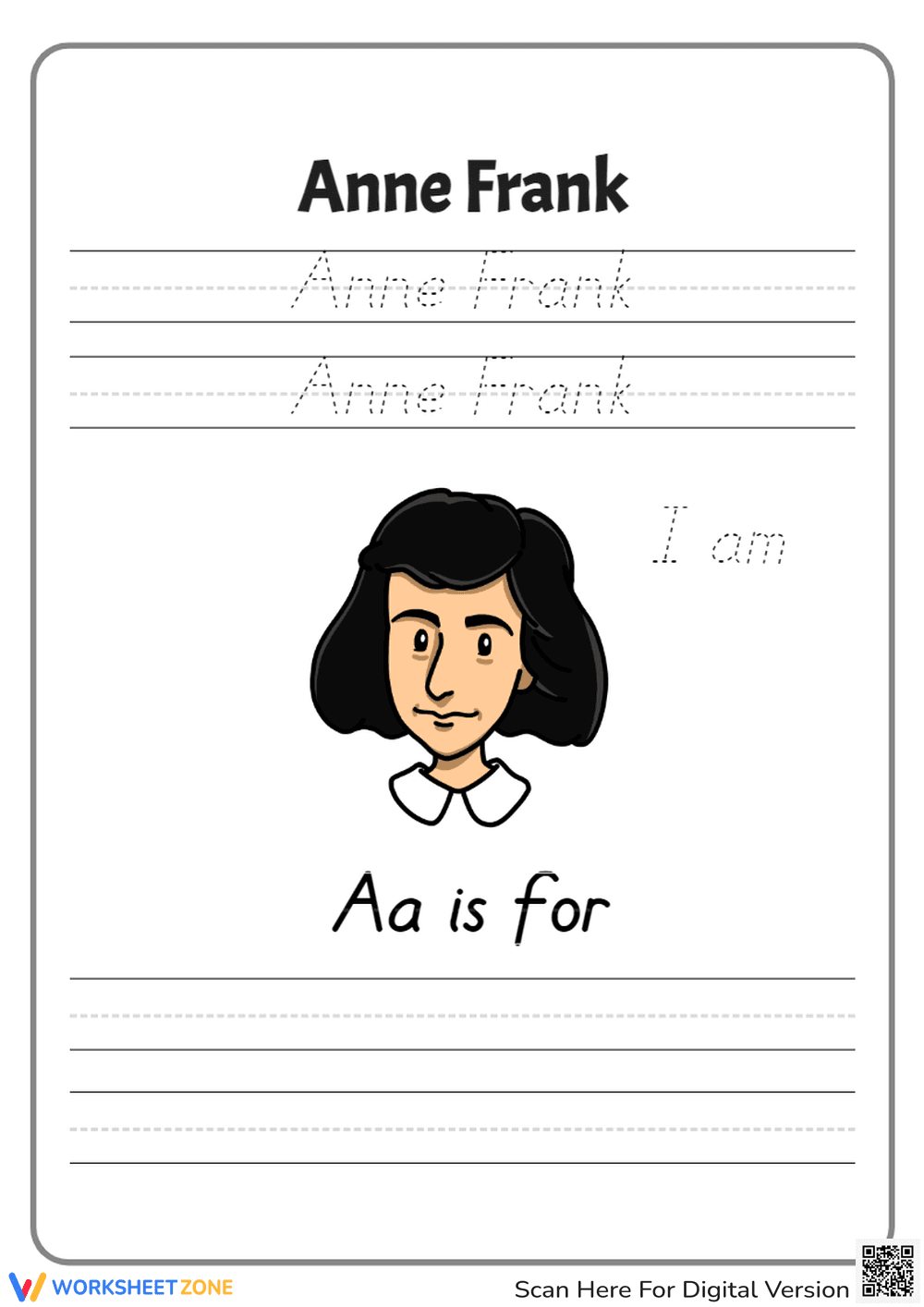

Anne Frank Name Tracing | Printable Grade K-1 Worksheet

Paste this activity's link or code into your existing LMS (Google Classroom, Canvas, Teams, Schoology, Moodle, etc.).
Students can open and work on the activity right away, with no student login required.
You'll still be able to track student progress and results from your teacher account.
This Kindergarten and Grade 1 handwriting worksheet provides students with structured tracing and writing practice focused on the name Anne Frank. By combining fine motor development with historical figures, students build letter formation skills while engaging with Women's History Month themes. It ensures young learners master uppercase and lowercase letter strokes through guided repetition.
At a Glance
- Grade: K-1 · Subject: Handwriting
- Standard:
CCSS.ELA-LITERACY.L.K.1.A— Print many upper- and lowercase letters accurately and legibly- Skill Focus: Proper letter formation
- Format: 1 page · 5 tasks · No answer key required · PDF
- Best For: Morning work or history integration
- Time: 10–15 minutes
Inside this single-page PDF, you will find two dedicated lines for tracing the name "Anne Frank" in a clear, dashed font. Below the portrait, students trace the phrase "I am" and observe the "Aa is for" prompt. The bottom of the page features two sets of primary ruled lines for independent practice, allowing students to transition from guided tracing to freehand writing.
The zero-prep workflow for this resource is designed for maximum efficiency in busy classrooms. First, print the single-page PDF for your entire class (30 seconds). Second, distribute the sheets during your literacy block or morning meeting (1 minute). Third, review student letter formation and pencil grip as they work independently (10 minutes). Total teacher preparation time is under 2 minutes, making it an ideal sub plan addition.
Standards Alignment
This resource aligns with `CCSS.ELA-LITERACY.L.K.1.A`, which requires students to print many upper- and lowercase letters. It also supports RF.K.1.B by reinforcing that spoken names are represented by specific sequences of written letters. Both standard codes can be copied directly into lesson plans, IEP goals, or district curriculum mapping tools.
How to Use It
Use this worksheet during Women's History Month as a thematic handwriting station. It works best after a brief read-aloud about Anne Frank's life to provide context for the name being written. As a formative assessment, observe if students start their letters from the top down. Completion typically takes 10 to 15 minutes depending on the student's fine motor control and focus.
Who It's For
This worksheet is designed for Kindergarten and first-grade students who are refining their print legibility. It is particularly helpful for students needing extra fine motor support or English Language Learners (ELLs) practicing basic sentence starters. Pair this with a picture book about Anne Frank or a classroom anchor chart featuring the alphabet.
Handwriting remains a foundational literacy skill, as research by Fisher & Frey (2014) emphasizes that the physical act of letter formation supports orthographic mapping and long-term memory. This worksheet targets CCSS.ELA-LITERACY.L.K.1.A by providing 5 specific tasks that move from high-support tracing to independent production. By integrating the name of a historical figure like Anne Frank, the resource provides a meaningful context for repetitive practice, which is essential for developing muscle memory in early childhood. Studies in the NAEP framework suggest that students who develop fluent handwriting early are better able to focus cognitive resources on higher-level composition tasks later in their academic careers. This 1-page PDF serves as a practical tool for teachers to implement these evidence-based strategies without increasing their daily preparation burden. It bridges the gap between simple motor drills and social studies content, ensuring that instructional time is used effectively for multi-disciplinary learning.


