




























Views
Downloads
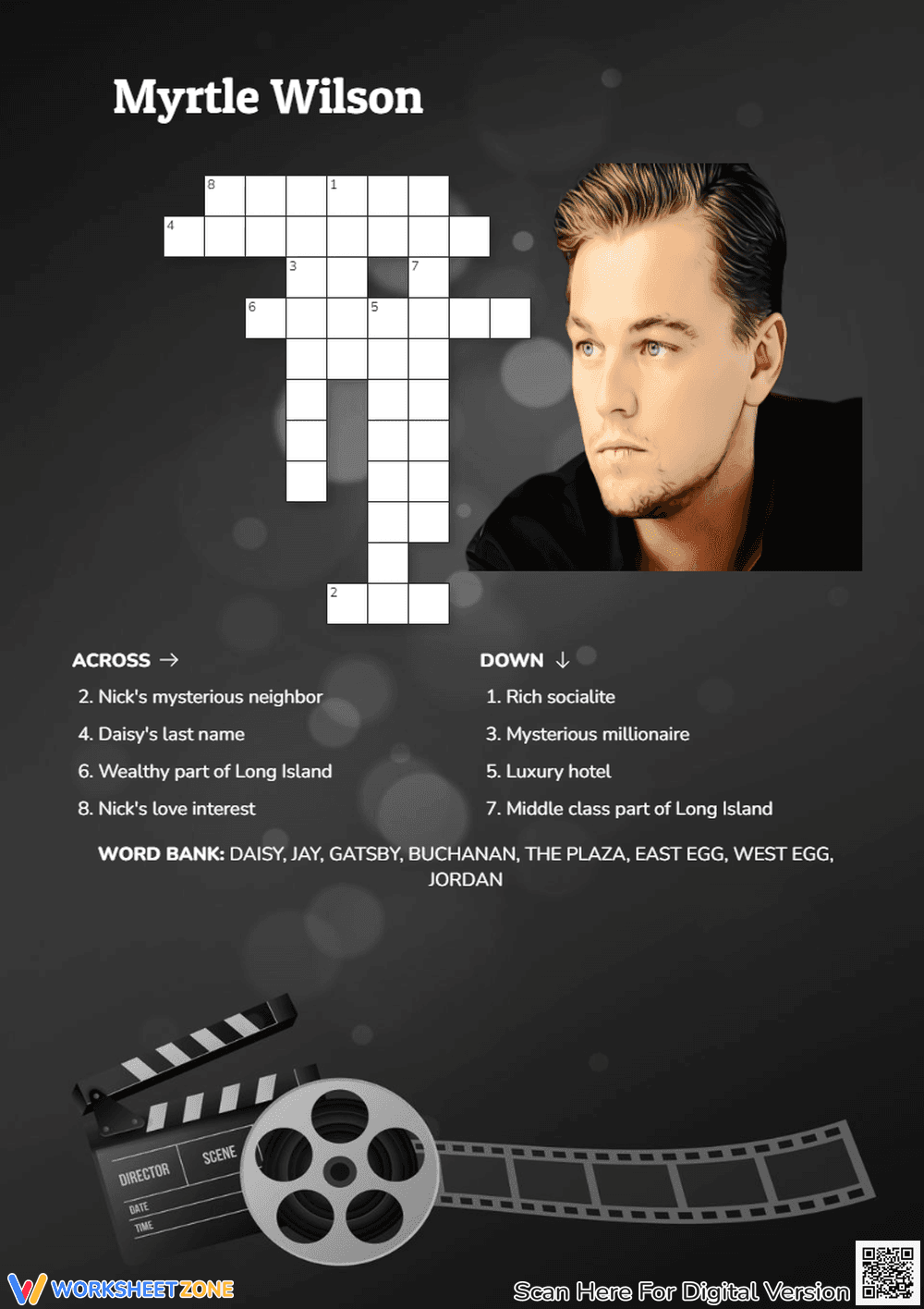

Essential Myrtle Wilson Crossword | Grade 5 ELA

Paste this activity's link or code into your existing LMS (Google Classroom, Canvas, Teams, Schoology, Moodle, etc.).
Students can open and work on the activity right away, with no student login required.
You'll still be able to track student progress and results from your teacher account.
This Grade 5 ELA worksheet uses a crossword format to help students identify key characters and settings from literature. By connecting clues to specific names and locations, learners reinforce their reading comprehension and recall of narrative details. It provides a focused way to review character traits and plot-relevant geography.
At a Glance
- Grade: 5 · Subject: ELA
- Standard:
CCSS.ELA-LITERACY.RL.5.3— Compare and contrast two or more characters, settings, or events in a story- Skill Focus: Character & Setting Identification
- Format: 1 page · 8 problems · Answer key included · PDF
- Best For: Quick literature review or sub plans
- Time: 15–20 minutes
This single-page PDF features a professionally designed crossword grid centered on the world of literary characters. It includes 8 specific clues—4 across and 4 down—covering major figures like Nick and Daisy, as well as iconic locations like East Egg and West Egg. A helpful word bank is provided at the bottom to support vocabulary acquisition and spelling accuracy for every student.
The workflow for this resource is designed for maximum efficiency. First, print the single-page PDF in under 30 seconds. Next, distribute the sheets to students as a warm-up or exit ticket. Finally, review the answers using the included key to provide immediate feedback. This makes it an ideal choice for emergency sub plans or transition periods where teacher prep time must stay under 2 minutes.
The primary standard addressed is CCSS.ELA-LITERACY.RL.5.3, which requires students to describe in depth a character, setting, or event in a story, drawing on specific details in the text. By correctly identifying "Nick's mysterious neighbor" or "Wealthy part of Long Island," students demonstrate their ability to recall and categorize narrative elements. Both standard codes can be copied directly into lesson plans, IEP goals, or district curriculum mapping tools.
Use this worksheet as a formative assessment after a shared reading session to gauge student recall of character names and settings. It works effectively during the independent practice phase of a lesson. Teachers should observe if students rely heavily on the word bank or can identify the characters based on the clues alone. Expected completion time ranges from 15 to 20 minutes.
This resource is tailored for Grade 5 students but can be adapted for younger advanced readers or older students needing a quick review. It is particularly useful for visual learners who benefit from the spatial organization of a crossword. Pair this with a character map or an anchor chart detailing the differences between East and West Egg for a complete instructional unit.
This Grade 5 literature worksheet aligns with CCSS.ELA-LITERACY.RL.5.3 by requiring students to identify and differentiate between specific characters and settings within a narrative framework. According to Fisher & Frey (2014), the use of word-play and puzzles like crosswords can significantly enhance vocabulary retention and thematic recall by providing a low-stakes, high-engagement environment for retrieval practice. By utilizing 8 targeted clues and a supporting word bank, the resource scaffolds the cognitive load required to move from simple recognition to active recall. Research from the RAND AIRS 2024 report suggests that structured supplemental materials that focus on specific narrative details help bridge the gap between surface-level reading and deep comprehension. This worksheet serves as a reliable tool for educators looking to verify student understanding of literary foundations while maintaining high classroom engagement through interactive, printable formats.


