


























Views
Downloads

My Writing Goal Worksheet | Grade 4 Printable
Paste this activity's link or code into your existing LMS (Google Classroom, Canvas, Teams, Schoology, Moodle, etc.).
Students can open and work on the activity right away, with no student login required.
You'll still be able to track student progress and results from your teacher account.
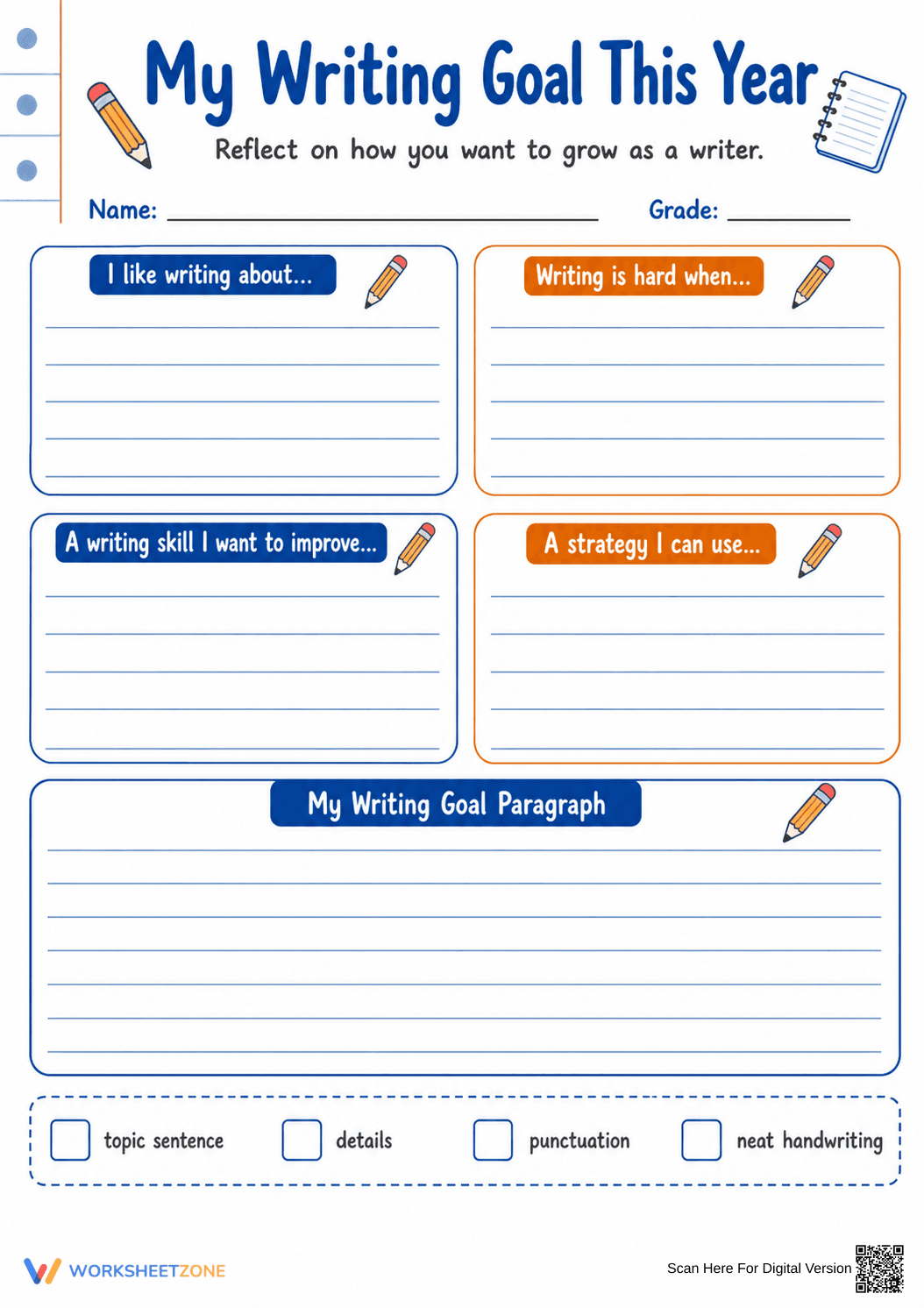
This Grade 4 writing reflection worksheet empowers students to take ownership of their literacy growth through structured goal setting. By identifying personal interests, challenges, and specific strategies, learners transform abstract intentions into a concrete, actionable paragraph. This resource serves as an ideal diagnostic tool for the start of the school year.
At a Glance
- Grade: 4 · Subject: ELA
- Standard:
CCSS.ELA-LITERACY.W.4.4— Produce clear and coherent writing with development and organization appropriate to the task.- Skill Focus: Goal setting and reflection
- Format: 1 page · 5 tasks · Answer key included · PDF
- Best For: Back-to-school writing workshop launch
- Time: 20–30 minutes
The worksheet features a clean, notebook-style layout. It includes four distinct planning boxes to scaffold the brainstorming process: interests, challenges, target skills, and specific strategies. Following the planning phase, a dedicated lined section allows for the synthesis of these ideas into a formal paragraph. A built-in self-editing checklist ensures students attend to topic sentences, supporting details, punctuation, and handwriting.
Zero-Prep Workflow
- Print: Select the PDF and print enough copies for your class (30 seconds).
- Distribute: Hand out the sheets during your writing workshop launch or morning work (1 minute).
- Review: Use the completed goals to inform your small-group instruction or 1-on-1 writing conferences.
Total teacher prep time is under 2 minutes, making this an ideal sub plan or last-minute addition to a writing unit.
Standards Alignment
The primary standard addressed is `CCSS.ELA-LITERACY.W.4.4`, which requires students to produce clear and coherent writing in which the development and organization are appropriate to task, purpose, and audience. By requiring a structured paragraph based on pre-writing reflections, this worksheet directly supports the organizational requirements of the standard. Both standard codes can be copied directly into lesson plans, IEP goals, or district curriculum mapping tools.
How to Use It
Use this worksheet during the first week of school as a formative assessment to gauge student writing levels and self-awareness. It works well as a cover page for a writing portfolio, allowing students to revisit their goals mid-year. Observe how students identify their struggle areas to target specific interventions. Expected completion time ranges from 20 to 30 minutes.
Who It's For
This resource is designed for students in Grades 3 through 6. It is particularly effective for reluctant writers who benefit from the visual scaffolding of the planning boxes. Pair this worksheet with a mentor text about growth mindset or a direct instruction lesson on SMART goals to maximize its instructional impact.
According to Fisher & Frey (2014), the process of metacognitive reflection is essential for developing student agency in the writing process. This worksheet facilitates that growth by requiring students to identify specific obstacles and actionable strategies before committing to a formal goal statement. By aligning with CCSS.ELA-LITERACY.W.4.4, the resource ensures that students are not just writing for the sake of completion, but are producing coherent, organized text that reflects their personal developmental needs. Research from the NAEP indicates that students who engage in regular self-assessment and goal-setting demonstrate higher proficiency in complex writing tasks compared to those who follow purely teacher-directed prompts. This printable resource provides the necessary scaffolding to transition students from identifying preferences to articulating a structured paragraph. The inclusion of a self-editing checklist further reinforces the standard by emphasizing the importance of development, organization, and conventions in student-produced work.


