


























Views
Downloads
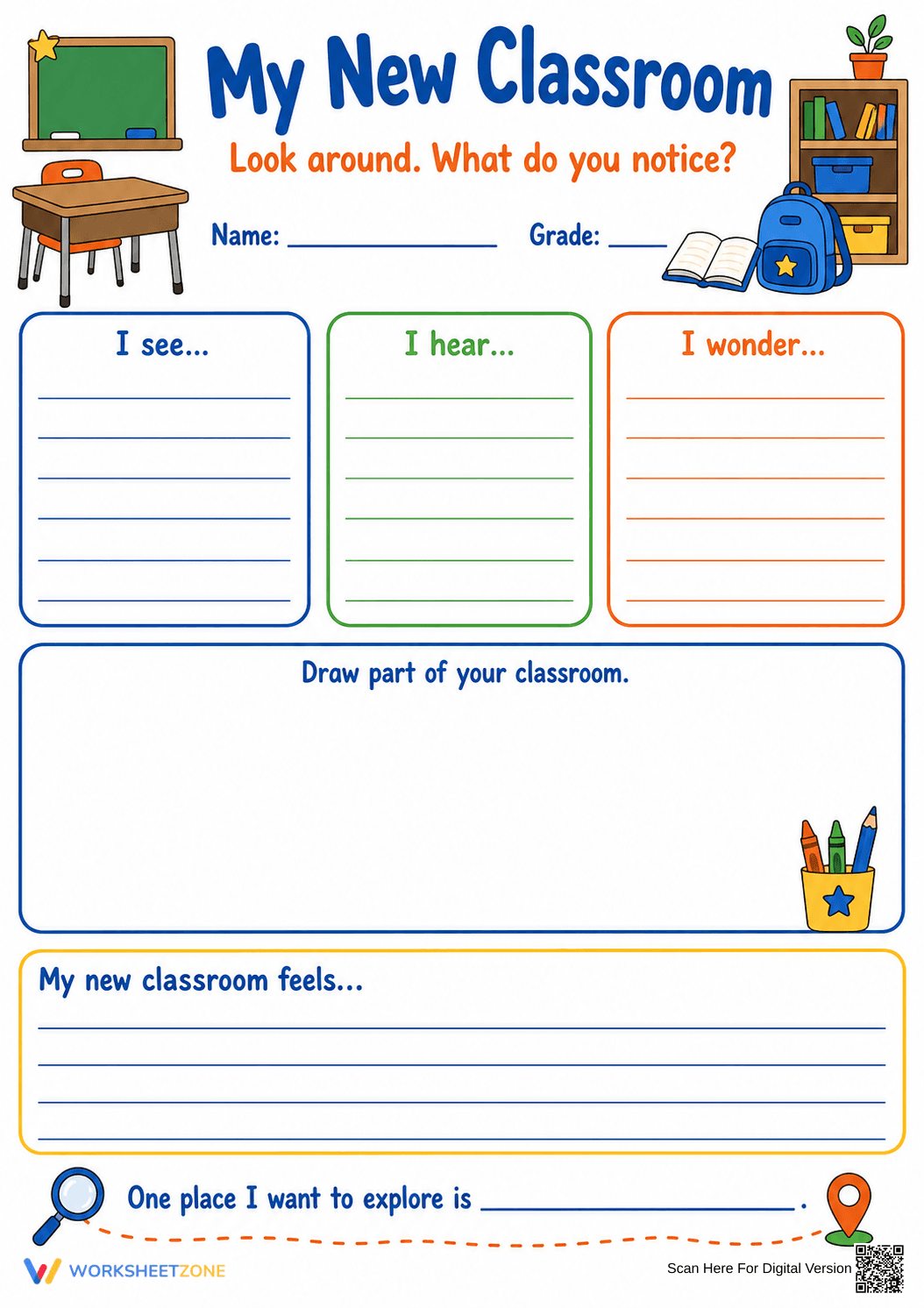

My New Classroom Printable Worksheet | Grade 2 ELA
Paste this activity's link or code into your existing LMS (Google Classroom, Canvas, Teams, Schoology, Moodle, etc.).
Students can open and work on the activity right away, with no student login required.
You'll still be able to track student progress and results from your teacher account.
This Grade 2 descriptive writing worksheet helps students document their environment through sensory observation and creative reflection. By engaging with "I see," "I hear," and "I wonder" prompts, learners develop the foundational skills needed to translate physical surroundings into clear, descriptive prose. It serves as an ideal back-to-school activity for establishing classroom community and assessing early-year writing readiness.
At a Glance
- Grade: 2 · Subject: ELA · Writing
- Standard:
CCSS.ELA-LITERACY.W.2.3— Write descriptions using details to describe actions, thoughts, and feelings.- Skill Focus: Sensory Observation & Descriptive Writing
- Format: 1 page · 6 tasks · Answer key not applicable · PDF
- Best For: First week of school reflection activity
- Time: 20–30 minutes
The worksheet features a clean, visual layout with six distinct engagement zones. Students interact with three primary observation boxes designed for sensory input (sight and sound) and inquiry (wonder). A large central drawing box allows for visual representation of the classroom layout. The bottom half includes a three-line guided writing section with a "feels" starter and a final fill-in-the-blank prompt for exploration goals, ensuring students practice both fragmented and complete sentence structures.
Zero-Prep Workflow
- Print: Select the single-page PDF and print enough copies for your class (30 seconds).
- Distribute: Hand out the worksheets during a morning meeting or writing block (1 minute).
- Review: Walk around as students observe their surroundings, then facilitate a 5-minute share-out of their "I wonder" questions (5 minutes).
Total teacher preparation time is under 2 minutes, making this an excellent choice for busy first-week schedules or unexpected sub plans.
This resource is aligned with CCSS.ELA-LITERACY.W.2.3, which requires students to "Write narratives in which they recount a well-elaborated event or short sequence of events, include details to describe actions, thoughts, and feelings." By focusing on the immediate classroom environment, students practice selecting specific details that convey a sense of place. This standard code can be copied directly into lesson plans, IEP goals, or district curriculum mapping tools.
Use this worksheet during the first three days of school as a formative assessment of student writing stamina and observational skills. It works best after a brief classroom tour. As students work, observe who focuses on physical objects versus social interactions; these observations provide valuable data for early-year grouping. Expected completion typically takes 20 to 30 minutes depending on the depth of the drawing.
While designed for Grade 2, the visual nature of the prompts makes it accessible for Grade 1 students or English Language Learners (ELLs) who may rely on the drawing box to communicate ideas. It pairs naturally with a "Classroom Scavenger Hunt" or an anchor chart listing descriptive adjectives for feelings and sounds to support vocabulary development.
Research by Fisher & Frey (2014) emphasizes the importance of scaffolded writing where students move from simple observations to complex descriptions. This worksheet utilizes sensory prompts to reduce the cognitive load of starting a blank page, allowing students to focus on vocabulary acquisition and sentence structure. By aligning with CCSS.ELA-LITERACY.W.2.3, the activity ensures that even early-year reflections contribute to long-term mastery of descriptive narrative techniques. The inclusion of an inquiry-based "I wonder" section encourages higher-order thinking, moving beyond mere identification to critical engagement with the learning environment. According to NAEP writing framework analysis, students who practice descriptive tasks in familiar contexts show higher proficiency in later academic writing. This printable tool provides the structured support necessary for Grade 2 learners to achieve these benchmarks while building a sense of belonging in their new educational space.


