


























Views
Downloads
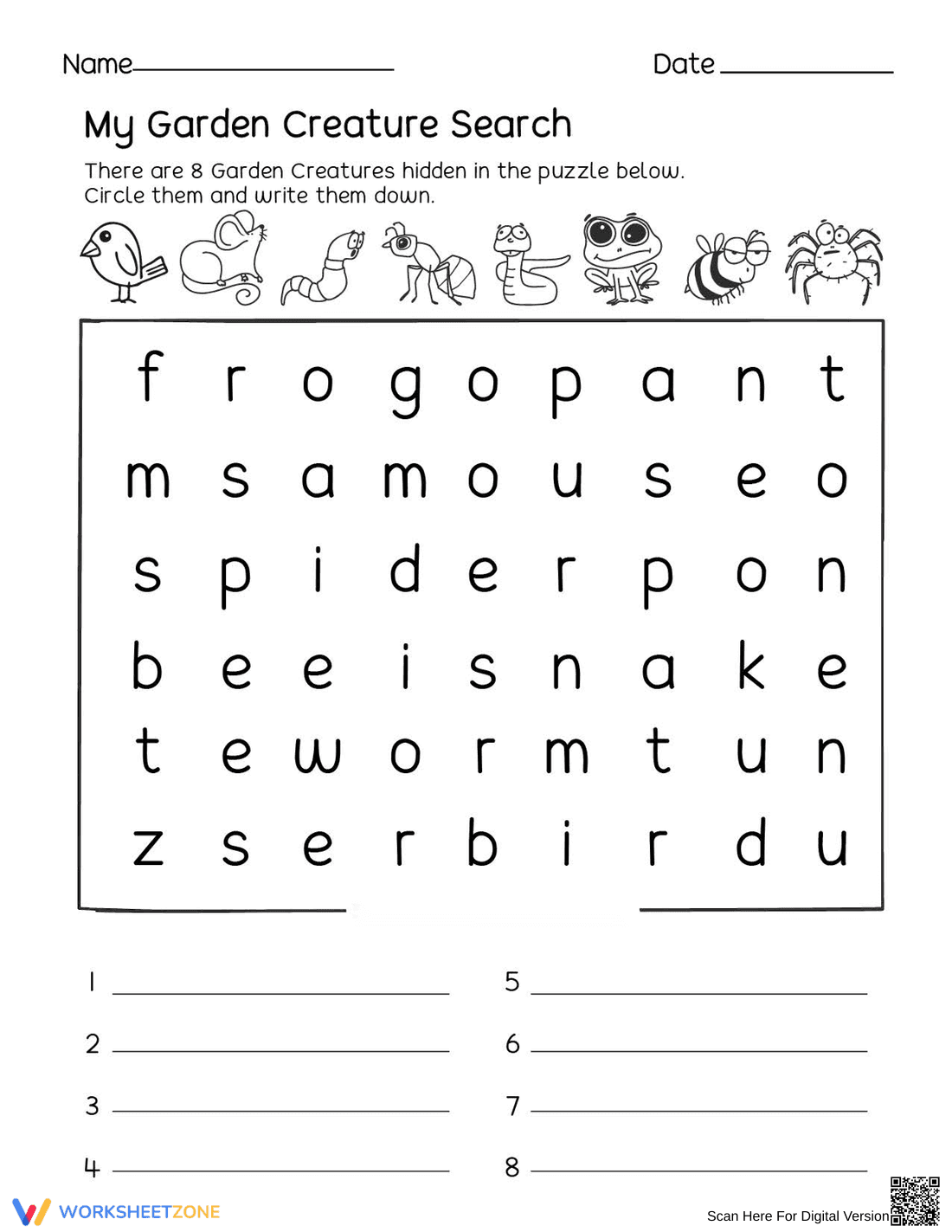

Printable Garden Creature Search Worksheet | K-1 Science
Paste this activity's link or code into your existing LMS (Google Classroom, Canvas, Teams, Schoology, Moodle, etc.).
Students can open and work on the activity right away, with no student login required.
You'll still be able to track student progress and results from your teacher account.
This printable science worksheet engages early learners in identifying common garden animals through a fun word search and writing activity. Students practice observation skills and spelling as they locate eight hidden creatures, strengthening their understanding of local biodiversity and living things in their immediate environment before recording their findings on structured lines.
At a Glance
- Grade: Kindergarten · Subject: Science
- Standard:
K-LS1-1— Use observations to describe patterns of what animals need to survive- Skill Focus: Animal identification and spelling
- Format: 1 page · 8 problems · Answer key included · PDF
- Best For: Science centers and early finisher activities
- Time: 10–15 minutes
What's Inside
This single-page PDF features a clear word search grid containing eight specific garden creatures. It includes visual icons for each animal (bird, mouse, worm, ant, snake, frog, bee, spider) to support emergent readers, followed by eight numbered lines for writing practice to reinforce spelling and handwriting. The layout is clean and high-contrast for easy printing.
Zero-Prep Workflow
- Print: Select the single-page document and print enough copies for your small group or class in under 30 seconds.
- Distribute: Hand out the sheets for independent or partner work during your science block or morning work rotation.
- Review: Quickly scan the completed writing lists as a formative assessment of spelling accuracy and visual identification.
The self-explanatory nature of the search-and-write format makes this an ideal resource for substitute teacher plans or quick science extensions.
Standards Alignment
Aligned to K-LS1-1: "Use observations to describe patterns of what plants and animals (including humans) need to survive." This resource supports observation skills by requiring students to recognize animal forms and translate those visual patterns into written words. Both standard codes can be copied directly into lesson plans, IEP goals, or district curriculum mapping tools.
How to Use It
Use this worksheet during a "Living Things" unit after an outdoor garden walk or a nature-themed read-aloud. It serves as a perfect transition activity from physical observation to literacy practice. For a formative-assessment observation tip, note whether students can match the visual icons to the letters in the grid, which indicates strong visual-discrimination skills. Expected completion time is 15 minutes.
Who It's For
This resource is designed for Preschool, Kindergarten, and Grade 1 students. It is especially effective for emergent writers who benefit from visual cues to support spelling tasks. Pair this resource with a local habitat anchor chart or a garden creature picture book for a complete, integrated science and ELA lesson.
According to EdReports 2024, high-quality supplemental materials for early science education must bridge the gap between observation and literacy. This worksheet addresses that need by aligning with the K-LS1-1 standard, which emphasizes the use of observations to understand animal patterns. By integrating a word search with writing tasks, the activity supports dual-mode learning, where students process visual information (the animal icons) and symbolic information (the letters and spelling). Research indicates that incorporating fine-motor activities like circling and writing into science lessons increases student engagement and retention of vocabulary. This resource provides a structured environment for students to practice these essential skills while exploring the concept of living things in their own backyards. It serves as an accessible entry point for teachers to assess both scientific observation and foundational literacy within a single, no-prep instructional moment that requires minimal setup while delivering measurable student results in Kindergarten classrooms.


