




























Views
Downloads

My First Week Reflection Worksheet | Grade 4 Essential

Paste this activity's link or code into your existing LMS (Google Classroom, Canvas, Teams, Schoology, Moodle, etc.).
Students can open and work on the activity right away, with no student login required.
You'll still be able to track student progress and results from your teacher account.
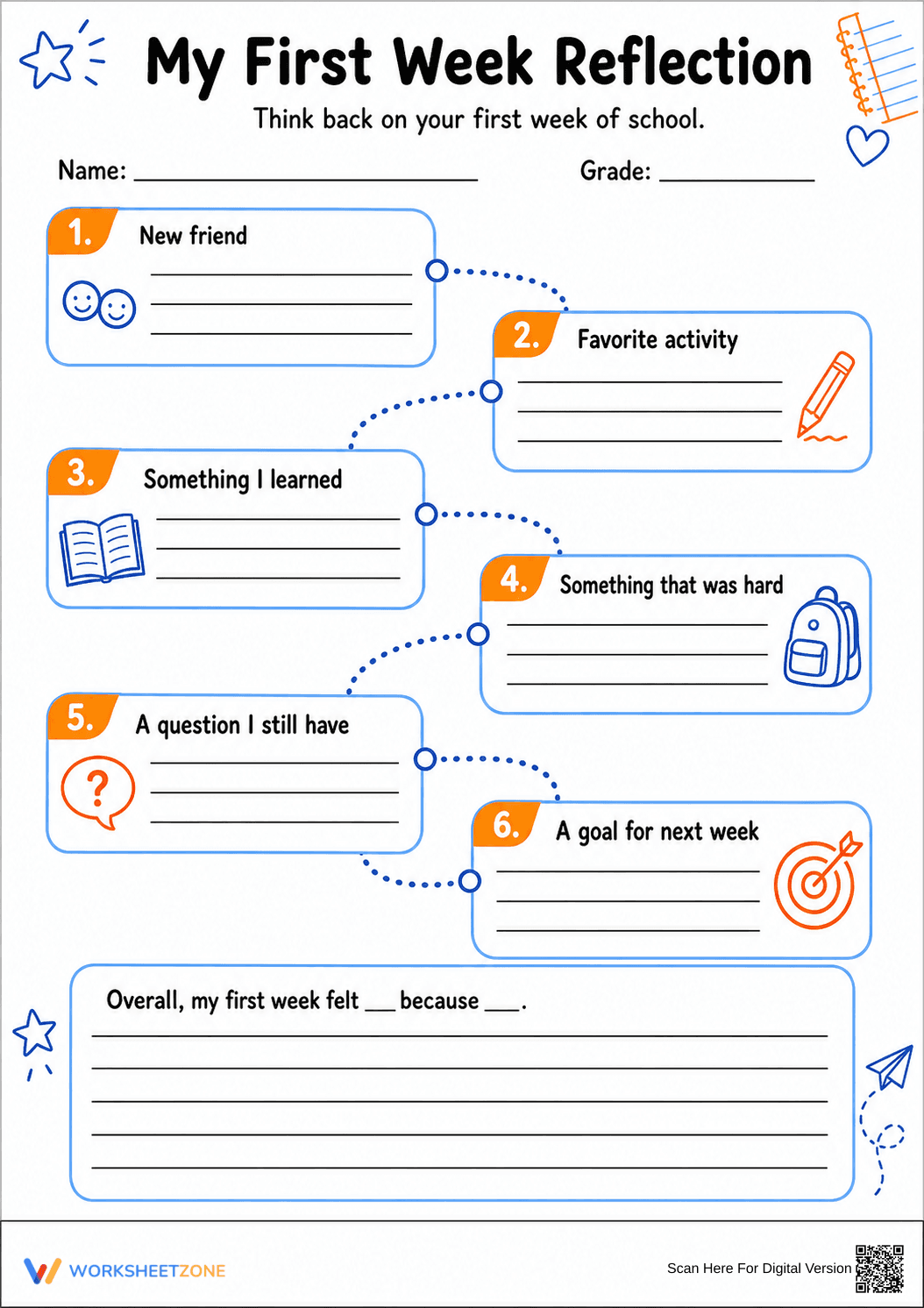
Reflective writing helps students process major transitions and build self-awareness during the start of a new school year. This worksheet guides Grade 4 students through a structured review of their first week, fostering social-emotional growth and narrative writing skills. Students identify successes, challenges, and future goals through a visual reflection path that encourages thoughtful responses.
At a Glance
- Grade: 4 · Subject: ELA / Writing
- Standard:
CCSS.ELA-LITERACY.W.4.3— Write narratives to develop real experiences using effective technique and clear sequences.- Skill Focus: Personal reflection and goal setting
- Format: 1 page · 7 prompts · Open-ended responses · PDF
- Best For: Back-to-school morning work or Friday wrap-up
- Time: 20–30 minutes
What's Inside: This single-page PDF features a clean, engaging layout designed as a "reflection path." It contains six specific guided prompts, each accompanied by a school-themed icon to support visual learners. The prompts cover social connections, academic highlights, and personal challenges. The page concludes with a wider lined section for a summary paragraph, providing a total of 7 distinct writing tasks that help students organize their thoughts about the school transition.
Zero-Prep Workflow
- Print (1 minute): Simply print the A4 portrait PDF in color or grayscale. The high-contrast design ensures clarity even on standard school copiers.
- Distribute (30 seconds): Hand out the sheets during a morning meeting or dedicated writing block. No additional materials are required beyond a pencil.
- Review (1 minute): Use the completed sheets as a quick formative check to gauge student sentiment and identify any children who may be struggling with the transition.
Standards Alignment: The primary focus is `CCSS.ELA-LITERACY.W.4.3`, which requires students to write narratives to develop real experiences or events using effective technique and clear sequences. By reflecting on specific moments, students practice selecting relevant details to convey their experiences. Standard codes can be copied directly into lesson plans or district curriculum mapping tools.
How to Use It: This worksheet is best utilized as a Friday afternoon wrap-up activity to help students decompress. It also serves as a formative assessment tool; teachers should look for students who struggle to identify a "new friend" or a "goal," as these may indicate a need for additional support. Expect students to spend 20 to 30 minutes completing the path and the final summary paragraph.
Who It's For: This resource is designed for general education classrooms in grades 3 through 6, but it is particularly effective for Grade 4. It provides support for English Language Learners through visual icons and structured prompts. It pairs naturally with a classroom anchor chart about growth mindset or a first-week read-aloud book.
According to research by Fisher & Frey (2014), structured reflection is a critical component of the gradual release of responsibility, allowing students to internalize their learning and emotional experiences. This worksheet addresses CCSS.ELA-LITERACY.W.4.3 by providing a scaffolded framework for personal narrative writing. By breaking the reflection into six distinct stops, the resource reduces cognitive load and prevents "blank page" syndrome. The inclusion of a goal-setting prompt aligns with evidence-based practices for developing student agency. This tool serves as a bridge between informal journaling and formal narrative composition, ensuring students can articulate their school experiences with clarity. Educators can use these reflections to build stronger classroom communities and tailor instruction to specific social and academic needs.


