


























Views
Downloads
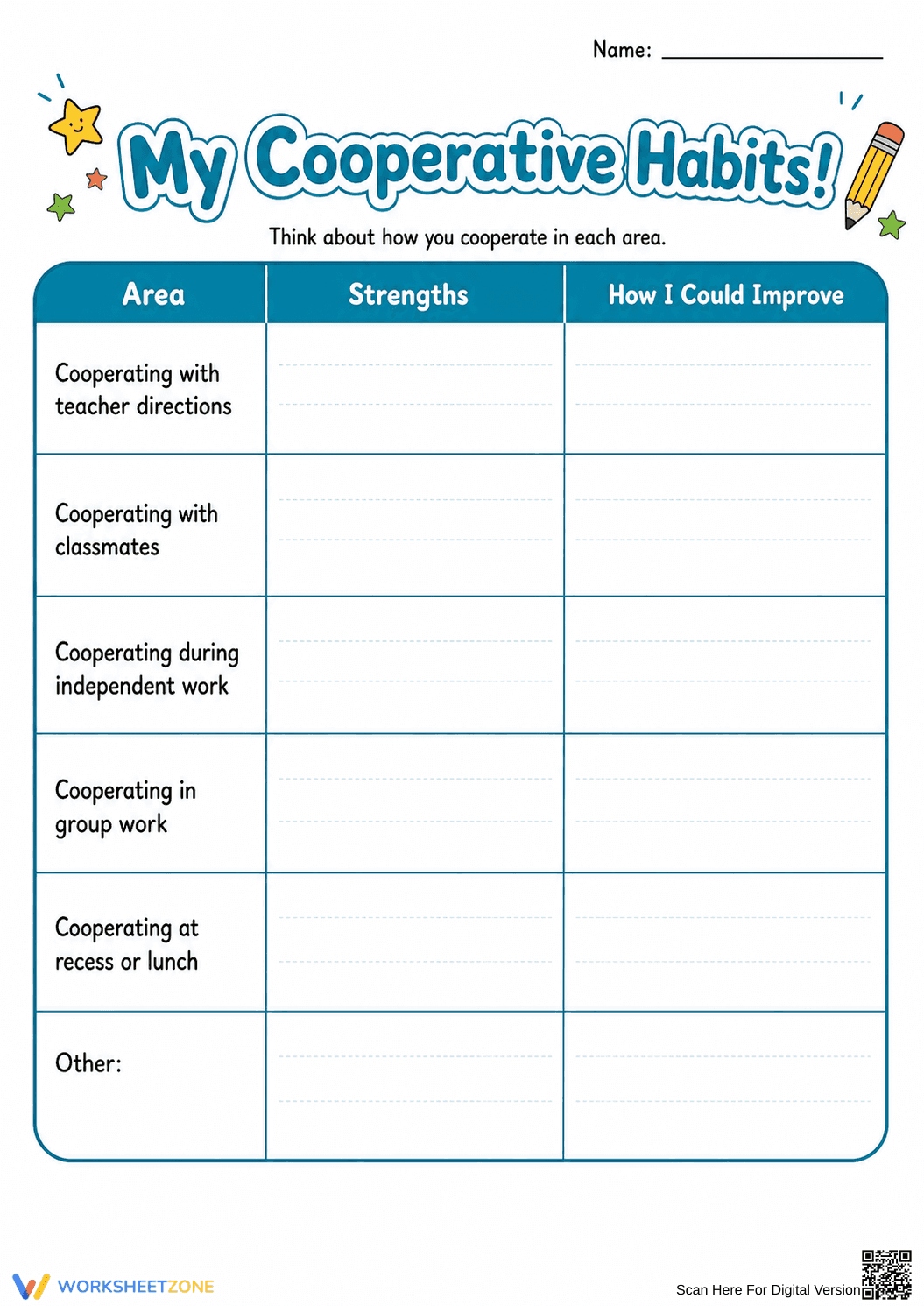

My Cooperative Habits Worksheet | Grade 2-5 Essential
Paste this activity's link or code into your existing LMS (Google Classroom, Canvas, Teams, Schoology, Moodle, etc.).
Students can open and work on the activity right away, with no student login required.
You'll still be able to track student progress and results from your teacher account.
This Grade 2-5 social-emotional learning worksheet empowers students to evaluate their own cooperative behaviors across various school environments. By identifying specific strengths and growth areas, learners develop the self-awareness necessary for successful collaboration. This tool transforms abstract social concepts into concrete, actionable reflections that improve classroom culture and peer relationships immediately.
At a Glance
- Grade: 2-5 · Subject: Social Skills
- Standard:
CCSS.ELA-LITERACY.SL.3.1— Engage effectively in collaborative discussions and follow agreed-upon rules for teamwork- Skill Focus: Self-reflection and cooperation
- Format: 1 page · 12 reflection tasks · Open-ended · PDF
- Best For: Social-emotional learning and behavior reflection
- Time: 15–20 minutes
What's Inside
The worksheet features a clean, organized table layout designed for elementary students. It includes six distinct "Area" categories: teacher directions, classmates, independent work, group work, recess/lunch, and a customizable "Other" row. For each area, students are prompted to fill in two columns: "Strengths" and "How I Could Improve." This 1-page PDF provides 12 total reflection prompts and uses a clear, legible font suitable for young writers.
Zero-Prep Workflow
- Print: Select the single-page PDF and print copies for your entire class in under 30 seconds.
- Distribute: Hand out the worksheets during your morning meeting, SEL block, or as a transition activity (1 minute).
- Review: Facilitate a brief 5-minute discussion defining "strengths" and "improvement" before students begin their independent reflection.
Standards Alignment
The primary alignment for this resource is CCSS.ELA-LITERACY.SL.3.1, which requires students to engage effectively in a range of collaborative discussions and follow agreed-upon rules for individual and group work. By reflecting on their habits, students prepare to meet the behavioral expectations of this standard. This standard code can be copied directly into lesson plans, IEP goals, or district curriculum mapping tools.
How to Use It
Use this worksheet as a formative assessment tool during the first week of school to establish classroom norms and expectations. It is also highly effective as a reflection activity after a difficult group project or a high-conflict recess period. Teachers should observe which areas students struggle to identify strengths in, as this provides a clear indicator for where direct social skills instruction is needed next.
Who It's For
This resource is tailored for general education teachers in grades 2 through 5, as well as school counselors and special education providers. It serves as an excellent companion to an anchor chart on "What Cooperation Looks Like" or a direct instruction lesson on active listening. It is particularly helpful for students working on specific behavioral IEP goals related to peer interaction.
Research by Fisher & Frey (2014) emphasizes that productive group work requires students to possess explicit social-emotional competencies, particularly the ability to monitor their own contributions to a team. This worksheet directly supports CCSS.ELA-LITERACY.SL.3.1 by providing a structured framework for students to engage in self-reflection regarding their collaborative habits. By analyzing their strengths and identifying specific areas for improvement in contexts like group work, recess, and teacher interactions, students move from passive participation to active, metacognitive cooperation. The 12 reflection prompts serve as a scaffold for developing the interpersonal skills necessary for academic success and positive peer relations. According to NAEP data, students who demonstrate strong self-regulation and cooperative skills often perform better in collaborative problem-solving tasks. This resource provides the essential documentation needed for tracking social-emotional growth and can be easily integrated into existing classroom management systems.


