


























Views
Downloads
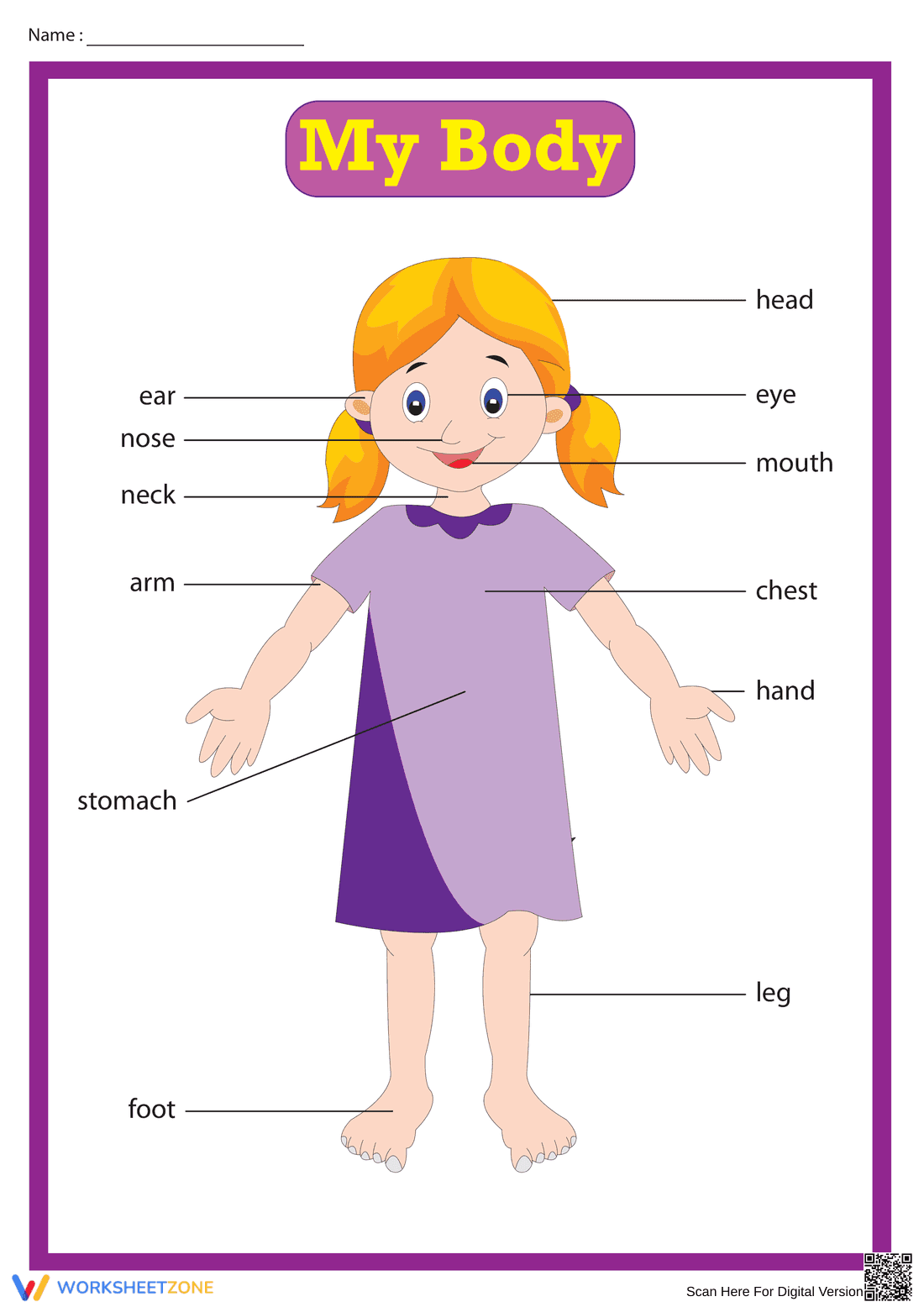

My Body Parts Chart | Essential Grade K-2 Science
Paste this activity's link or code into your existing LMS (Google Classroom, Canvas, Teams, Schoology, Moodle, etc.).
Students can open and work on the activity right away, with no student login required.
You'll still be able to track student progress and results from your teacher account.
This Grade K-2 science chart provides a clear visual reference for students learning to identify primary human body parts. By connecting anatomical terms to a friendly illustration, it helps young learners build essential vocabulary and biological awareness. It serves as a foundational tool for health and life science units.
At a Glance
- Grade: K-2 · Subject: Science
- Standard:
1-LS1-1— Describe how external parts of animals and humans help them survive and grow- Skill Focus: Identifying human body parts
- Format: 1 page · 12 labels · Reference Chart · PDF
- Best For: Classroom posters and science notebooks
- Time: 5–10 minutes
This single-page PDF features a high-quality illustration of a child with 12 clear labels pointing to major body parts. The layout includes terms like stomach, neck, and chest, alongside common features like eyes and hands. It is designed as a visual anchor chart that requires no additional assembly or teacher preparation.
The workflow for this resource is designed for maximum efficiency. First, print the chart in color or grayscale (30 seconds). Second, distribute copies to student folders or display the poster on a central science wall (1 minute). Third, review the 12 labels during a whole-group point and say activity (5 minutes). Total teacher prep time is under 2 minutes, making it an ideal sub-plan addition.
The primary alignment is 1-LS1-1, which focuses on using observations to describe living things. By identifying the structures of the human body, students begin to understand how organisms are organized to interact with their environment. Both standard codes can be copied directly into lesson plans, IEP goals, or district curriculum mapping tools.
Use this chart during the Engage phase of a life science lesson to assess prior knowledge of anatomy. Alternatively, provide it as a scaffold during a writing activity where students describe their own physical characteristics. Formative assessment can occur by asking students to point to their own neck or stomach while referencing the chart. Expected completion for a labeling review is 10 minutes.
This resource is tailored for Kindergarten through 2nd-grade students, including English Language Learners who benefit from visual-text associations. It pairs naturally with a My Five Senses anchor chart or a direct instruction lesson on healthy habits and physical growth.
This anatomy reference chart supports early childhood science literacy by providing a structured visual for the 1-LS1-1 standard. Research from Fisher & Frey (2014) emphasizes the importance of visual scaffolds and anchor charts in the gradual release of responsibility, particularly when introducing technical vocabulary to primary learners. By labeling 12 distinct body parts, the worksheet facilitates the I Do phase of instruction, where teachers model correct terminology before students apply it independently. According to the RAND AIRS 2024 report on instructional materials, high-quality visual aids in early science education significantly improve retention of biological concepts among diverse learner populations. This printable PDF ensures that students have a consistent, accurate reference point for classroom discussions and personal health journals, bridging the gap between observation and academic language.


