


























Views
Plays
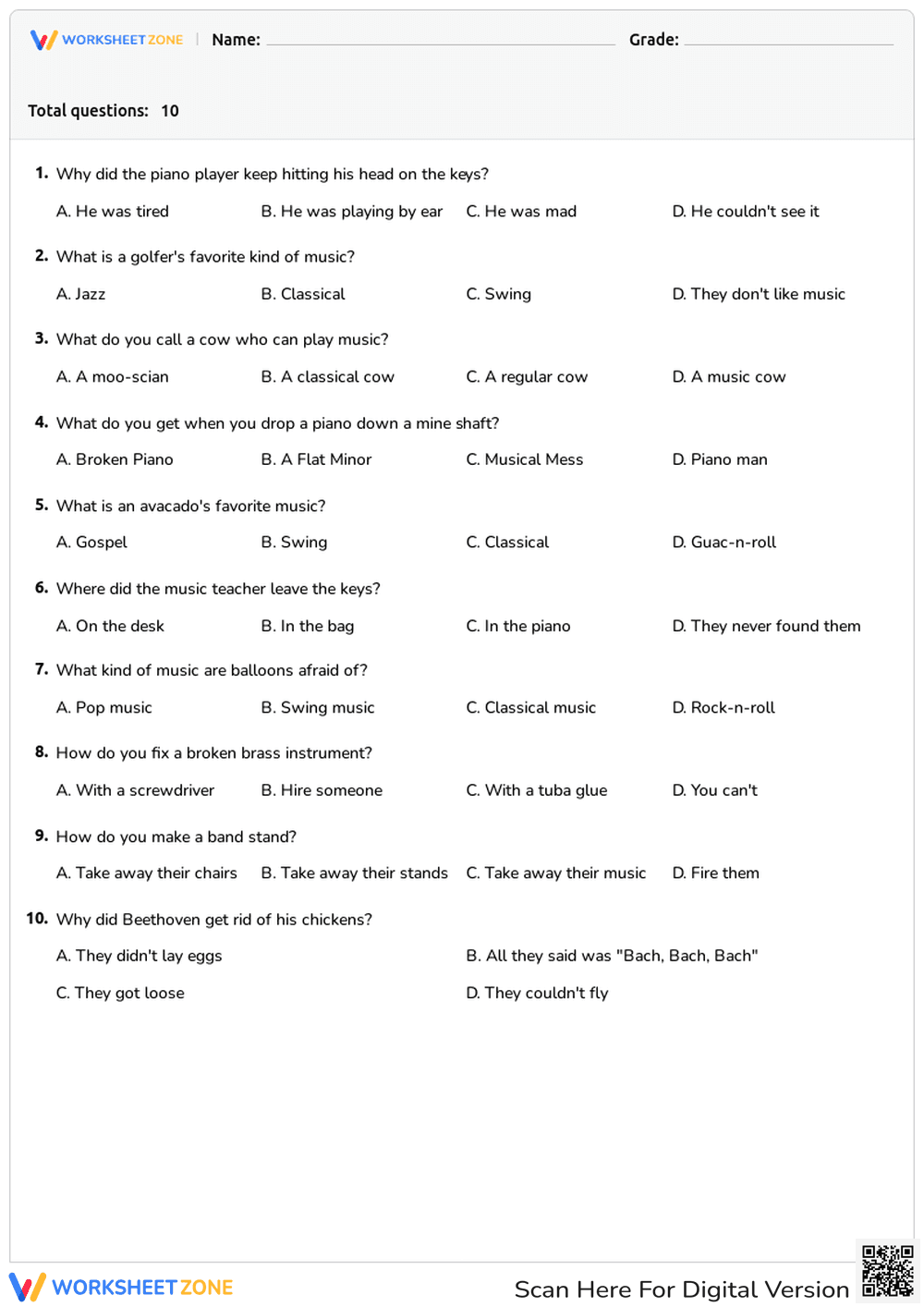

Music Puns Worksheet | Grade 2 Printable Ready
Paste this activity's link or code into your existing LMS (Google Classroom, Canvas, Teams, Schoology, Moodle, etc.).
Students can open and work on the activity right away, with no student login required.
You'll still be able to track student progress and results from your teacher account.
This Grade 2 music puns worksheet introduces students to the humorous side of music theory through 10 multiple-choice questions. By identifying double meanings in musical terms like "A Flat Minor" or "Bach," students develop a deeper appreciation for wordplay while reinforcing their understanding of core musical concepts and instruments in an engaging format.
At a Glance
- Grade: 2 · Subject: Music
- Standard:
CCSS.ELA-LITERACY.L.2.5— Demonstrate understanding of word relationships and nuances in word meanings- Skill Focus: Music Vocabulary & Wordplay
- Format: 1 page · 10 problems · Answer key included · PDF
- Best For: Music class warm-ups or transitions
- Time: 10–15 minutes
What's Inside
This single-page PDF features 10 carefully crafted multiple-choice questions that blend musical terminology with classic humor. The worksheet covers various instruments, including pianos, brass, and drums, as well as famous composers like Beethoven. Each question provides four distinct options, encouraging students to think critically about the literal and figurative meanings of the words presented. A full answer key is provided for quick grading.
Zero-Prep Workflow
- Print: Select the single-page PDF and print copies for your entire class in under 30 seconds.
- Distribute: Hand out the sheets as a bell-ringer activity or a fun transition between music theory and practice (30 seconds).
- Review: Spend one minute reviewing the puns as a group to explain the musical theory behind the jokes, such as the difference between a flat and a minor key. Total teacher prep time is under 2 minutes.
Standards Alignment
The primary focus is `CCSS.ELA-LITERACY.L.2.5`, which requires students to demonstrate an understanding of word relationships and nuances in word meanings. By navigating the puns, students practice identifying how musical terms function in different contexts. This standard code can be copied directly into lesson plans, IEP goals, or district curriculum mapping tools.
How to Use It
Use this worksheet as a formative assessment during a unit on musical instruments to see if students can identify the brass or keys mentioned in the jokes. Alternatively, assign it as a fun Friday activity to build classroom culture. Observe if students can explain why "A Flat Minor" is funny; this indicates a high level of conceptual mastery regarding musical notation and puns.
Who It's For
This activity is perfect for Grade 1 and Grade 2 students, as well as English Language Learners (ELLs) practicing figurative language. It pairs naturally with an introductory lesson on musical instruments or a classroom anchor chart displaying common musical symbols and their names.
According to Fisher & Frey (2014), the use of wordplay and puns in the classroom significantly enhances metalinguistic awareness, allowing students to manipulate language for humorous effect while solidifying their grasp of technical vocabulary. This worksheet leverages that research by applying it to the specific domain of music education. By engaging with CCSS.ELA-LITERACY.L.2.5 through 10 targeted questions, students move beyond rote memorization of musical terms toward a more nuanced understanding of how language functions. The structured format ensures that even early readers can access the humor, making it a valuable tool for inclusive classrooms. This resource provides a low-stakes environment for students to test their knowledge of musical concepts like swing, pop, and brass while developing the cognitive flexibility required for advanced literacy. It serves as a bridge between artistic appreciation and linguistic mastery, ensuring that students remain engaged with the subject matter through humor.


