


























Views
Downloads
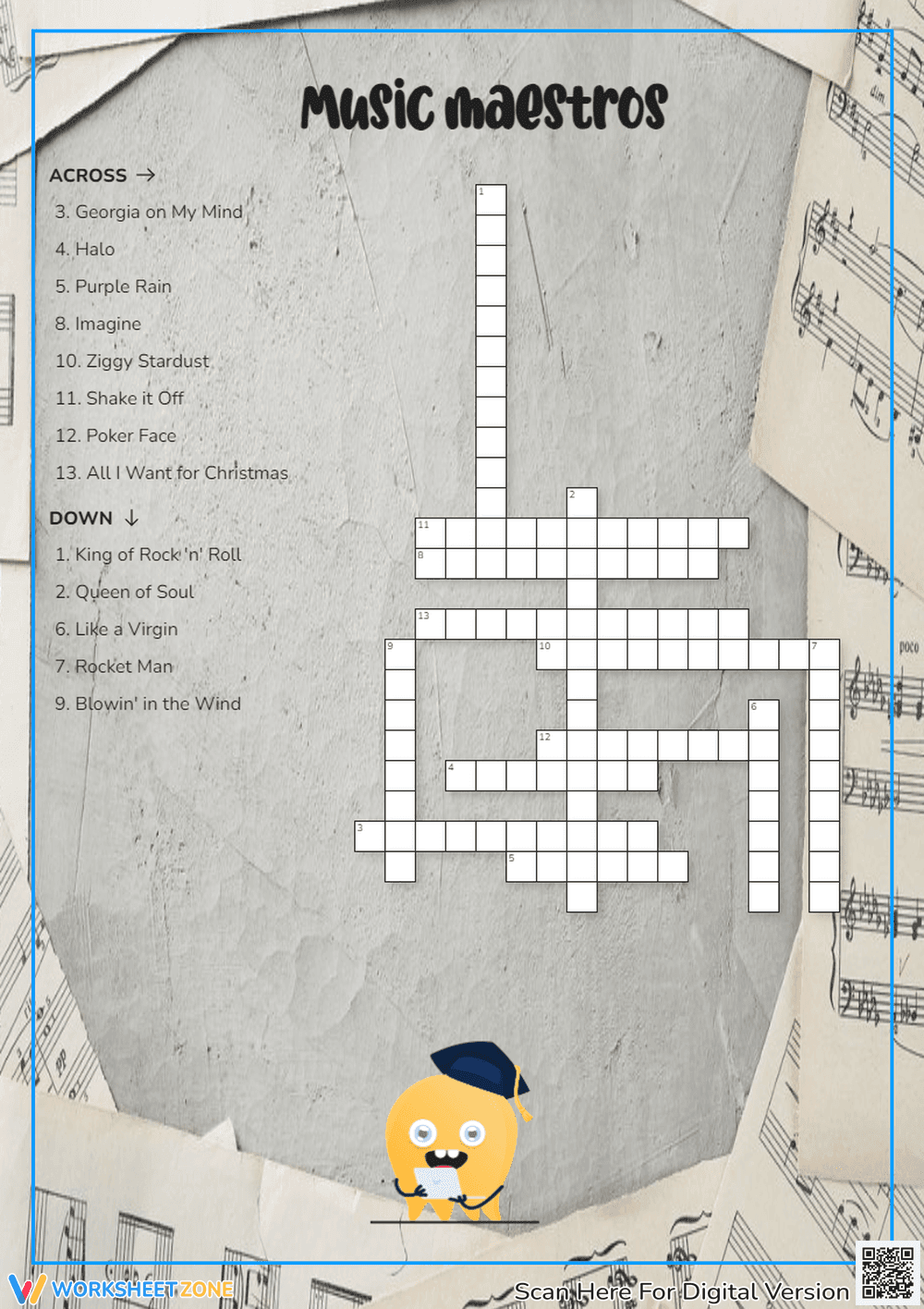

Music Maestros Crossword | Grade 2-4 Printable
Paste this activity's link or code into your existing LMS (Google Classroom, Canvas, Teams, Schoology, Moodle, etc.).
Students can open and work on the activity right away, with no student login required.
You'll still be able to track student progress and results from your teacher account.
This Grade 2-4 music history worksheet challenges students to identify legendary maestros and their iconic songs through an engaging crossword format. By connecting famous titles like Purple Rain and Halo to their creators, students reinforce their cultural literacy and spelling skills. This activity provides a structured way for learners to demonstrate their knowledge of musical influences.
At a Glance
- Grade: 2-4 · Subject: Music
- Standard:
MU:Cn11.0.3a— Demonstrate how interests and knowledge relate to responding to music- Skill Focus: Music History & Artist Identification
- Format: 1 page · 13 problems · Answer key included · PDF
- Best For: Music appreciation bell ringers or sub plans
- Time: 15–20 minutes
What's Inside: This resource features a professionally designed crossword grid containing 13 distinct clues divided into Across and Down sections. The clues reference a diverse range of artists, from the King of Rock 'n' Roll to modern pop icons. The single-page layout is optimized for clear printing, and a comprehensive answer key is provided to ensure quick and accurate grading.
First, print the single-page PDF (30 seconds). Second, distribute the sheets to students as they enter the room or during a transition period (1 minute). Third, review the answers using the included key to facilitate a brief discussion about the artists mentioned (5 minutes). Total teacher preparation time is under 2 minutes, making this an ideal solution for unexpected schedule changes or as a reliable sub-plan component.
Standards Alignment: This worksheet is primarily aligned with MU:Cn11.0.3a: "Demonstrate how interests, knowledge, and ideas relate to personal choices and intent when creating, performing, and responding to music." It also supports CCSS.ELA-LITERACY.L.3.4 by encouraging vocabulary acquisition through context clues. Both standard codes can be copied directly into lesson plans, IEP goals, or district curriculum mapping tools.
How to Use It: Assign this crossword as a hook at the beginning of a unit on music genres to gauge prior student knowledge. Alternatively, use it as a formative assessment after a lesson on 20th-century musical influencers. Observe how students use the length of the grid boxes to self-correct their spelling of artist names. Expected completion time is 15 to 20 minutes.
Who It's For: This activity is tailored for elementary students in grades 2 through 4 who are exploring music appreciation or general arts. It is particularly effective for visual learners who benefit from the spatial logic of puzzles. Pair this worksheet with a curated playlist of the mentioned songs to create a multi-sensory learning experience during independent work time.
The Music Maestros Crossword Puzzle aligns with standard MU:Cn11.0.3a, focusing on the intersection of cultural knowledge and musical appreciation. By identifying artists like Elvis Presley and Beyonce through their signature works, students develop a contextual framework for music history. Research from RAND AIRS 2024 indicates that gamified vocabulary tools, such as crosswords, significantly increase student engagement and retention of non-academic factual knowledge compared to rote memorization. This worksheet provides 13 specific data points that challenge students to recall and spell the names of influential maestros across various genres. Integrating these interactive elements into the curriculum supports the development of cultural literacy and auditory recognition skills. Educators can use this resource to bridge the gap between contemporary interests and historical musical foundations, ensuring a well-rounded arts education.


