































Multiplying by 7s: Complete Mixed Review Worksheet

Paste this activity's link or code into your existing LMS (Google Classroom, Canvas, Teams, Schoology, Moodle, etc.).
Students can open and work on the activity right away, with no student login required.
You'll still be able to track student progress and results from your teacher account.
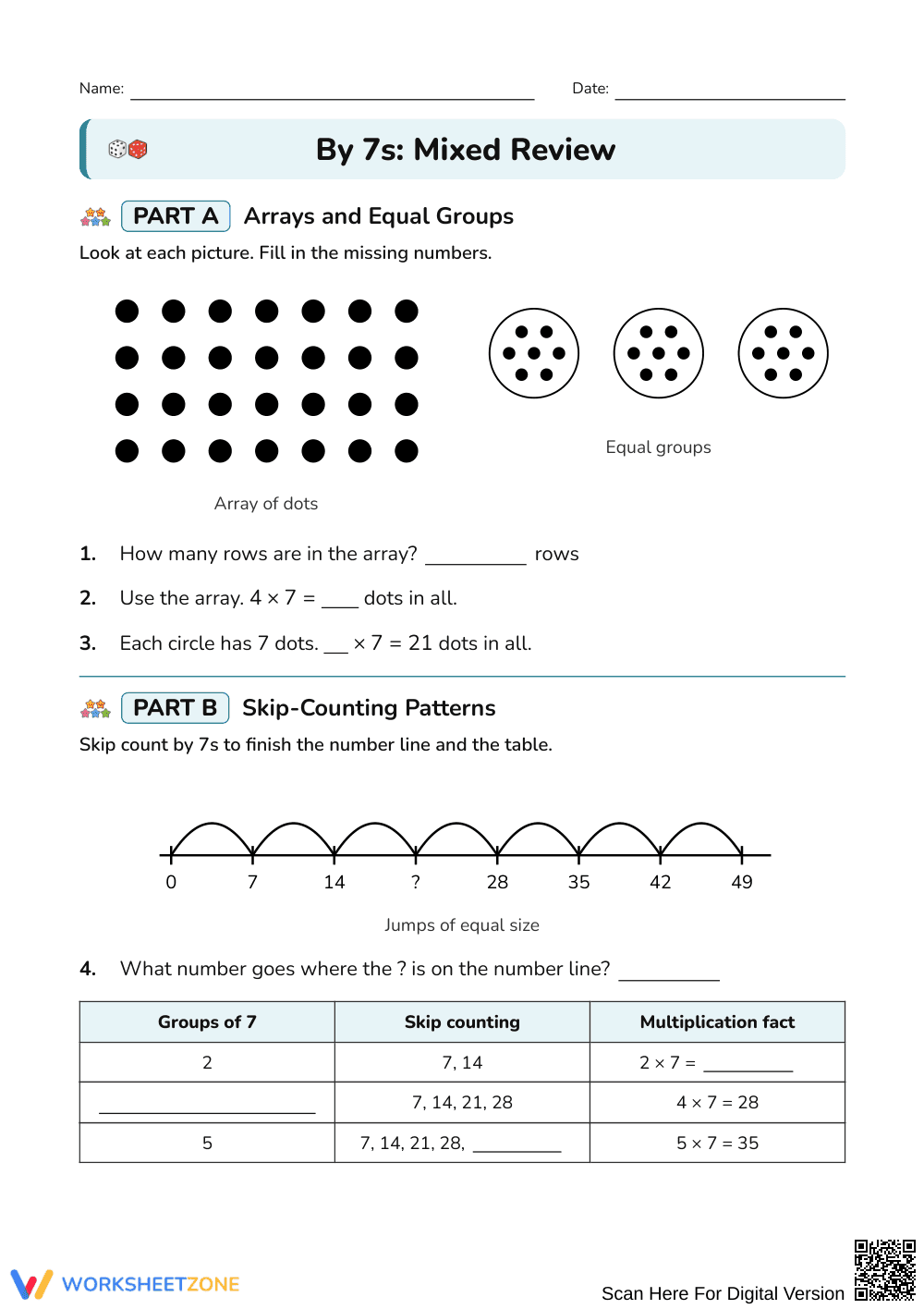
This Grade 3 math worksheet strengthens multiplication fluency for the seven times table through visual models, skip-counting sequences, missing factors, and word problems. Designed to build conceptual depth alongside procedural fluency, it equips learners to decompose factors and solve products within 100.
At a Glance
- Grade: 3 · Subject: Elementary Mathematics
- Standard:
3.OA.C.7— Fluently multiply and divide within 100 using strategies and operations- Skill Focus: Multiplying by 7s using models, patterns, and properties
- Format: 2 pages · 18 problems · Complete answer key included · Printable PDF
- Best For: Daily independent practice and targeted skills review
- Time: 20–30 minutes
What's Inside
The 2-page resource features 18 targeted tasks across four structured sections. Students examine dot arrays and equal groups in Part A, complete skip-counting sequences in Part B, calculate basic facts and missing factors in Part C, and apply strategic reasoning to word problems in Part D. A complete 2-page answer key provides strategic models.
Skill Progression
- Guided practice (Tasks 1–3): Visual representations provide support as learners identify dot rows and calculate equal groups using picture scaffolds.
- Supported practice (Tasks 4–13): Skip-counting tracks, structured tables, and missing-factor equations prompt students to connect number patterns to multiplication facts.
- Independent practice (Tasks 14–18): Word problems require learners to justify calculation methods, evaluate student errors, and solve division applications.
This architecture follows a gradual-release model, moving from teacher modeling to independent mastery.
Standards Alignment
This worksheet aligns directly with primary standard `3.OA.C.7`: Fluently multiply and divide within 100, using properties of operations and relationships between operations. In addition, contextual tasks support standard `3.OA.A.3` by engaging students in equal-group multiplication word problems. Both standard codes can be copied directly into lesson plans, IEP goals, or district curriculum mapping tools.
How to Use It
Deploy this worksheet during independent practice, directly following instruction on distributive decomposition strategies. It also works as a mid-unit formative check to evaluate individual computational accuracy. During completion, observe whether students rely on repeated addition or decompose factors like 8 into 5 and 3. Most Grade 3 students finish all 18 tasks within 20 to 30 minutes.
Who It's For
This activity targets third-grade learners mastering their multiplication facts, while supporting Tier 2 intervention students through visual dot grouping. For students needing support, provide physical counters or a hundreds chart. Pair this worksheet naturally with an anchor chart illustrating the distributive property of multiplication.
Developing automaticity with challenging multiplication combinations requires a structured pedagogical progression from concrete visual arrays to conceptual number relationships. Grounded in research by Fisher & Frey (2014) on the gradual release of responsibility framework, this curriculum resource systematically guides third-grade students toward rigorous mastery of standard 3.OA.C.7. By intentionally linking equal-group models and skip-counting sequences to abstract missing-factor equations, students cultivate procedural multiplication fluency for seven times tables while internalizing the distributive property. Empirical studies demonstrate that pairing representational visual scaffolding with purposeful metacognitive strategy selection significantly improves long-term arithmetic fact retention and proportional reasoning compared to isolated rote drill sheets. Classroom educators can confidently utilize this comprehensive 18-task sequence to identify specific calculation misconceptions, bridge elementary arithmetic reasoning directly into formal algebraic thinking, and ensure verifiable standards-based mastery across diverse elementary instructional settings.


