































Multiplying by 1s: Complete Cumulative Assessment

Paste this activity's link or code into your existing LMS (Google Classroom, Canvas, Teams, Schoology, Moodle, etc.).
Students can open and work on the activity right away, with no student login required.
You'll still be able to track student progress and results from your teacher account.
This Grade 3 cumulative assessment evaluates multiplication fluency for multiplying by 1 through 23 structured math problems. Students demonstrate mastery of the identity property across equal groups, visual arrays, number line patterns, missing factors, and word problems. By connecting visual models to abstract computation, learners show complete conceptual understanding and operational fluency.
At a Glance
- Grade: Grade 3 · Subject: Elementary Mathematics
- Standard:
3.OA.C.7— Multiply fluently within 100 using arrays, equal groups, and related operational properties- Skill Focus: Multiplication fluency and reasoning for times-one facts
- Format: 3 pages · 23 total problems · Full answer key included · Printable PDF
- Best For: End-of-unit cumulative topic assessment
- Time: 30–45 instructional minutes
What's Inside
This three-page assessment features four balanced sections targeting single-digit and double-digit multiplication by 1. Students interact with visual representations including equal group diagrams, rectangular arrays, and jump-labeled number lines alongside abstract equations, fact family triangles, and open-response word problems. A complete three-page answer key provides step-by-step solutions and model explanations for every question.
Skill Progression
- Guided practice (Part A, 2 tasks): Students analyze visual equal group models and rectangular arrays with concrete row and column prompts to establish conceptual foundations.
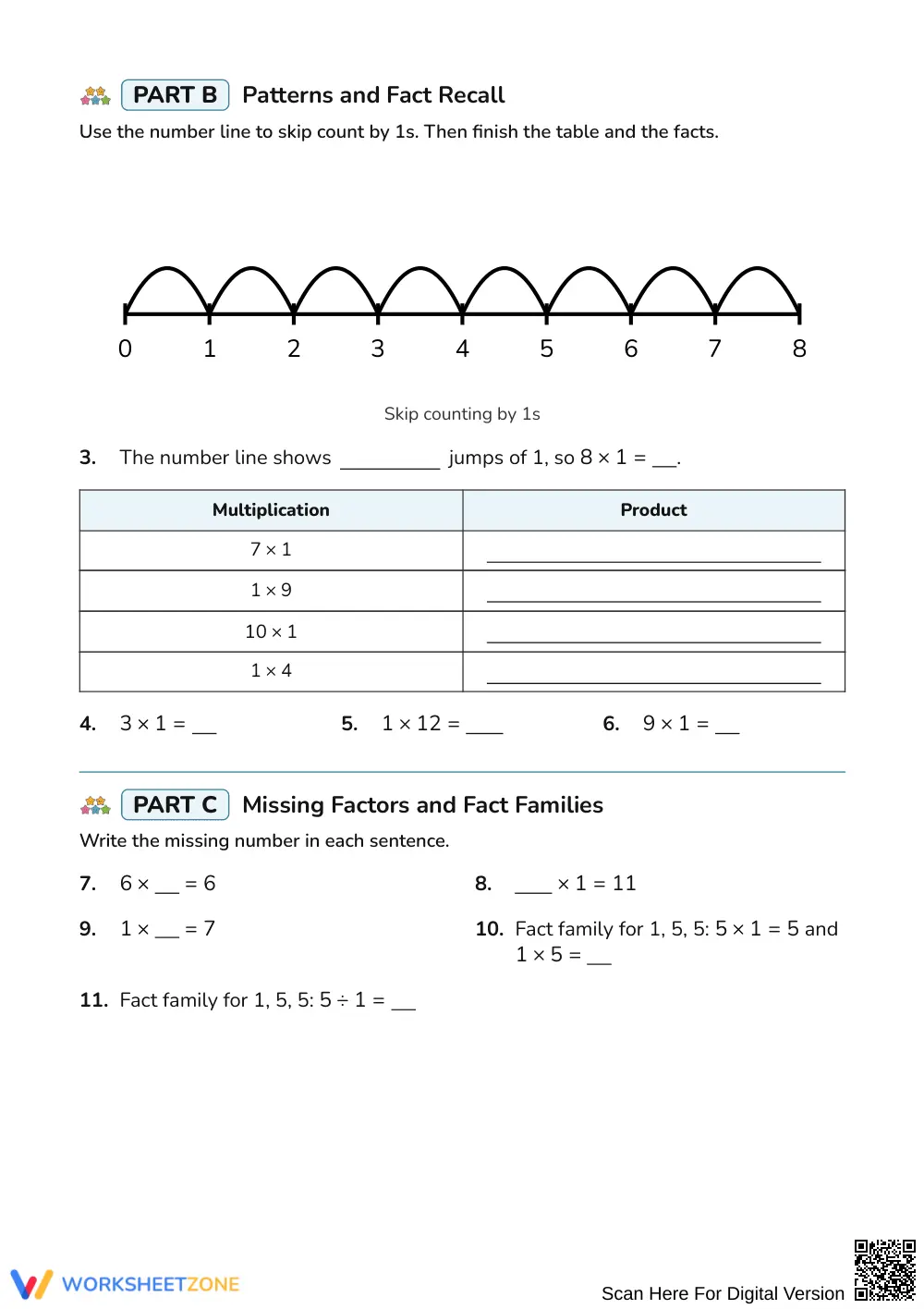
- Supported practice (Parts B & C, 16 tasks): Learners complete number line skip-counting, input-output factor tables, missing factor equations, and related multiplication-division fact families with structured visual aids.
- Independent practice (Part D, 5 tasks): Students solve real-world word problems, select matching equations, and construct written mathematical justifications evaluating peer claims.
This deliberate sequence reflects the gradual release of responsibility model, guiding students systematically from concrete representations to independent mathematical reasoning.
Standards Alignment
This resource aligns directly with primary standard 3.OA.C.7: Fluently multiply and divide within 100, using strategies such as the relationship between multiplication and division or properties of operations. Foundational work also supports 3.OA.A.1 by interpreting products of whole numbers through arrays and equal groups. Both standard codes can be copied directly into lesson plans, IEP goals, or district curriculum mapping tools.
How to Use It
Administer this assessment after completing direct instruction on multiplying by 1 to measure summative topic mastery, or divide the sections across two days for targeted formative checkpoints. During completion, monitor whether students automatically apply the identity property or continue relying on manual skip-counting. Expect students to complete the 23 items in 30 to 45 minutes.
Who It's For
This resource serves general education third-grade classrooms, math intervention groups, and special education students tracking IEP multiplication goals. Teachers can offer counters or grid paper to students needing sensory scaffolds before testing abstract recall. Pair this sheet with a multiplication properties anchor chart to reinforce the identity property before formal assessment.
Mastering basic multiplication facts forms the cornerstone of third-grade mathematical development under 3.OA.C.7. This 23-task assessment evaluates student multiplication fluency for times-one facts across multiple representations, including equal groups, rectangular arrays, number lines, and fact families. According to Fisher & Frey (2014), structured progressions that transition from visual modeling to independent reasoning optimize cognitive retention and reduce procedural errors in elementary mathematics. By requiring learners to justify why any factor multiplied by 1 retains its identity and evaluate peer misconceptions, the assessment measures both procedural automaticity and deep conceptual understanding. Students synthesize multiplication and division relationships within related fact families, ensuring readiness for multi-digit computation and algebraic problem solving. Educators receive actionable diagnostic data across 3 pages to verify mastery or target specific foundational interventions before advancing to subsequent multiplication tables.


