































Multiplying by 11s: Complete Worked Examples

Paste this activity's link or code into your existing LMS (Google Classroom, Canvas, Teams, Schoology, Moodle, etc.).
Students can open and work on the activity right away, with no student login required.
You'll still be able to track student progress and results from your teacher account.
This Grade 3 math worksheet develops multiplication fluency with 14 structured problems focusing on multiplying by 11s. Students study step-by-step worked examples with missing reasoning steps, relate visual models to multiplication sentences, and explain key mathematical concepts across equal groups, arrays, and skip-counting.
At a Glance
- Grade: 3 · Subject: Math
- Standard:
3.OA.A.3— Multiply within 100 to solve word problems involving equal groups and arrays.- Skill Focus: Multiplying by 11s using models and reasoning
- Format: 3 pages · 14 problems · Answer key included · PDF
- Best For: Small group instruction and guided practice
- Time: 30–40 minutes
What's Inside
This 3-page printable worksheet includes 14 scaffolded problems organized into three core parts. Each section provides an explicit worked example featuring step-by-step guidance and written reasoning prompts. Students examine equal groups of marbles, decompose arrays into tens and ones, and complete number line skip-counting to determine unknown factors. A 3-page answer key provides complete solutions.
Skill Progression
- Guided practice (Part A, 4 problems): Students analyze marble group models, complete repeated addition statements, and explain connections to multiplication facts.
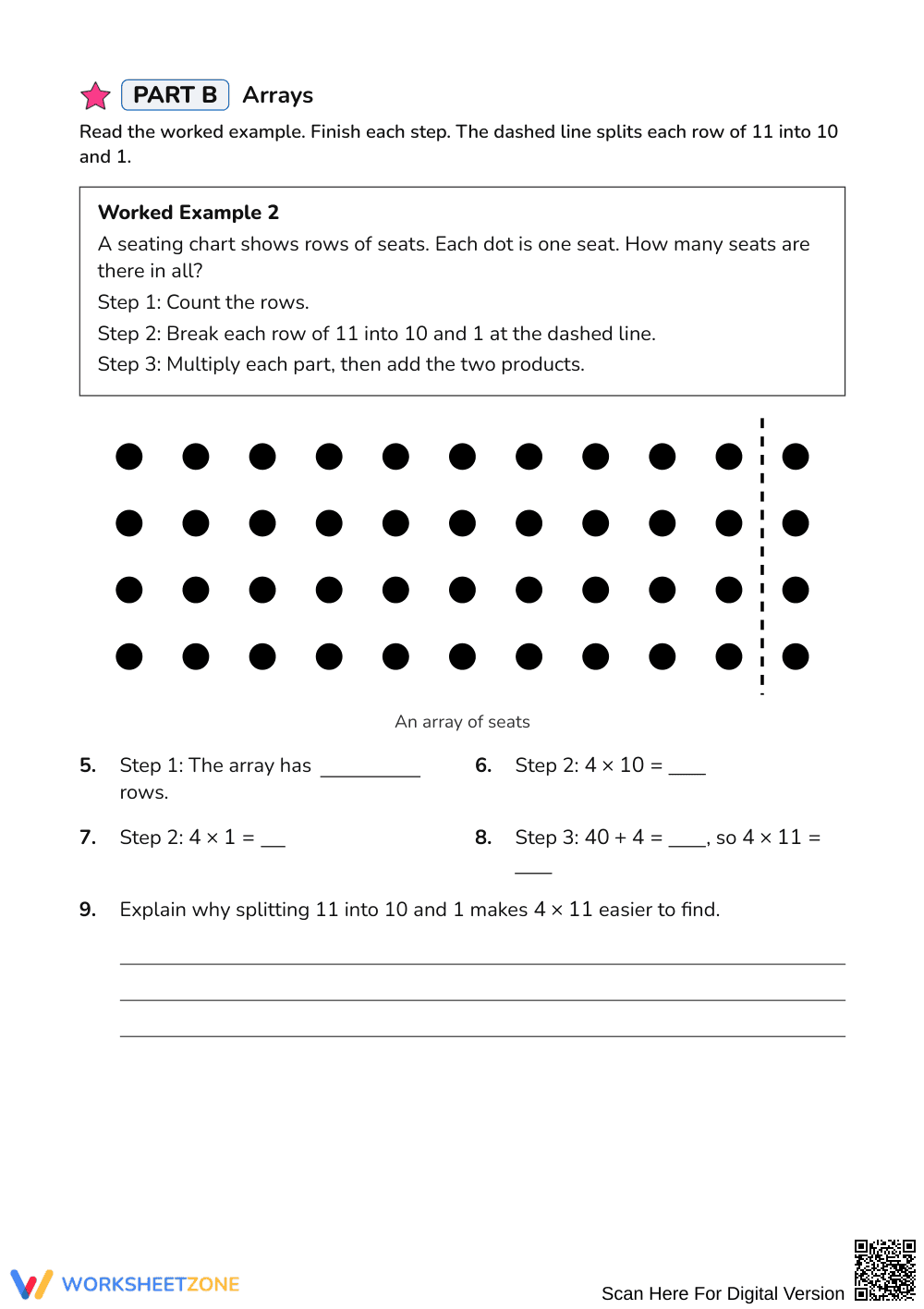
- Supported practice (Part B, 5 problems): Students break 11 into 10 and 1 using visual arrays and complete distributive decomposition steps.
- Independent practice (Part C, 5 problems): Students skip-count along number lines, find missing factors, and verify products using related division facts.
This gradual-release structure moves students from supported visual analysis to independent arithmetic reasoning.
Standards Alignment
This resource aligns with primary standard `3.OA.A.3`, solving multiplication word problems using equal groups and arrays. It also supports `3.OA.B.5` through distributive property factor decomposition. Both standard codes can be copied directly into lesson plans, IEP goals, or district curriculum mapping tools.
How to Use It
Use this worksheet during independent practice following direct instruction on the 11s multiplication facts, or during targeted intervention for students needing conceptual scaffolding. Formatively assess whether learners can explain why decomposing 11 into 10 and 1 simplifies multi-digit multiplication. Expected completion time is 30 to 40 minutes.
Who It's For
This resource serves Grade 3 general education math students mastering multi-digit facts and Grade 4 learners requiring targeted remediation. English language learners benefit from the explicit worked examples and structured sentence frames. Pair this activity with an array anchor chart or base-ten blocks during instruction.
Mastering multiplication within 100 under standard 3.OA.A.3 requires students to move beyond rote memorization by connecting concrete visual models to abstract arithmetic operations. According to research on explicit instruction by Fisher & Frey (2014), gradual-release instructional designs that incorporate scaffolded worked examples with reflective prompts significantly improve student problem-solving efficacy and mathematical discourse. This 3-page Grade 3 resource delivers 14 targeted tasks that systematically scaffold multiplication by 11s across equal-group representations, array decompositions, and number-line skip-counting. By prompting young learners to explain the mathematical reasoning behind decomposing factors into tens and ones and relating repeated addition to multiplication sentences, the material strengthens both procedural fluency and conceptual comprehension. Educators can implement this structured practice to diagnose misconception patterns rapidly, reinforce foundational properties of operations, and support verified standards-based mastery across diverse elementary mathematics classrooms.


