































Multiplying by 11: Printable Error Analysis

Paste this activity's link or code into your existing LMS (Google Classroom, Canvas, Teams, Schoology, Moodle, etc.).
Students can open and work on the activity right away, with no student login required.
You'll still be able to track student progress and results from your teacher account.
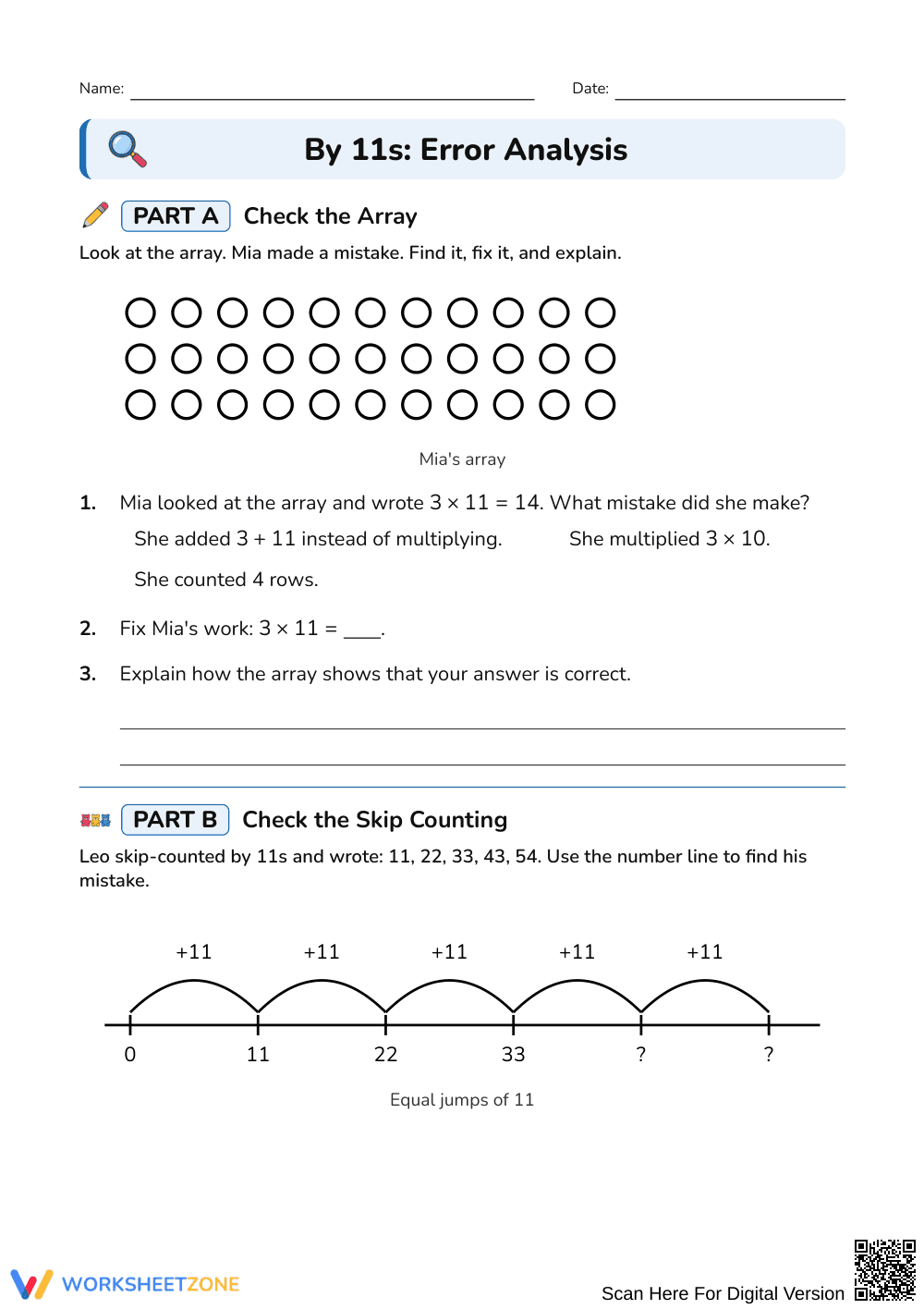
This Grade 3 math worksheet strengthens multiplication fluency by training students to identify, correct, and explain common calculation errors with the 11s facts. By analyzing flawed arrays, faulty skip-counting sequences, and misapplied place-value patterns, learners develop diagnostic reasoning and achieve durable conceptual mastery across 24 focused tasks.
At a Glance
- Grade: 3 · Subject: Math
- Standard:
3.OA.C.7— Fluently multiply and divide within 100 using strategies and properties- Skill Focus: Error analysis in multiplying by 11
- Format: 3 pages · 24 problems · Answer key included · PDF
- Best For: Targeted math intervention and guided practice
- Time: 25–35 minutes
Across 3 printable pages, students engage with visual models, number line representations, fact verification tables, and word-problem scenarios. The resource includes visual arrays, equal-jump skip-counting diagrams, and fact-family equations, paired with a complete 3-page answer key that provides full written explanations for every corrected problem.
Skill Progression
- Guided practice (Part A): Students examine a visual array with scaffolded prompts to diagnose addition-versus-multiplication confusion, correcting 3 × 11 with explicit row-and-column models (3 problems).
- Supported practice (Parts B & C): Learners analyze skip-counting jumps on a number line and verify a 5-fact table, detecting place-value slips like overextending two-digit repeating patterns (13 problems).
- Independent practice (Part D): Students independently evaluate division inverse relationships, fact families, and multi-step word problems involving boxes of items (8 problems).
This systematic structure implements a gradual-release model, shifting students from visual diagnosis to independent mathematical critique.
Standards Alignment
This worksheet aligns directly to primary standard `3.OA.C.7`: Fluently multiply and divide within 100, using properties of operations and the relationship between multiplication and division. Supporting standard `3.OA.B.5` applies properties of operations as strategies to multiply. Both standard codes can be copied directly into lesson plans, IEP goals, or district curriculum mapping tools.
How to Use It
Implement this activity during small-group guided instruction or as an after-lesson formative checkpoint following direct instruction on 11s multiplication. During completion, observe whether students confuse adding 10 versus adding 11 on the number line or overgeneralize double-digit symmetry to 10 × 11. Students typically complete the 24 problems within 25 to 35 minutes.
Who It's For
This resource supports Grade 3 general education students, Tier 2 math intervention groups, and special education resource rooms needing conceptual reinforcement with multiplication. Pair this practice packet directly with a physical base-ten block station or an 11s multiplication anchor chart illustrating equal-groups arrays.
Targeted error analysis provides an evidence-based mechanism for cementing multiplication fluency under 3.OA.C.7, requiring students to evaluate mathematical reasoning rather than memorize answers mechanically. In their foundational instructional research, Fisher & Frey (2014) demonstrated that presenting learners with authentic student errors prompts metacognitive reflection, closing persistent conceptual gaps through structured corrective explanation. This worksheet operationalizes that pedagogical framework by prompting third-grade students to pinpoint why common missteps occur when multiplying by 11, such as confusing repeated addition with addition of factors or overextending the repeating-digit heuristic past single-digit multipliers. By systematically shifting from identifying computational errors to providing written justifications with arrays and number lines, students internalize the inverse relationship between multiplication and division. The resulting diagnostic practice builds resilient procedural accuracy and conceptual flexibility, ensuring that learners achieve sustainable mastery of basic multiplication facts across diverse elementary classroom settings.


