


























Views
Downloads




Essential Multiplication Tables 2, 3, 4 Worksheet | Grade 3
Paste this activity's link or code into your existing LMS (Google Classroom, Canvas, Teams, Schoology, Moodle, etc.).
Students can open and work on the activity right away, with no student login required.
You'll still be able to track student progress and results from your teacher account.
Building Multiplication Fluency with Tables 2, 3, and 4
This essential multiplication tables worksheet provides an efficient way for students to master the facts for the 2, 3, and 4 times tables. By focusing on these specific multiples, learners build the fluency required for multi-digit operations and algebraic thinking. The clear layout ensures students stay focused on numerical relationships.
At a Glance
- Grade: 3 · Subject: Math
- Standard:
CCSS.MATH.CONTENT.3.OA.C.7— Fluently multiply within 100, using strategies such as the relationship between multiplication and division- Skill Focus: Multiplication Tables 2, 3, 4
- Format: 5 pages · 36 problems · Answer key included · PDF
- Best For: Daily multiplication drills and fluency practice
- Time: 15–20 minutes
What's Inside
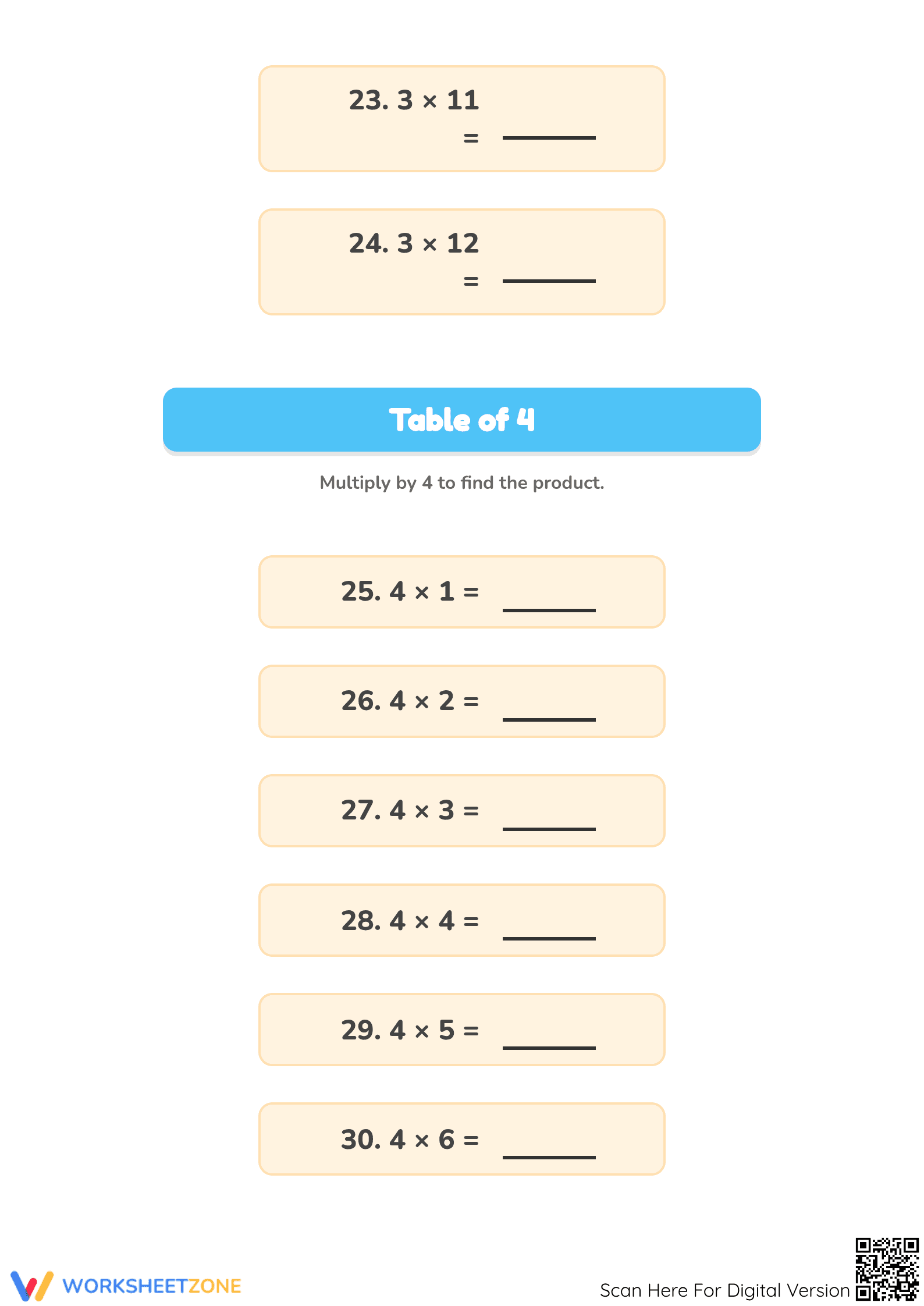
This five-page PDF packet contains 36 targeted multiplication problems. Each page is organized into sections: "Table of 2," "Table of 3," and "Table of 4." Facts are presented from 1 through 12, allowing students to internalize skip counting patterns. The worksheet includes fields for name, date, and score. A full answer key is included for rapid grading or student self-correction.
Zero-Prep Workflow
This resource is designed for a three-step implementation: Print the five-page packet (30 seconds), Distribute to students for immediate work (1 minute), and Review using the included answer key (2 minutes). Total teacher prep time remains under 2 minutes. This streamlined workflow makes the worksheet an ideal selection for last-minute substitute plans or unexpected gaps in the instructional day.
Standards Alignment
The primary focus is CCSS.MATH.CONTENT.3.OA.C.7, which requires students to fluently multiply within 100. This systematic approach supports the progression toward the Grade 3 goal of knowing all single-digit products from memory. Both standard codes can be copied directly into lesson plans, IEP goals, or district curriculum mapping tools to ensure instructional alignment.
How to Use It
Incorporate this worksheet into your routine as a high-frequency drill. Set a timer and observe which students rely on counting versus those who demonstrate automatic recall. This identifies learners needing scaffolding with arrays. Alternatively, assign specific pages as homework to reinforce tables introduced during instruction. The predictable format reduces cognitive load, allowing students to focus on fluency.
Who It's For
This resource is for third-grade students working toward multiplication mastery. It serves as a challenge for second graders and a rapid intervention for fourth graders needing review. The "Table of 2" provides an entry point for students with diverse learning needs who require success with smaller multiples before moving to higher numbers.
Research demonstrates that building automaticity with basic multiplication facts is a prerequisite for higher-level mathematics. According to Fisher & Frey (2014), the gradual release of responsibility model is most effective when supported by structured practice that isolates specific skills. This Grade 3 math worksheet on multiplication tables 2, 3, and 4 provides that structure, moving students from pattern exploration to independent fluency. By aligning with CCSS.MATH.CONTENT.3.OA.C.7, the resource ensures practice is tied to rigorous state standards. A 2024 analysis of instructional materials suggests that frequent, low-stakes drills like those in this 36-problem packet lead to higher retention than isolated assessments. Teachers can use these 5 pages to provide the consistent repetition necessary for students to move facts to long-term storage, ultimately freeing up cognitive resources for complex problem-solving and multi-step mathematical operations in subsequent grades.


