


























Views
Downloads


Essential Grade 2 Multiples of 5 Worksheet | Skip Counting
Paste this activity's link or code into your existing LMS (Google Classroom, Canvas, Teams, Schoology, Moodle, etc.).
Students can open and work on the activity right away, with no student login required.
You'll still be able to track student progress and results from your teacher account.
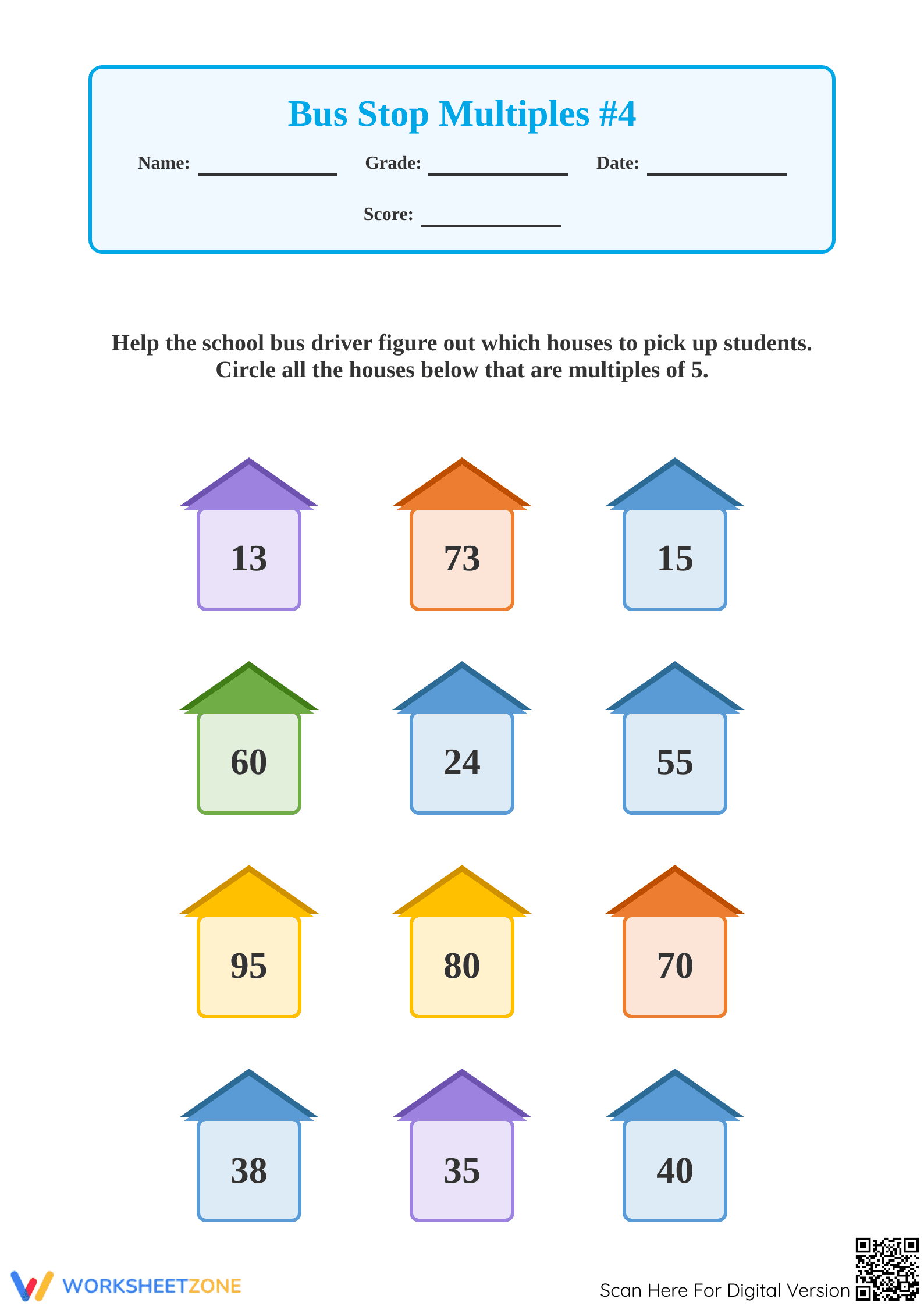
Strengthen early numeracy skills with this focused mathematics resource designed to help second-grade students master multiples of five. By engaging with a relatable bus stop theme, learners identify specific numerical values that belong to the skip-counting sequence. This worksheet ensures students build the foundational patterns necessary for future multiplication and division proficiency through repetitive identification.
At a Glance
- Grade: 2 · Subject: Math
- Standard:
2.NBT.A.2— Skip-count by 5s, 10s, and 100s within 1000- Skill Focus: Identifying multiples of 5
- Format: 2 pages · 15 problems · Answer key included · PDF
- Best For: Morning work or quick skill checks
- Time: 10–15 minutes
This resource contains two pages of interactive content featuring fifteen distinct number houses. Each task requires students to evaluate a two-digit number and determine if it fits the criteria for a multiple of five. The structured layout includes a clear header for student information and a designated scoring area for quick grading. A complete answer key is provided to facilitate rapid review or self-correction sessions.
The zero-prep workflow for this activity is designed for maximum teacher efficiency. First, print the two-page document in approximately thirty seconds. Next, distribute the sheets to your class, which takes less than a minute. Finally, review the answers using the included key in under two minutes. This entire instructional cycle requires less than four minutes of teacher preparation, making it a perfect choice for unexpected sub plans or transition periods.
This worksheet is aligned to the primary standard `2.NBT.A.2`, which requires students to skip-count by 5s, 10s, and 100s. By focusing specifically on the multiples of five, students internalize the pattern of numbers ending in zero or five, which is a critical sub-skill for place value understanding. This standard code can be copied directly into lesson plans, IEP goals, or district curriculum mapping tools to ensure documented compliance with state frameworks.
Incorporate this activity during a math center rotation as an independent practice station. Alternatively, use it as a formative exit ticket at the end of a skip-counting lesson to gauge student understanding of numerical patterns. Teachers should observe whether students are counting by ones to verify each number or if they have recognized the visual pattern of the ones digit. Expect most second graders to complete the fifteen house identifications within fifteen minutes.
This resource is tailored for Grade 2 students who are developing their base-ten number sense. It provides essential support for learners who need a visual anchor for skip-counting patterns. This worksheet pairs naturally with a hundreds chart or a classroom number line to help students visualize the jumps between multiples. The clear font and spacious design accommodate young writers and those still mastering fine motor control.
Mastery of skip-counting by fives is a prerequisite for understanding the US currency system and telling time to the nearest five minutes. Research from EdReports 2024 emphasizes that fluency with these numerical patterns reduces the cognitive load during more complex operations like multi-digit addition. By isolating the `2.NBT.A.2` standard in this targeted format, students build the automaticity required for higher-order mathematical reasoning. Identifying multiples of five helps children recognize the underlying structure of our base-ten system, which is essential for mental math strategies. Consistent practice with these patterns allows students to transition from simple counting to multiplicative thinking, a shift that is vital for success in third-grade mathematics and beyond. This worksheet provides the repeated exposure needed for long-term retention of these foundational patterns.


