


























Views
Downloads

Printable Mr. Brown Can Moo Worksheet | Grade K-1 ELA
Paste this activity's link or code into your existing LMS (Google Classroom, Canvas, Teams, Schoology, Moodle, etc.).
Students can open and work on the activity right away, with no student login required.
You'll still be able to track student progress and results from your teacher account.
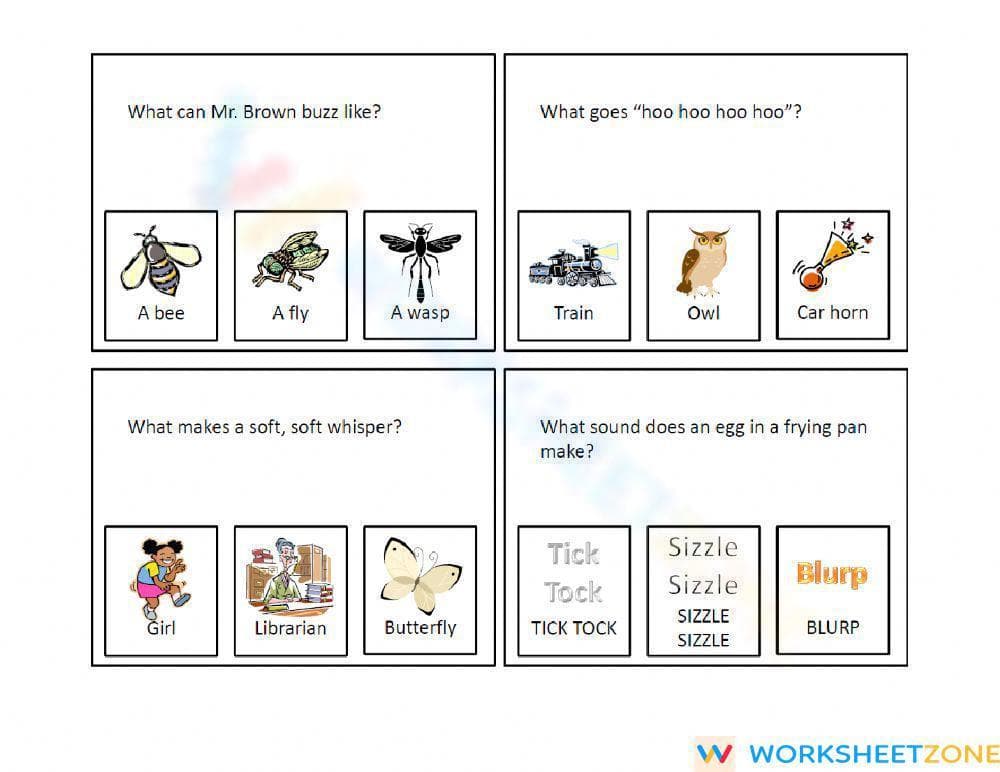
This printable Mr. Brown Can Moo worksheet helps Kindergarten and Grade 1 students master story recall. By matching onomatopoeia sounds to their sources, children develop essential phonological awareness and literal comprehension. This resource ensures young readers accurately identify key details from the Dr. Seuss text while engaging with high-interest imagery and clear visual prompts.
At a Glance
- Grade: K-1 · Subject: English Language Arts
- Standard:
CCSS.ELA-LITERACY.RL.K.1— Ask and answer questions about key details in a text- Skill Focus: Story recall and sound identification
- Format: 1 page · 4 problems · Answer key included · PDF
- Best For: Literacy centers and quick story checks
- Time: 10–15 minutes
The worksheet features a four-quadrant layout designed for early learners. Each quadrant presents a question based on the text, accompanied by three clear illustrations serving as multiple-choice options. This visual structure supports pre-readers and English Language Learners by reducing cognitive load. The single-page PDF includes a comprehensive answer key for quick verification during busy literacy blocks.
The zero-prep workflow for this resource is designed for efficiency. First, print the single-page PDF, taking 30 seconds for a full class set. Second, distribute materials during your literacy block in less than one minute. Finally, review answers as a whole group or individually using the provided key. This streamlined process makes it an ideal choice for emergency sub plans or quick formative assessments during busy instructional days.
Standards Alignment
This activity is aligned to the primary standard `CCSS.ELA-LITERACY.RL.K.1`, which requires students to answer questions about key details in a literature text. It also supports `CCSS.ELA-LITERACY.RF.K.2` by emphasizing the relationship between spoken sounds and their visual representations. Both standard codes can be copied directly into lesson plans, IEP goals, or district curriculum mapping tools to provide documented evidence of standards-based instruction.
How to Use It
Use this worksheet immediately following a read-aloud of the story to assess immediate recall. It serves as an excellent formative assessment during small-group instruction, allowing teachers to observe student responses. A helpful tip is to watch for students who vocalize the sounds before selecting their answer, indicating phonemic processing. Most students will complete the four tasks within a 10-minute window, providing immediate feedback on their comprehension.
Who It's For
This resource is tailored for Kindergarten and Grade 1 students, particularly those developing early literacy skills. It is highly effective for students requiring visual scaffolds or those in specialized education settings who benefit from structured, low-distraction tasks. Pair this worksheet with the original picture book or an audio recording to create a multi-sensory learning experience that reinforces text-to-sound connections.
The inclusion of visual multiple-choice questions in this resource aligns with the findings of Fisher & Frey (2014) regarding the importance of scaffolding for literal comprehension in early childhood education. By utilizing the `CCSS.ELA-LITERACY.RL.K.1` standard as a foundation, the worksheet builds the necessary story recall skills that precede higher-order analysis. The specific focus on onomatopoeia—identifying sounds like buzzing bees or sizzle sounds—directly supports phonological development as outlined in the NAEP framework. Research indicates that using high-interest texts like Dr. Seuss significantly increases engagement among reluctant readers. This 4-task activity provides a structured evidence-based approach to assessing whether a child can extract specific facts from a narrative. Education professionals can trust this tool to deliver measurable data on a student's ability to decode auditory information and link it to literary content effectively.


