


























Views
Downloads

Printable Punnett Square Worksheet | Grade 9 Biology
Paste this activity's link or code into your existing LMS (Google Classroom, Canvas, Teams, Schoology, Moodle, etc.).
Students can open and work on the activity right away, with no student login required.
You'll still be able to track student progress and results from your teacher account.
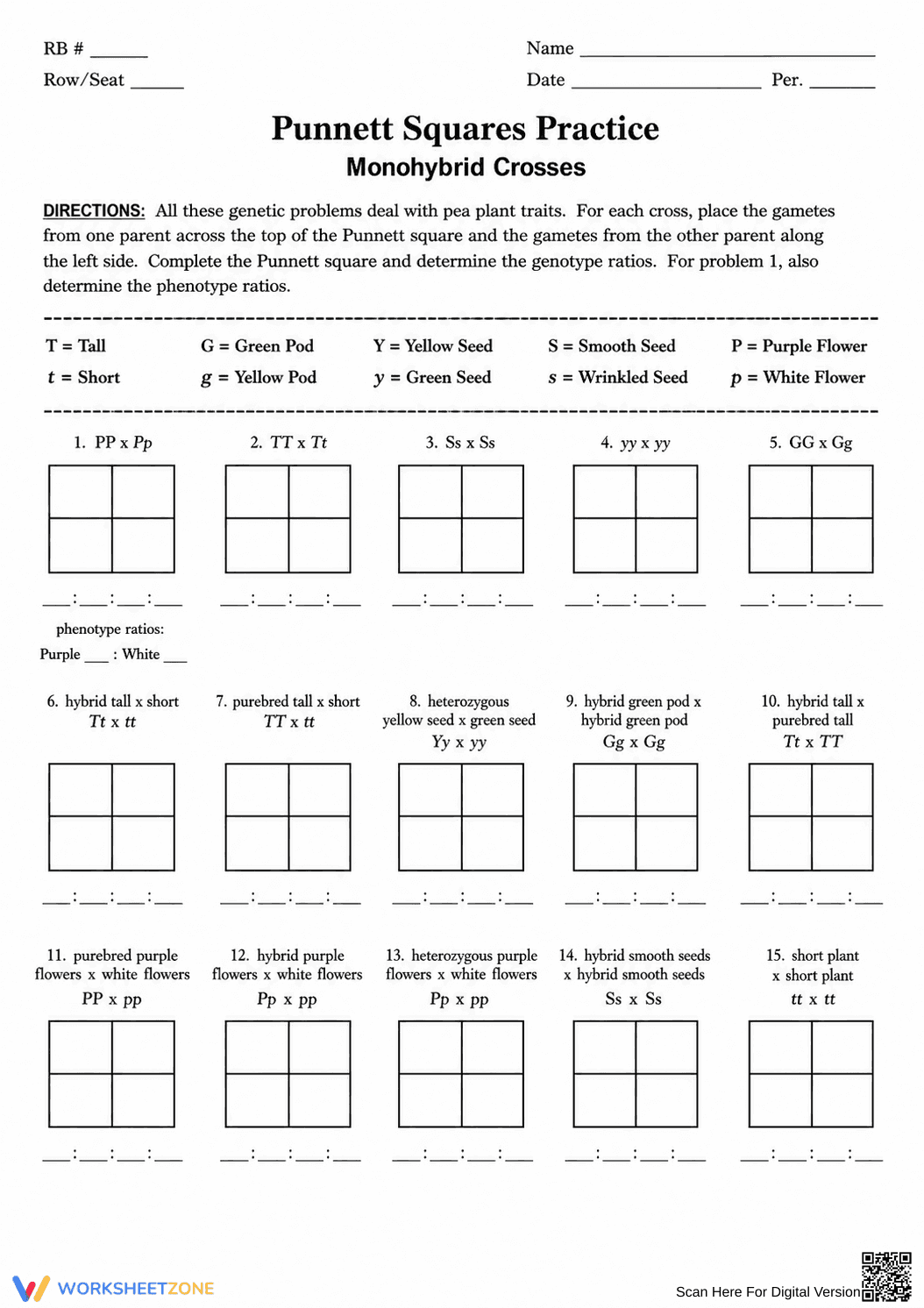
This printable biology worksheet gives students targeted practice with monohybrid crosses to predict genetic outcomes. By completing 15 distinct Punnett square problems, learners will determine genotype and phenotype ratios for various pea plant traits. This straightforward activity reinforces foundational Mendelian genetics concepts and builds confidence in predicting inheritance patterns.
At a Glance
- Grade: 9 · Subject: Biology
- Standard:
HS-LS3-3— Apply probability to explain trait variation- Skill Focus: Punnett squares and monohybrid crosses
- Format: 1 page · 15 problems · Answer key included · PDF
- Best For: Independent practice or homework
- Time: 20–30 minutes
This single-page resource features a clear reference key defining alleles for five classic pea plant traits, including stem height, pod color, and seed shape. Students are presented with 15 genetic crosses, ranging from simple homozygous pairings to more complex heterozygous combinations. Each problem includes a blank Punnett square and designated spaces to record the resulting genotype ratios, with the first problem also requiring a phenotype ratio calculation. A complete answer key is provided for quick grading.
- Print (1 minute): Simply print the single-page PDF. No special materials or complex setup required.
- Distribute (1 minute): Hand out the worksheets after your introductory lesson on Mendelian genetics. The built-in allele key means students have the reference data they need right on the page.
- Review (5 minutes): Use the included answer key to quickly check student work or project it on the board for self-correction. Total teacher prep time is under two minutes, making this an ideal emergency sub plan.
Aligned to primary standard HS-LS3-3: Apply concepts of statistics and probability to explain the variation and distribution of expressed traits in a population. By calculating genotype and phenotype ratios, students directly apply statistical thinking to biological inheritance. Both standard codes can be copied directly into lesson plans, IEP goals, or district curriculum mapping tools.
This worksheet is highly effective as independent practice immediately following direct instruction on monohybrid crosses. Teachers can also assign it as a focused homework task to solidify understanding before moving on to dihybrid crosses. As a formative assessment tip, observe whether students correctly place the parent gametes on the outside of the squares before filling in the offspring boxes. Expected completion time is 20 to 30 minutes.
Designed primarily for high school biology students, this resource is also appropriate for advanced middle school life science classes. For students needing extra support, teachers can complete the first three problems together as a guided model. This worksheet pairs perfectly with introductory anchor charts on dominant and recessive alleles.
Integrating structured practice with visual models like Punnett squares is essential for mastering genetic inheritance. Aligned with HS-LS3-3, this resource requires students to apply probability to explain trait variation. According to a ScienceDirect TpT Analysis (2024), providing students with repetitive, targeted practice using visual organizers significantly improves their ability to calculate and interpret statistical probabilities in biological contexts. By working through 15 distinct monohybrid crosses, learners transition from abstract concepts of alleles to concrete mathematical ratios. This methodical approach ensures that foundational Mendelian principles are firmly established before introducing more complex inheritance patterns. The clear formatting and embedded reference keys reduce cognitive load, allowing students to focus entirely on the mechanics of genetic probability and trait distribution.


