


























Views
Downloads

Essential Monohybrid Cross Worksheet | Grade 9-12 Biology
Paste this activity's link or code into your existing LMS (Google Classroom, Canvas, Teams, Schoology, Moodle, etc.).
Students can open and work on the activity right away, with no student login required.
You'll still be able to track student progress and results from your teacher account.
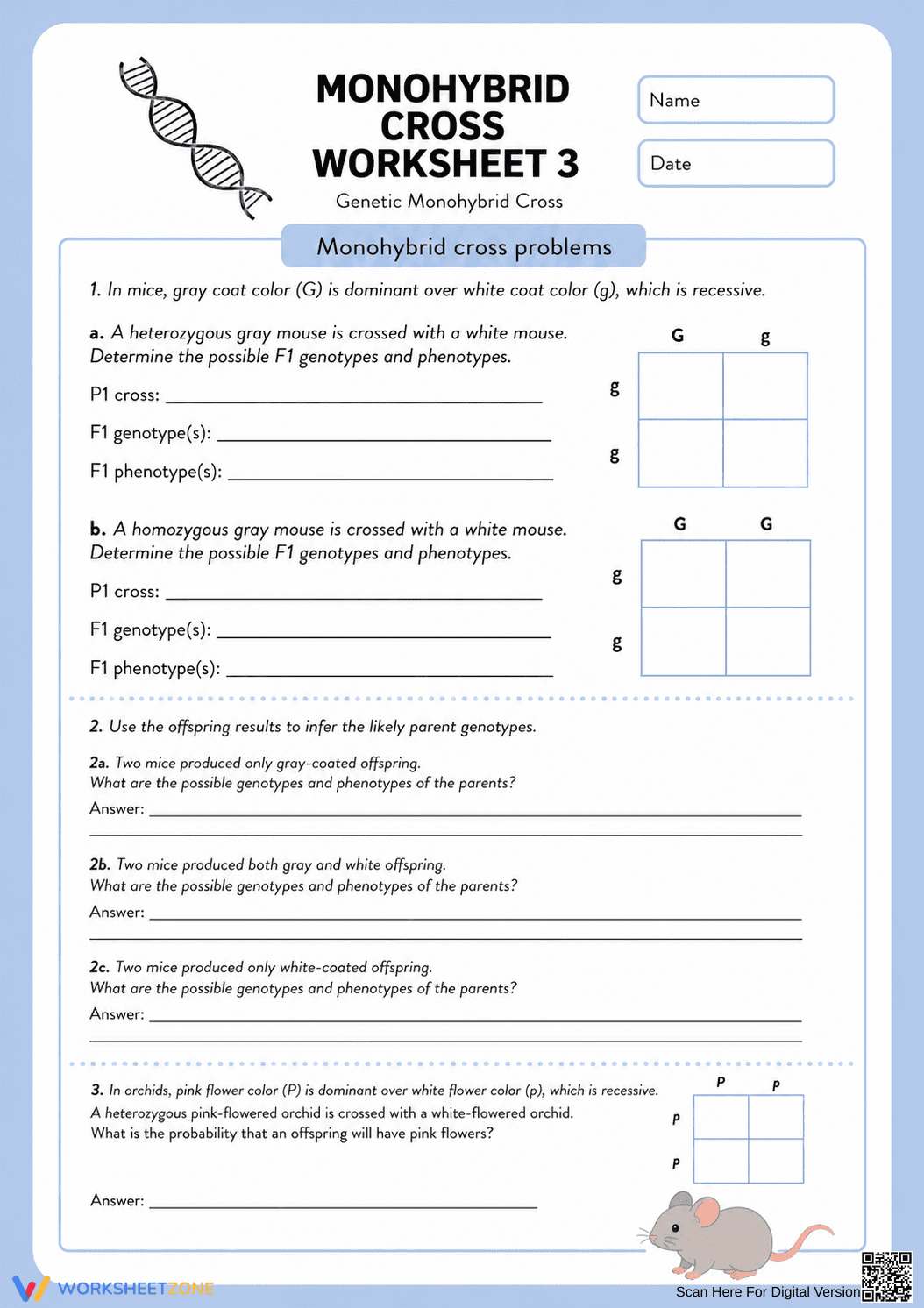
This monohybrid cross worksheet provides high school biology students with targeted practice in Mendelian genetics. By calculating allele distributions and predicting phenotypic ratios, learners develop a concrete understanding of how traits are inherited. Students will move beyond simple rote memorization to apply probability laws to biological scenarios involving mice and orchids.
At a Glance
- Grade: 9-12 · Subject: Biology
- Standard:
HS-LS3-3— Apply probability to explain the variation and distribution of expressed traits- Skill Focus: Monohybrid Crosses & Punnett Squares
- Format: 1 page · 6 problems · Answer key included · PDF
- Best For: Independent practice or formative assessment
- Time: 20–30 minutes
The worksheet contains six distinct genetic problems across one structured page. It features pre-drawn Punnett squares to scaffold student work and clear prompts for P1 crosses, F1 genotypes, and F1 phenotypes. The scenarios include dominant/recessive coat colors in mice and flower pigmentation in orchids, ensuring students practice with different variable sets and allele notations.
- Guided Practice: The first section provides the parental genotypes and pre-labeled Punnett squares, requiring students to fill in the 4-cell grid and identify resulting ratios for heterozygous and homozygous crosses.
- Supported Practice: Students transition to orchid genetics where they must determine the specific probability of phenotypes based on a heterozygous cross, requiring a deeper understanding of Mendelian ratios.
- Independent Practice: The final challenge requires students to work backward, inferring parental genotypes based on observed offspring phenotypes (e.g., "all gray" vs "mixed").
This sequence follows a gradual-release model, moving from simple calculation to higher-order logical inference.
This resource is aligned with HS-LS3-3: "Apply concepts of statistics and probability to explain the variation and distribution of expressed traits in a population." It also supports MS-LS3-2 for advanced middle schoolers. Both standard codes can be copied directly into lesson plans, IEP goals, or district curriculum mapping tools.
Use this worksheet as a mid-unit formative assessment after introducing Gregor Mendel’s laws. It is particularly effective for identifying students who struggle with the distinction between homozygous and heterozygous states. Teachers should observe students during Problem 2 to see if they can logically reverse-engineer a cross, which indicates true mastery. Expected completion time is 25 minutes.
This practice set is designed for Grade 9-12 Biology students, including those in Honors or AP tracks requiring a refresher on Mendelian basics. It pairs perfectly with a digital chromosome simulation or a physical "alien genetics" lab. The clear layout also supports English Language Learners by using consistent scientific terminology and visual Punnett square aids.
According to research by Fisher & Frey (2014) on the gradual release of responsibility, structured practice that moves from scaffolded calculation to independent inference is critical for long-term retention of complex scientific concepts like HS-LS3-3. This worksheet facilitates that transition by providing 6 specific tasks that require students to apply Mendelian probability to real-world biological examples. By requiring students to define genotypes and phenotypes explicitly, the resource ensures that the mathematical probability of a monohybrid cross is grounded in observable biological traits. Such targeted practice is essential for preparing students for high-stakes assessments that demand the application of genetic principles rather than simple recall. This resource provides the necessary repetition to ensure students can accurately predict trait distribution in any standard monohybrid scenario.


