


























Views
Downloads
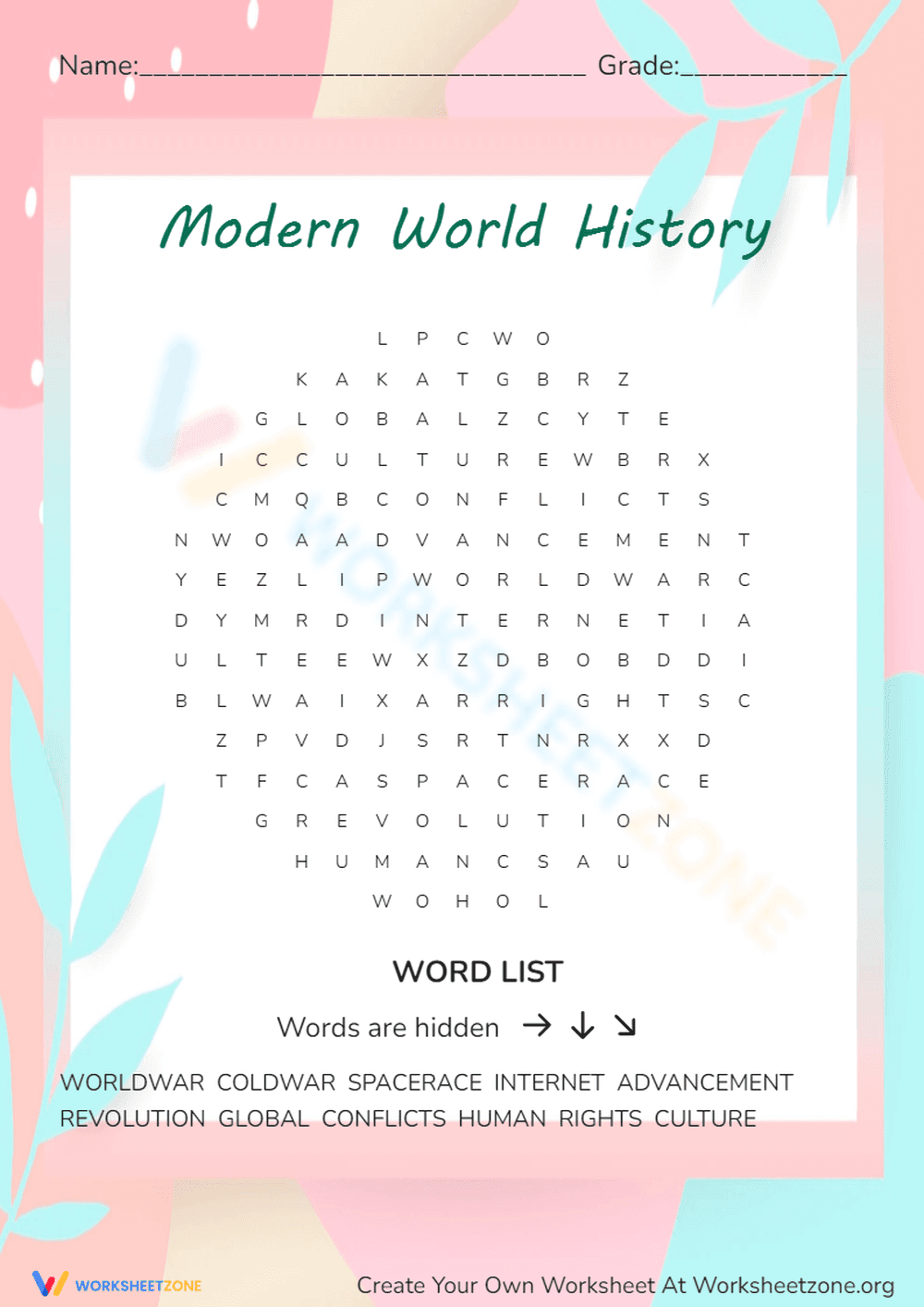

Modern World History Word Search | Grade 3-5 Essential
Paste this activity's link or code into your existing LMS (Google Classroom, Canvas, Teams, Schoology, Moodle, etc.).
Students can open and work on the activity right away, with no student login required.
You'll still be able to track student progress and results from your teacher account.
This Modern World History word search provides an engaging way for upper elementary students to identify and internalize key historical terminology. By searching for domain-specific vocabulary, learners build familiarity with the concepts that define the 20th and 21st centuries, from technological leaps to global social movements. It serves as an excellent bridge between direct instruction and independent reading.
At a Glance
- Grade: 3-5 · Subject: Social Studies
- Standard:
CCSS.ELA-LITERACY.L.3.6— Acquire and use accurately grade-appropriate general academic and domain-specific words- Skill Focus: Vocabulary Recognition
- Format: 1 page · 10 problems · Answer key included · PDF
- Best For: Early finishers or social studies warm-up
- Time: 10–15 minutes
The worksheet features a clean, 1-page layout with a 10-word list including terms like "Cold War," "Space Race," and "Human Rights." The grid is designed for readability, with words hidden horizontally, vertically, and diagonally. It includes a clear word bank at the bottom to support student tracking and an answer key for quick grading or self-correction.
This resource is designed for immediate classroom implementation with a total teacher prep time of under 2 minutes. Simply print the single-page PDF (30 seconds), distribute it to students as they enter or finish a primary task (30 seconds), and use the provided answer key for a rapid visual check or peer-grading session (1 minute). It serves as an ideal emergency sub plan component or a quiet transition activity during busy school days.
Primary alignment is to `CCSS.ELA-LITERACY.L.3.6`, focusing on the acquisition of domain-specific vocabulary related to history and social sciences. It also supports general literacy by reinforcing spelling patterns and visual scanning skills. Both standard codes can be copied directly into lesson plans, IEP goals, or district curriculum mapping tools to ensure compliance with state and federal literacy requirements.
Use this as a "hook" at the start of a unit on modern history to gauge prior knowledge of terms, or as a quiet transition activity following a heavy lecture. For a formative assessment, ask students to circle one word they found and write a one-sentence definition on the back. Completion typically takes 10 to 15 minutes, making it a flexible tool for various instructional blocks.
This activity is perfect for students in grades 3 through 5 who are beginning to explore global history. It is particularly effective for English Language Learners (ELLs) as a low-stakes introduction to complex terms. Pair this with a timeline anchor chart or a short reading passage about the Cold War for a complete, multi-modal lesson that supports diverse learning styles.
Research from Fisher & Frey (2014) emphasizes that domain-specific vocabulary acquisition is a cornerstone of content-area literacy, particularly in social studies where abstract concepts like "Global Conflicts" or "Advancement" require multiple exposures. This worksheet facilitates the initial exposure phase of the gradual release of responsibility model. By isolating 10 high-frequency historical terms in a visual search format, the activity reduces cognitive load while reinforcing the orthographic mapping of complex words. According to the NAEP framework, students who interact with specialized terminology through varied formats—including puzzles and word banks—demonstrate higher retention rates during summative assessments. This resource provides a structured, low-stakes environment for students to master the vocabulary required by CCSS.ELA-LITERACY.L.3.6, ensuring they are prepared for more rigorous text analysis and historical inquiry in subsequent lessons.


