




























Views
Downloads
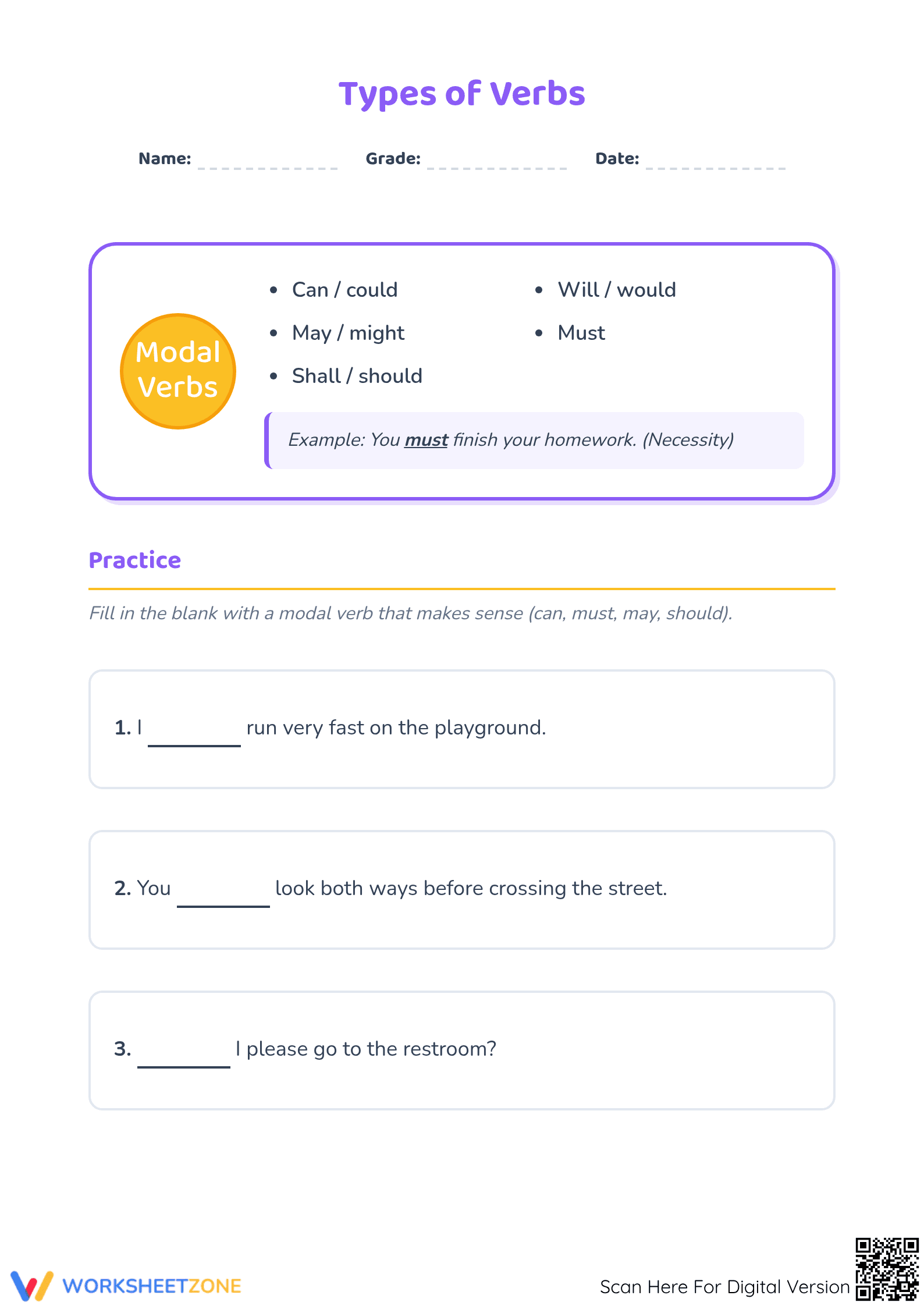


Printable Modal Verbs Worksheet | Grade 3 ELA

Paste this activity's link or code into your existing LMS (Google Classroom, Canvas, Teams, Schoology, Moodle, etc.).
Students can open and work on the activity right away, with no student login required.
You'll still be able to track student progress and results from your teacher account.
This focused worksheet helps students master modal verbs by providing clear examples and targeted practice. By completing these exercises, learners will understand how to use words like "can," "must," and "may" to express necessity and possibility in their everyday writing.
At a Glance
- Grade: 3 · Subject: ELA
- Standard:
CCSS.ELA-LITERACY.L.3.1— Explain the function of verbs in particular sentences- Skill Focus: Modal Verbs
- Format: 2 pages · 5 problems · Answer key included · PDF
- Best For: Independent practice
- Time: 10–15 minutes
This resource features a helpful reference box at the top of the first page, outlining common modal verbs and providing a clear example sentence. Following the guide, students will complete 5 fill-in-the-blank sentences across two pages, choosing the correct modal verb from a provided list to complete each thought accurately. A complete answer key is included for quick grading.
- Guided practice: The built-in reference chart serves as a visual anchor, introducing the concept with a clear example of necessity.
- Supported practice: The first few sentences offer straightforward context clues, allowing students to apply the rules immediately.
- Independent practice: The remaining problems require students to independently evaluate sentence meaning to select the most logical modal verb.
This structure follows a gradual-release model, ensuring students build confidence as they work through the I Do, We Do, You Do progression.
Aligned to CCSS.ELA-LITERACY.L.3.1, this worksheet requires students to demonstrate command of the conventions of standard English grammar and usage. It specifically targets the ability to explain and apply the function of verbs in particular sentences. Both standard codes can be copied directly into lesson plans, IEP goals, or district curriculum mapping tools.
Deploy this worksheet immediately after a mini-lesson on verbs to reinforce the specific function of modals. It also works exceptionally well as a morning work activity or a quick homework assignment. While students work, teachers can use the first two questions as a formative assessment to check if learners understand the difference between possibility and necessity. Expect students to complete the task in 10 to 15 minutes.
This activity is designed for second and third-grade students developing their foundational grammar skills. The clear reference box makes it highly accessible for English Language Learners or students needing extra visual support. Pair this worksheet with a short reading passage, asking students to highlight any modal verbs they find in the text.
Mastering grammar conventions, specifically as outlined in CCSS.ELA-LITERACY.L.3.1 to explain the function of verbs in particular sentences, is a critical step in developing strong writing skills. According to Fisher & Frey (2014), providing students with clear visual models and immediate opportunities for targeted practice significantly improves their ability to transfer grammar rules into independent writing. This worksheet bridges the gap between recognizing modal verbs and actively using them to convey precise meaning. By focusing on the nuances of necessity and possibility, educators can help students refine their expressive capabilities and improve overall sentence structure. Furthermore, integrating these specific linguistic tools allows learners to articulate complex ideas with greater clarity and confidence. This resource serves as a foundational building block for more advanced syntactic development, ensuring that third-grade students possess the necessary grammatical framework to succeed in their future academic endeavors. Through consistent application and scaffolded support, students will eventually internalize these rules, leading to more sophisticated and effective communication.


