


























Views
Downloads

Mitosis Worksheet: Essential Cell Cycle Practice for Biology
Paste this activity's link or code into your existing LMS (Google Classroom, Canvas, Teams, Schoology, Moodle, etc.).
Students can open and work on the activity right away, with no student login required.
You'll still be able to track student progress and results from your teacher account.
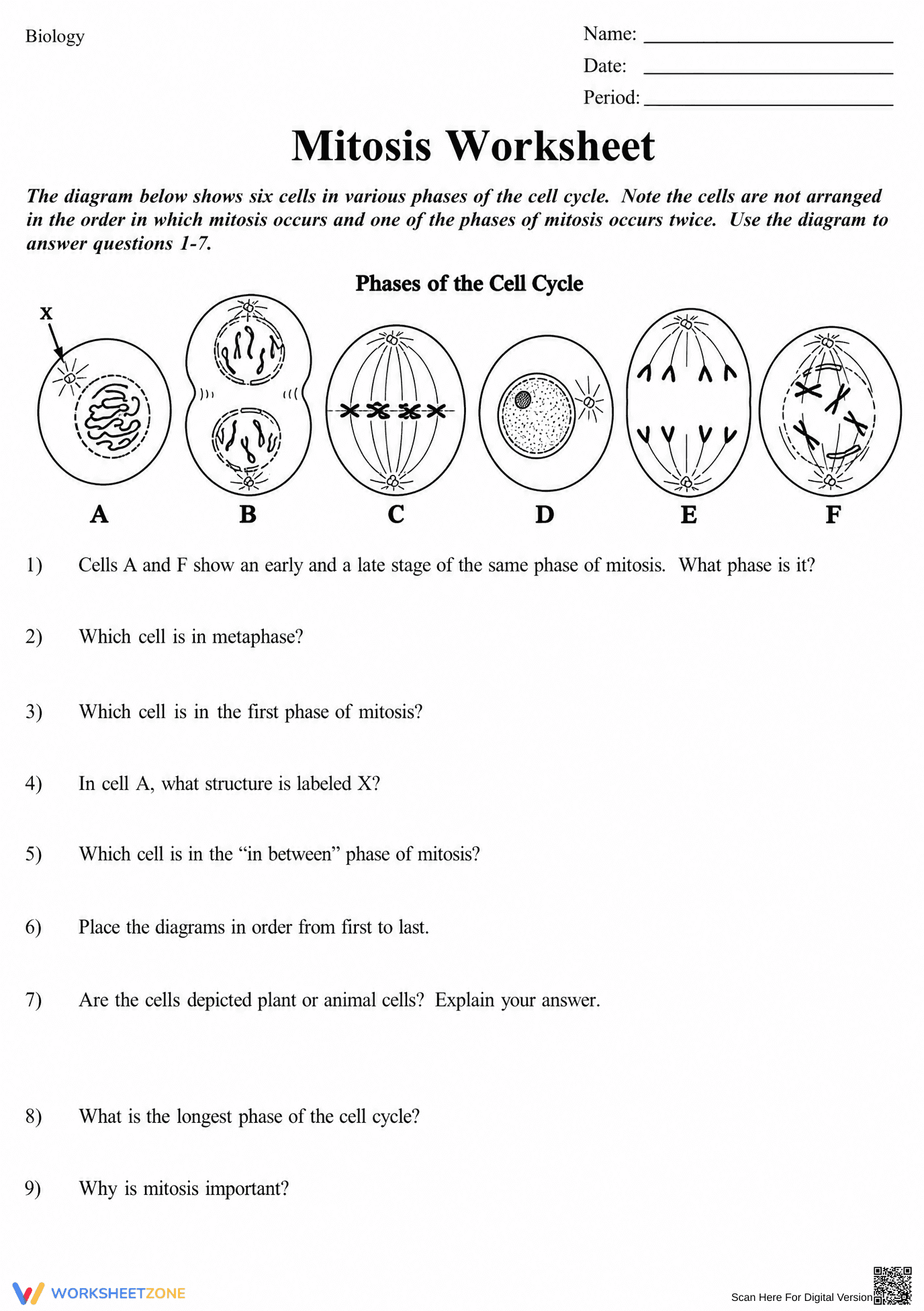
This high school biology worksheet provides a comprehensive review of the mitotic process through visual analysis and critical thinking. Students examine six distinct cell diagrams to identify specific phases of the cell cycle, reinforcing their ability to distinguish between prophase, metaphase, anaphase, and telophase. It is designed to solidify conceptual understanding of cellular reproduction and the structural changes that occur during division.
At a Glance
- Grade: 9-12 · Subject: Biology
- Standard:
HS-LS1-4— Use models to illustrate the role of cellular division in maintaining organisms- Skill Focus: Mitotic Phase Identification
- Format: 1 page · 9 problems · Answer key included · PDF
- Best For: Formative assessment or biology lab review
- Time: 15–20 minutes
The worksheet features a clear header with six labeled cell diagrams (A-F) depicting various stages of the cell cycle. It includes 9 targeted questions that progress from simple identification (naming phases) to higher-order analysis, such as determining if the cells are plant or animal based on structural evidence like centrioles or cell walls. The layout is clean, providing ample space for student responses and clear labeling of structures like the spindle apparatus.
This resource is designed for immediate classroom implementation with a three-step workflow. First, print the single-page PDF (30 seconds). Second, distribute to students as an independent review or exit ticket following a lecture on the cell cycle (1 minute). Finally, review the answers using the included key to provide instant feedback on common misconceptions regarding phase ordering and the distinction between interphase and mitosis (5 minutes). It is an ideal sub-plan component due to its self-contained nature.
This resource aligns with HS-LS1-4: "Use a model to illustrate the role of cellular division (mitosis) and differentiation in producing and maintaining complex organisms." It specifically addresses the modeling component by requiring students to interpret diagrammatic representations of chromosomes and spindle fibers. Both standard codes can be copied directly into lesson plans, IEP goals, or district curriculum mapping tools.
Use this worksheet as a mid-unit check for understanding after students have been introduced to the PMAT acronym. It serves as an excellent formative assessment tool; teachers should observe if students can correctly identify the "in-between" phase (interphase) versus the active mitotic stages. Completion typically takes 15 to 20 minutes, making it ideal for the start of a lab period or as a homework assignment to reinforce the day's lecture.
This is tailored for high school biology students, including those in Honors or AP Biology needing a quick refresher. It provides visual scaffolding for English Language Learners (ELLs) through the use of clear diagrams. It pairs naturally with a microscope lab where students observe onion root tip cells or whitefish blastula slides, allowing them to compare idealized diagrams with real-world biological samples.
According to the RAND AIRS 2024 report on science literacy, visual modeling is a critical component in mastering abstract biological concepts like cellular reproduction. This worksheet addresses that need by requiring students to translate static diagrams into a chronological sequence of the cell cycle. By focusing on the HS-LS1-4 standard, the resource ensures that students are not just memorizing names but are analyzing the structural changes necessary for genetic continuity. Research from Fisher & Frey (2014) suggests that such check for understanding tools are most effective when they bridge the gap between direct instruction and independent laboratory work. This 9-question set provides the necessary scaffold for students to move toward mastery of complex life science standards while reducing teacher preparation time significantly.


